

A broker friend of mine paid $18,000 for a year of CoStar. Great product. Genuinely. But when I asked him how many cold prospects he'd actually closed through it, he went quiet. Turns out he wasn't using it to find clients. He was using it to look up buildings his clients already knew about.
That's the whole confusion in one story.
When people search for a commercial real estate database, they mean two completely different things — and nobody selling these tools bothers to tell them apart. This guide fixes that. We'll cover what a CRE database actually is (both flavors), the real 2026 market numbers, a chiffré comparison of CoStar vs Crexi vs Reonomy vs the free stuff, and — the part most guides skip — how to build your own prospecting list of the firms behind the buildings. No "request a quote" nonsense. Real pricing.
- What Is a Commercial Real Estate Database?
- The U.S. CRE Market in 2026, By the Numbers
- Top CRE Databases & Data Sources in 2026
- Free Commercial Real Estate Databases
- Property Database vs Prospecting Database
- How to Build Your Own CRE Database in 2026 (Step by Step)
- Keeping CRE Data Clean, Fresh & Compliant
- The Bottom Line
- Frequently Asked Questions
What Is a Commercial Real Estate Database?
Here's the counter-intuitive part. Ask ten people what a commercial real estate database is and you'll get two very different answers, both correct.
Answer one: it's a property database. A giant, searchable record of buildings — square footage, ownership, sale history, lease comps, cap rates, tenants. This is what a commercial property database like CoStar or Reonomy sells. You use it to research assets, run valuations, and find off-market deals. Think of it as a library of things.
Answer two: it's a prospecting database. A list of the firms and people behind those buildings — brokerages, agencies, developers, property managers — with their emails and phone numbers. This is what you use to sell to the CRE industry. A library of people.
Same two words. Opposite use cases. And most articles ranking for this keyword lump them together, which is exactly why buyers end up disappointed.
The building-data crowd wants a CRE comps database, an ownership database, a transaction database, or a listing database — the raw intelligence to underwrite a deal. The prospecting crowd wants a broker database, an agent database, an investor database, or a lender database to fill a sales pipeline. Figure out which camp you're in before you spend a dollar. Seriously. It'll save you thousands.
The U.S. CRE Market in 2026, By the Numbers
The U.S. commercial real estate market is worth roughly $1.72 trillion in 2026, according to IMARC Group. Trillion. With a T. That's the scale of the asset base — and it explains why the data around it is such a lucrative business in its own right.
Behind that number sits an enormous ecosystem of firms. There are close to 3 million businesses operating across the broad U.S. commercial real estate industry, and the Real Estate Sales & Brokerage segment alone is a ~$235.2 billion industry spread over roughly 1 million businesses, per IBISWorld's 2026 data. Fragmented. Local. Hard to reach at scale. Which is the whole opportunity, if you sell anything to these people.
One more stat that surprised me. Search demand for "commercial real estate database" is up +515% over the past year (DataForSEO, July 2026), peaking hard in mid-2026. More people than ever are trying to figure this exact question out. You're early. Good.
And the data itself? Massive. CoStar alone claims 8.5 million+ property records, 42 million public records, 8.2 million tenant records, and 11 million sale comps (CoStar, 2026). That's a lot of buildings. But — and hold that thought — none of it tells you which brokerage in Tampa is actively looking for the software you're selling.
Top CRE Databases & Data Sources in 2026
Let's be blunt about something first: the "top 10 CRE databases" listicles you'll find on page one of Google are mostly outdated. A few of them literally haven't been touched since 2022. So here's a current, honest breakdown of the real players — and what each one actually costs.
| Database | What it's for | Coverage | Data freshness | Price (2026) |
|---|---|---|---|---|
| CoStar | Property + comps intelligence | 8.5M+ property records | Static, research-refreshed | ~$3,000–$23,000 / yr |
| Reonomy | Ownership + off-market data | Nationwide property records | Static, periodic updates | ~$4,800 / user / yr |
| Crexi | Marketplace + listings | Active for-sale/lease listings | Live listings | ~$250–$400 / mo |
| LoopNet | Marketplace / listings search | Public listings | Live listings | Free + paid ads |
| Scrap.io | Prospecting: firms & contacts | 39,177 US CRE agencies | Real-time (live) | From $49 / mo |
See the split? The top four are property tools. CoStar is the 800-pound gorilla — incredible depth, and priced like it. Reonomy shines for ownership and skip-tracing off-market owners. Crexi and LoopNet are marketplaces, better for browsing active listings than for building a contact list. This is also the corner of the market people mean when they say commercial real estate database software: heavyweight platforms with heavyweight contracts.
Not everyone can stomach those contracts, though. Over on AlternativeTo, the recurring complaint about CoStar from smaller shops is the same one every time: it's just too expensive for a two-person brokerage or a scrappy vendor. And on the flip side, one broker on r/CommercialRealEstate put it plainly: "Reonomy is THE BEST database I have ever used as a broker." Both things are true. It depends entirely on your budget and your goal.
Video: Stop Paying $20,000/Year for ZoomInfo
A Quick List of Commercial Real Estate Brokers (and Where to Find Them)
If what you actually want is a list of commercial real estate brokers — not a building database — your options are narrower than the marketing suggests. Here's the honest shortlist:
- National brokerage directories — CBRE, JLL, Cushman & Wakefield, Colliers, Marcus & Millichap all publish their own agent rosters.
- Marketplace agent pages — Crexi and LoopNet list the brokers behind each listing.
- Regional CRE exchanges — LACDB (Louisiana), KCREA (Kentucky), MSCREX (Mississippi) and similar boards list local brokers.
- Google Maps — where nearly every commercial real estate agency maintains its own profile, updated by the firm itself.
That last one is the sleeper. More on it in a minute.
Not looking for buildings, but for the firms behind them? See how Scrap.io maps 39,177 US commercial real estate agencies pulled live from Google Maps — filterable by email, phone, and rating before you spend a cent. Explore Scrap.io free →
Free Commercial Real Estate Databases
Is there such a thing as a free commercial real estate database? Sort of. Kind of. Depends what you need.
If you want free property data, your best bets are regional and public. LACDB (the Louisiana Commercial Database) is a genuinely useful regional exchange. CIMLS offers a free commercial listing service that The Close and others regularly recommend. County assessor sites and public records are free too — if you enjoy manual labor. And a Texas CRE database, an NYC CRE database, or a Mississippi CRE database can often be assembled piecemeal from these local sources.
The catch is always the same. Free data is either narrow (one region), shallow (no contacts), or stale (updated whenever someone remembers). You get what you pay for. Usually less.
Here's the reframe most people miss, though: the closest thing to a genuinely free, national, contact-level starting point is a free trial on a live-scraping tool. You extract real firms with real emails, and you don't pay until you've proven the data works. That's a different animal from a static freebie that bounces half your list.
Property Database vs Prospecting Database
Let me tell you about Thierry. (Not his real name. He'd kill me.)
Thierry runs a small SaaS company selling lease-management software. His whole addressable market is commercial real estate firms. So he did what everyone does — he bought a CoStar-style property database, thinking "great, now I have all the CRE data I need." Six weeks later he had a beautiful library of office buildings in Dallas and exactly zero people to email. Because a property database tells you about the asset. It doesn't hand you the sales director's inbox.
That's the difference, in one sad little anecdote.
A property database answers: what is this building worth, who owns it, when did it last trade? A prospecting database answers: who do I email to sell my product, and how do I reach them? Thierry needed the second one. He bought the first. Classic.
If your job is to generate commercial real estate leads — to sell software, insurance, marketing, financing, or services to the industry — you need contacts, not comps. You need a firm's name, its email, its phone, its rating, its location. And you need it fresh, because CRE firms open, merge, rebrand, and close constantly. A static list from last quarter is already leaking accuracy.
39,177 US commercial real estate agencies. 26,259 of them (67%) with a public email address. That's not a building library — that's your prospecting list, ready to filter by state, rating, or digital presence. See your numbers on Scrap.io →
How to Build Your Own CRE Database in 2026 (Step by Step)
OK but concretely — how do you actually build a commercial real estate database of firms and contacts without spending six months copy-pasting? This is the part people came for.
The short version: you pull it live from Google Maps, where every commercial real estate agency, broker, developer, and property manager already maintains its own listing. No stale broker file. No $20K contract. Here's the workflow, start to finish. Watch this first if you like seeing it done:
Video: Scrap.io — How to Start?
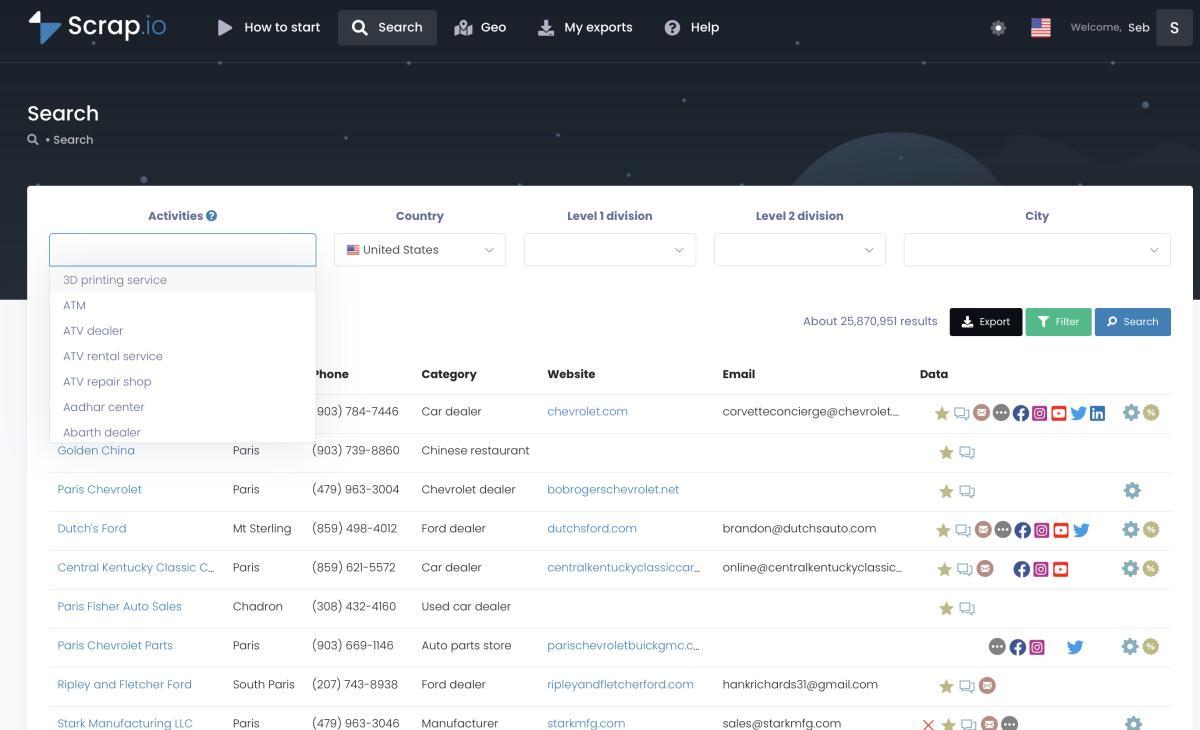
Step 1 — Pick your CRE categories
Start broad or start narrow, your call. Commercial real estate agency. Real estate broker. Real estate developer. Property manager. Scrap.io covers 4,000+ business categories, and you can combine several in one search to cast a wider net — say, agencies plus developers plus commercial brokers. Two clicks, one list.
Step 2 — Filter before you extract
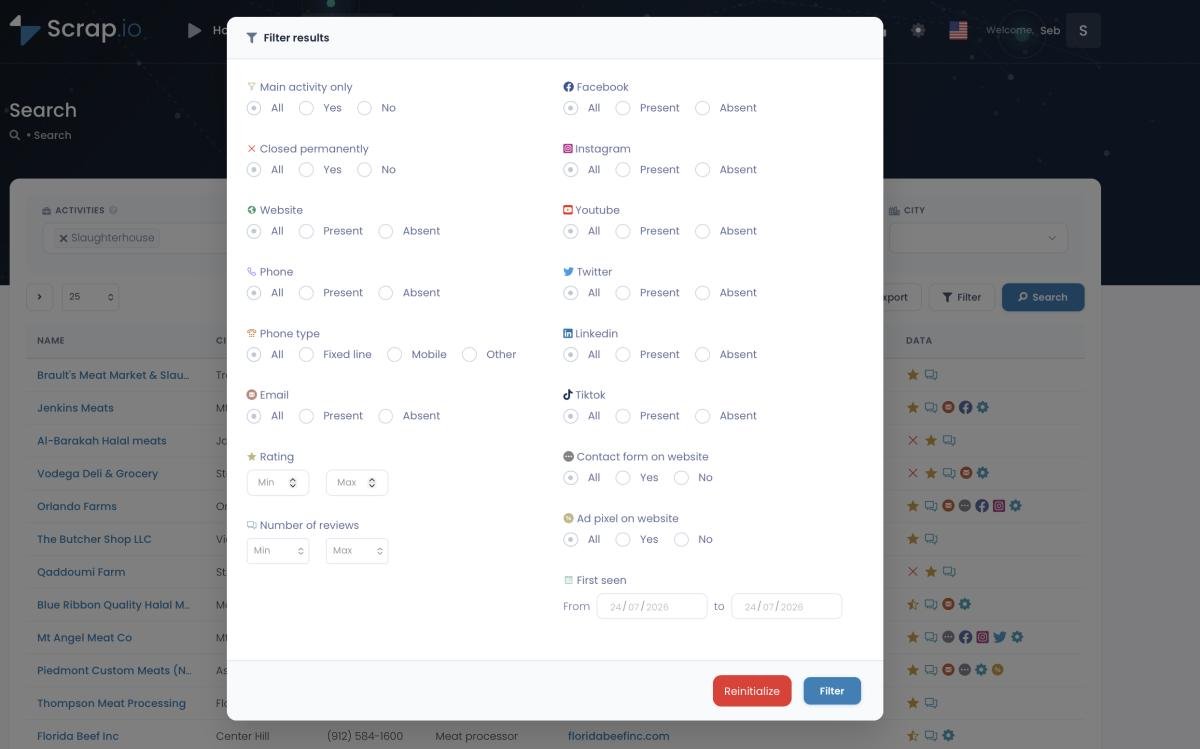
This is the step that saves you money, so pay attention. On most tools you pay first and filter later. Backwards. On Scrap.io, filters apply before credits are consumed. Only want CRE firms that actually have an email? Toggle it. Only ones with a phone, or a 4-star-plus rating, or a website? Filter. You never pay for a contact you can't use. (Remember: 67% of those 39,177 agencies have a public email — so the filter isn't throwing away much.)
Step 3 — Extract a state, a metro, or the whole country
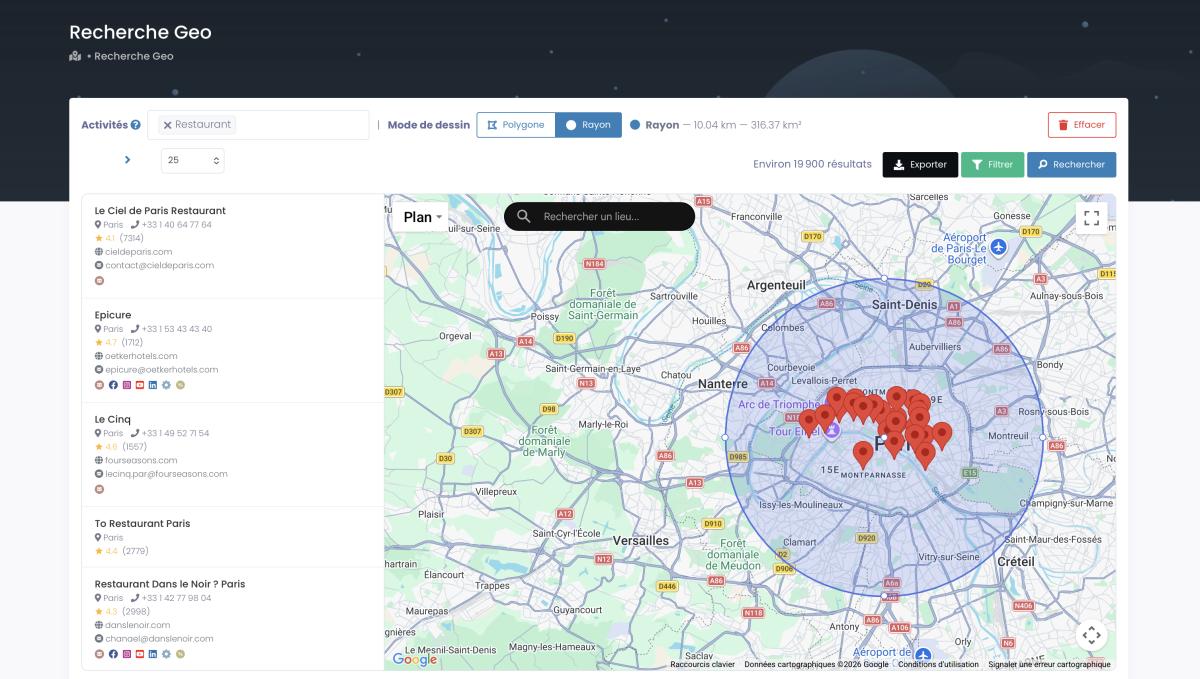
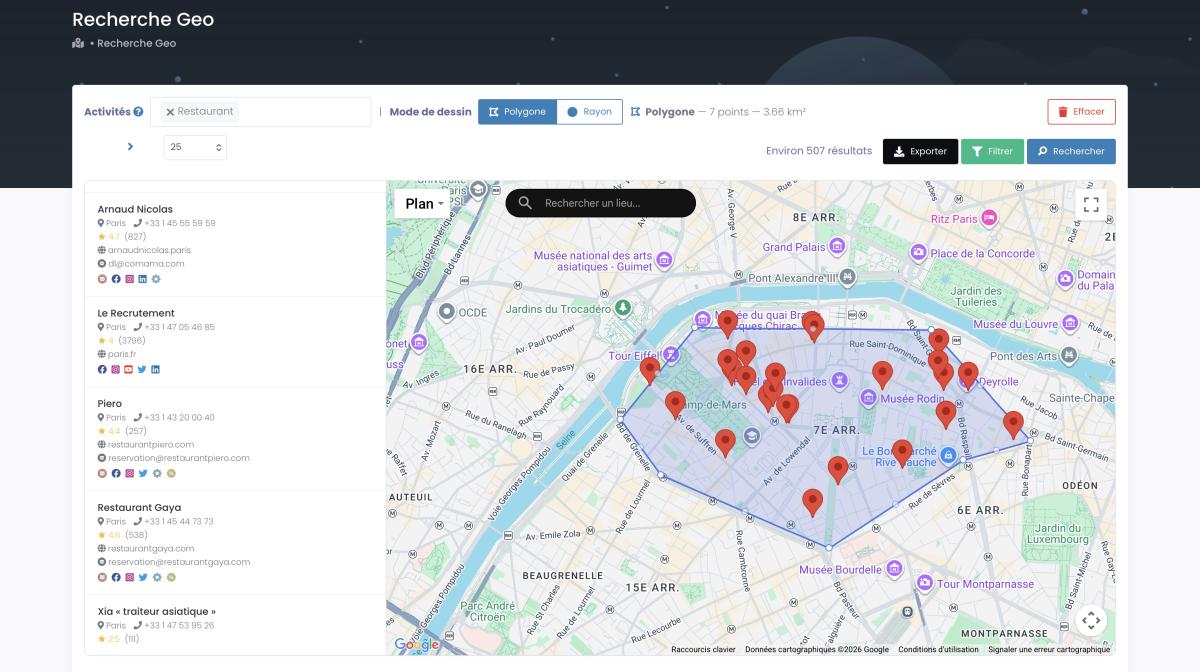
Here's where it gets unfair. You can pull one city, or you can pull the entire United States in a single search. Building a Texas CRE database? Draw the state. Want just downtown Chicago? Draw a radius or a custom polygon around it — GeoSearch lets you target a neighborhood that doesn't fit any administrative boundary. The video below walks through country-level extraction:
Video: How to Scrape Local Leads at the Country Level
Step 4 — Export your enriched commercial real estate email list
Hit export. You get a CSV or Excel file with everything: firm name, address, phone (classified landline vs mobile), website, Google rating, review count, social profiles, and up to five classified emails per business — individual (with first and last name), contact, sales, marketing, admin. That's a real commercial real estate email list, not a column of generic info@ addresses you have to guess at.
And because it's pulled live, the data reflects what those firms published this week — not what a broker compiled two years ago. Scrap.io indexes 225 million+ establishments across 195 countries, so the same workflow scales to any category, any market, whenever you need it.
Try Scrap.io free for 7 days — 100 export credits included. Search "commercial real estate agency," filter for firms with an email, and pull your first prospecting list in two clicks. Start your free trial →
Want to see exactly how the emails get pulled from each listing? Our guide on how to find emails on Google Maps breaks down the mechanics, and the full Google Maps scraping guide covers the technical side end to end.
Keeping CRE Data Clean, Fresh & Compliant
Nobody reads the compliance section. Read this one anyway — it's short, and the alternative is a fine.
First, freshness. Business contact data rots fast — industry estimates put decay around 20–25% per year, and CRE is worse than average because firms rebrand and merge constantly. A database that was 95% accurate in January is limping by summer. This is the single biggest argument for live data over a static purchase: real-time extraction sidesteps the whole decay problem because you pull it fresh every time.
Second, the legal part. In the U.S., cold B2B email is legal under CAN-SPAM as long as you use honest subject lines, identify yourself, include a physical mailing address, and honor unsubscribes. Selling into the EU? GDPR's "legitimate interest" basis generally covers B2B outreach that's relevant to the recipient's job — with clear opt-outs. California's CCPA gives contacts rights over their data too.
The good news, and it's genuinely good: data pulled from public sources sits on solid ground. If a commercial real estate agency published its email on its own Google Maps profile or website, that information is public by the firm's own choice. Scrap.io only extracts publicly available business data, is GDPR and CCPA compliant, and every data point is traceable to its source. No shady resold lists. No scraped personal accounts. Clean.
The Bottom Line
Two words, two totally different products. If you need building intelligence — comps, ownership, valuations — a property database like CoStar or Reonomy earns its keep, expensive as it is. But if your goal is to reach the commercial real estate industry, you don't need a library of buildings. You need the firms behind them, with fresh emails, filtered to the ones that match what you sell.
And you don't need to rent that access for $20,000 a year.
Stop renting access to somebody else's database. Build your own in two clicks — free for 7 days, 100 leads on us. 39,177 US CRE agencies waiting, 67% with a public email. Build your commercial real estate database on Scrap.io →
Related reading if you're prospecting adjacent audiences: the real estate agency email list guide, the real estate agent & broker contacts guide, our deep dive on the B2B realtor email database, the real estate developer list, the property management company list, and the broader USA business email database guide.
Frequently Asked Questions
What is the best commercial real estate database in 2026?
Depends on the job. For deep property intelligence — comps, ownership, valuations — CoStar is the market leader (and priced accordingly, ~$3,000–$23,000/yr). Reonomy is excellent for ownership and off-market data. But if you're prospecting to the industry and need firm-level contacts, a live tool like Scrap.io covering 39,177 US CRE agencies from $49/month is a fundamentally different, cheaper answer. "Best" is really "best for property research" versus "best for building a prospecting list."
Is there a free commercial real estate database?
Partly. Regional exchanges like LACDB (Louisiana) and free listing services like CIMLS give you property data at no cost, and county assessor records are public. The trade-off is narrow coverage, no contact data, or stale updates. For a free contact-level starting point, a 7-day free trial with 100 leads included on a live-scraping tool gets you further than most static freebies.
How do I build my own commercial real estate database?
Pull it live from Google Maps, where CRE firms maintain their own listings. Pick your categories (agency, broker, developer, property manager), filter for the firms that have an email or phone before you extract, choose your area — a city, a state, or the whole country — and export a CSV with names, emails, phones, and ratings. With Scrap.io the whole thing takes minutes, not months.
How much does CoStar cost versus the alternatives?
CoStar runs roughly $3,000 to $23,000 per year depending on markets and modules. Reonomy is around $4,800 per user per year. Crexi sits at ~$250–$400/month. Scrap.io, for prospecting rather than property data, starts at $49/month (or $35/month billed annually). Different tools, very different price structures — match the spend to your actual goal.
Is it legal to use a CRE database for cold outreach?
Yes, for B2B outreach, provided you follow the rules. In the U.S., CAN-SPAM requires honest headers, a physical address, and a working unsubscribe link. In the EU, GDPR's legitimate-interest basis generally covers relevant B2B email with clear opt-outs. Data sourced from public business listings — like a firm's own Google Maps profile — is on the strongest footing, and Scrap.io only extracts publicly available, traceable business data.
Generate a list of commercial real estate agency with Scrap.io