

Marcus burned through 50 free Seamless.AI credits in two days. He got 12 leads. Nine bounced. One of the three that didn't had closed sometime in 2023, which he found out from the voicemail.
That's the free lead gen experience most people actually get. Not the shiny "10,000 contacts, zero dollars" pitch. A handful of credits, a sales call within 48 hours, and a bounce rate that quietly torches your domain reputation.
So let's do this differently. We pulled 15 free lead generation tools that genuinely help you fill a pipeline in 2026, listed their real free tiers (the ones nobody advertises), and flagged where each one runs out of road. No fluff, no affiliate rankings, no pretending a 40-credit trial is "free forever."
Video: Get Emails from Google Maps for Free
What Counts as a "Free" Lead Generation Tool in 2026?
What does "free" actually mean when a tool asks for your credit card before you've clicked anything? Fair question. Because the word gets stretched into four very different shapes, and knowing which one you're dealing with saves you a lot of grief.
Here's the honest breakdown. A free plan (or "free forever") gives you a permanent, capped tier you never pay for. A freemium tool hands you real features up front, then gates the good stuff behind a wall. A free trial is full access for a set window, after which the meter starts. And a free tool in the loosest sense is a lead magnet, useful, sure, but built mostly to get you into a paid funnel.
Free plan vs freemium vs free trial vs free forever
The distinction matters because it decides how long the value lasts. A free-forever CRM you'll use for years. A 7-day trial you'll use for one campaign. Mix them up and you'll build a workflow on something that expires next Tuesday.
| Type | What you get | Catch | Best for |
|---|---|---|---|
| Free plan / forever | Permanent capped access | Low limits, few integrations | Long-term light use |
| Freemium | Real features up front | Best stuff paywalled | Testing before you commit |
| Free trial | Full access, fixed window | Expires, card often required | One full campaign |
| Free tool (lead magnet) | A single useful function | Built to upsell you | One-off jobs |
Keep this table in your head for the rest of the article. When someone lists "free b2b lead generation tools," they're almost always blending all four categories and hoping you won't notice. We noticed.
Why Most "Free" Lead Gen Tools Disappoint
Most free lead gen tools aren't free. They're demos wearing a costume.
You sign up, you get 40 or 50 credits, and by the time you've built one decent list the tool is already pinging your inbox about upgrading. That's not a bug. That's the entire business model. Free tiers exist to show you just enough value to make the paywall feel reasonable.
And the market's big enough to sustain a thousand of them. Lead generation software is worth roughly $6.4 billion in 2026, on track for about $8.9 billion by 2030 at a ~9.6% CAGR (The Business Research Company, 2026). A lot of that money is chasing you, the person who searched "free" and might convert. No wonder the free tiers are engineered to run dry fast.
The hidden cost of "free" data
Here's the part that actually costs you money, though. It's not the credits. It's the data quality.
Free-tier email accuracy tends to sit around 79-87%, versus roughly 98% on verified data (Prospeo, 2026). Doesn't sound like much? One team Prospeo worked with cut their bounce rate from 35% to under 4% after switching to verified contacts, and their connect rate tripled to 20-25%. Think about that gap. A third of your "free" list bouncing straight into a spam-folder death spiral.
It gets worse over time, too. B2B data decays at about 2.1% per month, roughly 22.5% a year (MarketingSherpa / Cognism data via Landbase), with some sources putting it closer to 30%. So a "free leads list" you download today is meaningfully wrong by summer. People change jobs. Businesses close. That PDF of 5,000 contacts? Rotting the moment you save it.
No surprise, then, that ~61% of marketers say generating quality traffic and leads is their single biggest challenge (DemandSage, 2026). The tools are everywhere. The good data is the bottleneck. And that's exactly the gap the community keeps circling on r/LeadGeneration, where the recurring verdict is blunt: free tiers are fine for testing, but real outbound volume needs a budget for data quality.
The 15 Best Free Lead Generation Tools in 2026
The best free tool isn't the one with the biggest database. It's the one that hands you clean data you'll actually use. Big difference.
We've sorted these 15 into six jobs, because "lead generation tools" is a category so broad it's almost meaningless. An email finder and a chatbot are both "lead gen." They do nothing alike. Skip the generic "best free lead generation websites" listicles for a second, they lump these together and help nobody. Here's the map first, then the details.
| Tool | Category | Real free tier (2026) | Best for |
|---|---|---|---|
| Hunter.io | Find emails | 25 searches + 50 verifications/mo | Occasional email lookups |
| Snov.io | Find emails | 50 credits/mo, no free export | Finding + light outreach |
| GetProspect | Find emails | 50 emails + 100 verif/mo (rollover) | Export-friendly workflows |
| Apollo.io | Find emails | Limited contacts + 2 sequences + 50 AI credits | Getting started with outbound |
| Scrap.io | Local / Google Maps | 7-day trial: 50 searches + 100 export credits, all filters, free counts | Local business leads at scale |
| Scrap.io Chrome extension | Local / Google Maps | Free & unlimited (view emails on Maps) | Grabbing a few prospects |
| HubSpot Free | Inbound capture | Free CRM + forms + 2,000 emails/mo | Inbound + CRM starter |
| forms.app | Inbound capture | 5 forms, 100 responses/mo | Simple lead forms |
| Typeform | Inbound capture | Free plan, 10 responses/mo | Conversational forms |
| BDOW! / OptinMonster | Inbound capture | Free/low-cost pop-up tiers | Turning traffic into signups |
| Leadfeeder Lite | Website visitor ID | 100 companies, 7-day retention | ABM on existing traffic |
| Mailchimp | Nurture & email | Free tier, up to 500 contacts | Early email nurture |
| Trustmary | Nurture & email | Free review/testimonial widget tier | Social proof capture |
| ChatGPT | AI helper | Free tier | ICP, copy, list cleanup |
| Wiza | AI helper | 20 email + 5 phone/mo | LinkedIn list export |
| LinkedIn (free) | AI helper / social | Free account + basic search | Manual social prospecting |
Find emails & contact data: Hunter, Snov, GetProspect, Apollo
This is the category people mean when they say "free lead generation tools like Apollo." Type a domain, get emails. Handy. Just watch the caps.
Apollo.io is the most-cited free tier in B2B, and for good reason: limited contacts, two active sequences, and 50 AI credits, no card required to start. Rated 4.7/5 across nearly 9,700 reviews on its lead generation product page. Solid for US SaaS contacts. The catch? Credits don't roll over, and accuracy outside North America gets shaky. Hunter.io keeps it simple: 25 searches and 50 verifications a month. Fine for occasional lookups, useless for systematic prospecting. Snov.io gives you 50 credits but, critically, no export on the free plan, so you can find leads and then... not get them out. GetProspect is the sleeper here: 50 emails and 100 verifications monthly, and the unused credits actually roll over. Rare.
All four share the same ceiling, though. They live on LinkedIn and corporate domains. Ask any of them for the local plumber with no LinkedIn page, and they've got nothing.
Local & Google Maps leads: Scrap.io (the one nobody else covers)
Everyone lists the same LinkedIn-flavored tools. Almost nobody covers the biggest, freshest pool of local business contacts on earth: Google Maps. That's where Scrap.io plays, and it's why it's the hero of this list.
Scrap.io extracts business data straight from Google Maps in real time, 225,676,406 establishments across 195 countries and 4,000+ categories. Emails, phone numbers (classified mobile vs landline), websites, social profiles, all pulled live, not from a database somebody froze six months ago. That directly answers the data-decay problem: every export is fresh at the moment you run it.
The trick that sets it apart is filtering before extraction. Only want businesses that have an email? Toggle it. Only mobiles for an SMS campaign? Done. The filter runs before a single credit is spent, so you never burn budget on contacts you can't reach. Compare that to a free email finder that hands you 50 credits and lets you discover the bounces afterward. And one real client extraction: 11,734 businesses in 45 minutes. Try that by hand.
There's also the free Chrome extension, genuinely free and unlimited, which shows emails and social links right on the Google Maps interface. Perfect when you just need a handful of prospects and don't want to open a full platform.
Inbound capture: HubSpot Free, forms.app, Typeform, BDOW/OptinMonster
Outbound hunts. Inbound waits. This category is the "waiting" half, turning the traffic you already have into named contacts.
HubSpot Free is the anchor here, and it's genuinely generous: a free CRM, landing pages, forms, and up to 2,000 marketing emails a month. You'll outgrow it, but as a starting point it's hard to beat. It also plays into a bigger trend, 64% of small businesses now use at least one automation tool, up from 42% two years earlier (HubSpot via BizIQ). forms.app (5 forms, 100 responses monthly) and Typeform (conversational forms, small free tier) cover the form-building side. And BDOW! (formerly Sumo) and OptinMonster handle pop-ups and exit-intent capture, the tools that squeeze signups out of visitors who were about to leave.
One honest note: none of these find you prospects. They convert traffic you already earned. No traffic, no leads. Keep that straight.
Video: Best 11+1 Cold Email Platforms for 2025
Website visitor ID: Leadfeeder Lite
Ever wonder which companies visit your site and then vanish without filling out a thing? Leadfeeder Lite de-anonymizes some of that traffic, showing you which businesses browsed and what they looked at. The free tier covers 100 companies with 7-day retention. Narrow, but for ABM teams with real traffic, it's a clever way to turn ghosts into named accounts.
Nurture & email: Mailchimp, Trustmary
Finding leads is half the job. Following up is the other half, and it's where the money actually lives. Email ROI still sits at roughly $36 for every $1 spent (Smartlead, 2025), a number that refuses to die. Mailchimp's free tier (up to 500 contacts) covers early nurture sequences. Trustmary takes a different angle, capturing reviews and testimonials you can turn into social proof, which is its own quiet form of lead gen. People trust people.
AI helpers: ChatGPT, Wiza, LinkedIn
Can ChatGPT do lead generation? Partly. And this is where the "free ai tools for lead generation" hype needs a reality check.
ChatGPT's free tier is brilliant at drafting outreach, building ICP criteria, and cleaning up messy lists. What it can't do is pull verified, real-time contact data on its own, it has no live source. Pair it with one, though, and it changes. Scrap.io exposes an MCP connector, so you can drive extractions from ChatGPT, Claude, or Gemini in plain English: "find every Italian restaurant in Brooklyn with 4+ stars and an email." The AI arranges the leads. It doesn't invent them. Wiza (20 emails + 5 phones monthly free) exports contacts off LinkedIn lists, and a free LinkedIn account itself, with basic search, is still a decent manual prospecting surface if you've got the patience.
How to Build a Free Lead List in 5 Minutes
Everyone lists tools. Nobody shows you how to actually get 200 real leads before your coffee's cold. So here's the part the other 14 tools can't do, a full local lead list from scratch, filtered so you only keep the contactable ones.
We'll use Scrap.io because it's the clearest example of the "find leads for free" workflow and it's built for exactly this. Timer starts.
Step 1, pick your category and area. Choose a business type, say "roofing contractor," and a location. A city, a county, a state, or a whole country. Scrap.io shows you the exact count of matching businesses before you spend anything. Counting is always free.
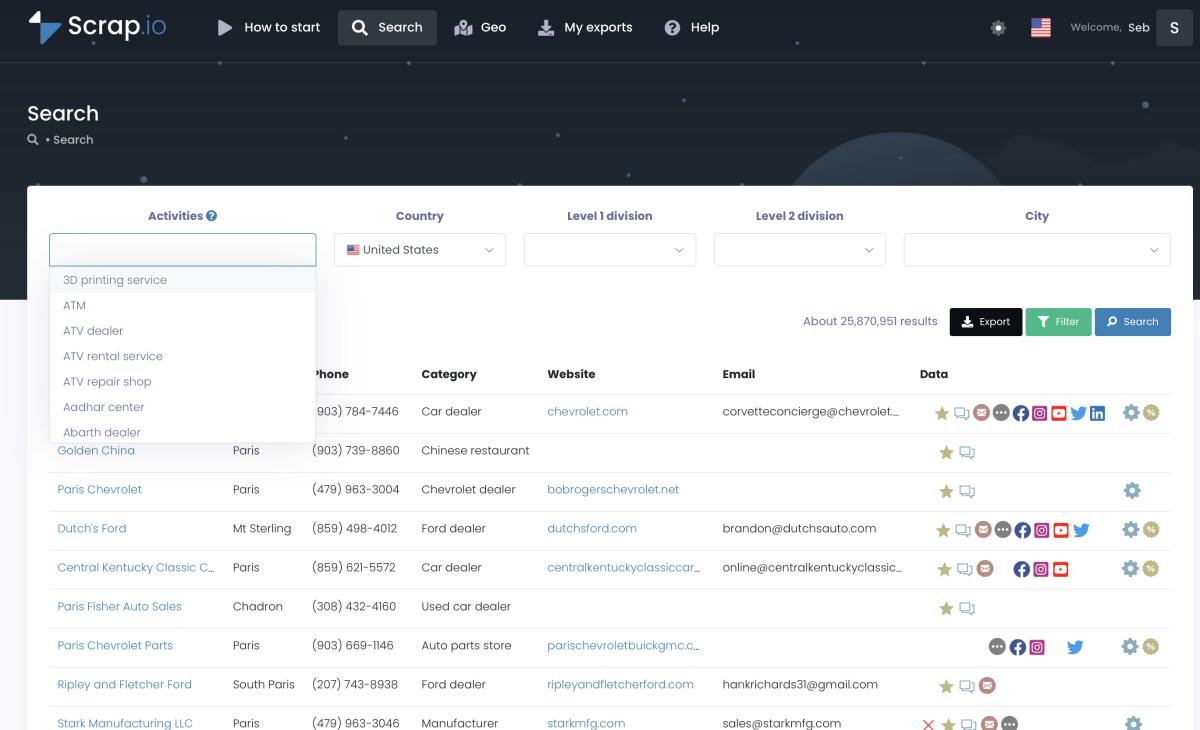
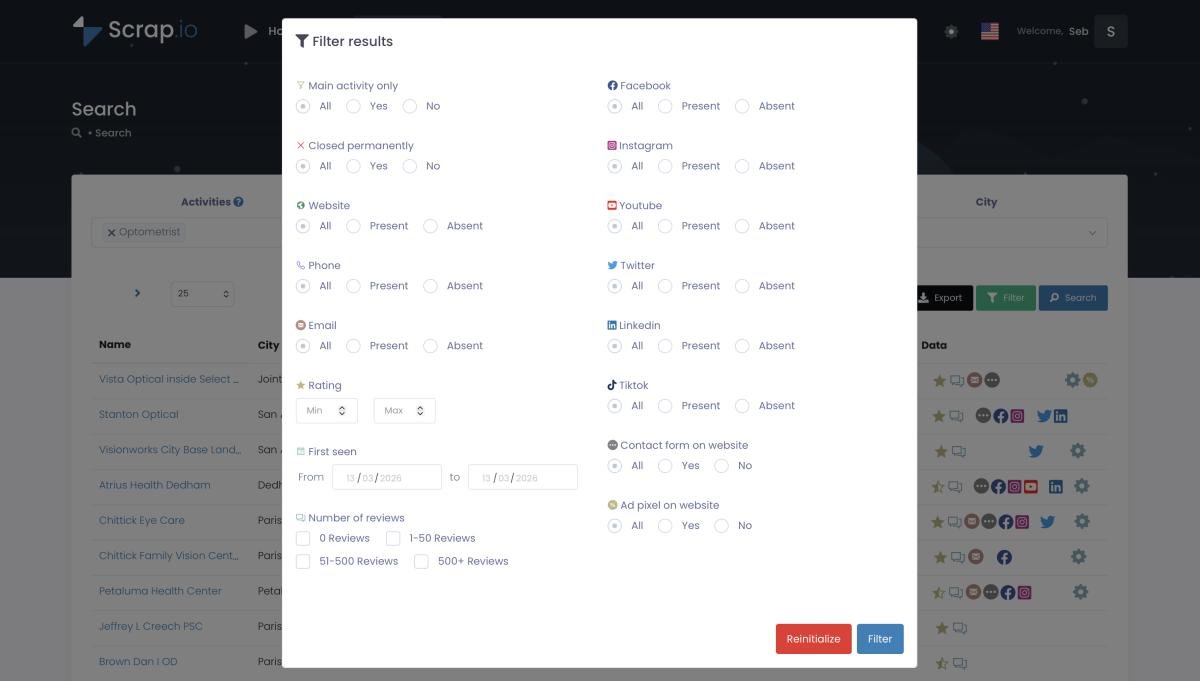
Step 2, filter before you extract. This is the whole game. Toggle "has email." Toggle "has a website." Set a minimum rating, a review count, whatever qualifies a prospect for you. Every filter applies before a single credit is consumed. You pay only for contacts you can actually use.
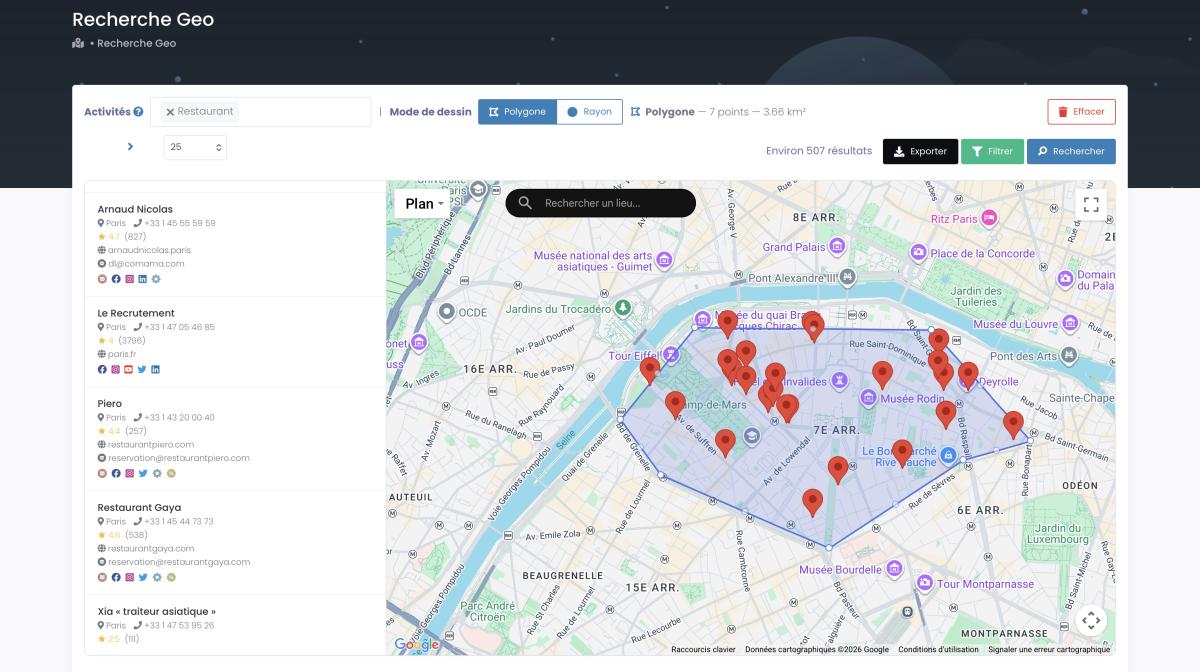
Step 3, use GeoSearch when a city doesn't fit. If your service area is shaped weird, a trade zone, a highway corridor, a neighborhood, draw a radius around a point or trace a polygon by hand on the map. Every filter still works inside the shape.
Step 4, export. CSV or Excel, ready for your CRM or cold email tool. Names, addresses, phone (with type), up to five classified emails per business, social links, website tech. Re-export the same business within 30 days and it costs zero extra credits. Done. That's the whole loop, and it genuinely takes minutes. If you want the deeper version, we wrote a full walkthrough on how to find emails on Google Maps, and a step-by-step on how to get local business leads with contact info.
Free-tier output: how many leads realistically?
Let's set expectations, because "unlimited free leads" is a lie and you know it. On Scrap.io's 7-day trial you get 50 searches and 100 export credits, so about 100 fully-enriched leads to test on your own market. On Apollo or Snov's free tiers, you're looking at a few dozen contacts before the wall. Free Chrome extensions grab maybe 50-120 rows, usually without emails, because emails live on the business website, not the map listing. So: enough for one real campaign, not enough to scale. That's the honest number. For the technical deep-dive on pulling data at volume, here's our complete Google Maps scraping guide and a breakdown of how a lead scraper actually works.
Free vs Paid: When Free Tools Stop Being Enough
Let's be honest: free gets you to your first 100 leads. Not your first 10,000.
Free tiers are perfect for validating an idea, testing a niche, running one campaign to see if the data converts. The moment you're doing real volume, though, the math flips. You start spending more time cleaning and deduplicating lists than actually prospecting, and the "free" tool quietly becomes the most expensive thing in your stack, paid for in hours.
| Tool | Real free tier | Where it runs out |
|---|---|---|
| Apollo.io | Limited contacts + 2 sequences + 50 AI credits, no rollover | Volume + non-US accuracy |
| Hunter.io | 25 searches + 50 verifications/mo | Systematic prospecting |
| Snov.io | 50 credits/mo, no free export | Getting data out |
| GetProspect | 50 emails + 100 verif/mo (rollover) | Beyond a few dozen/mo |
| Lusha | 40 credits/mo (~6 full records) | Almost immediately |
| Wiza | 20 email + 5 phone/mo | Any real list |
| HubSpot Free | CRM + 2,000 emails/mo | Advanced automation |
| Leadfeeder Lite | 100 companies, 7-day retention | Historical data + scale |
| Scrap.io | 7-day trial: 50 searches + 100 export credits, all filters | After the trial, plans from $35/mo |
When you cross that line, you're no longer shopping for "free." You're shopping for accuracy and coverage. If you want the full paid landscape, we ranked the 15 best lead generation software (the "best," not just the "free"), and broke down what lead generation actually costs per channel, average B2B CPL runs about $84, with LinkedIn nearer $110 and Google Ads around $70 (HubSpot, 2025). Against numbers like that, a filtered Google Maps list looks less like a splurge and more like a rounding error.
And you don't have to take the pitch on faith. Regie.ai documented a case where a scraping-based, multi-channel play delivered 6x ROI and over $200,000 in pipeline (Regie.ai). That's the ceiling free tiers can point you toward but not carry you to.
Are Free Lead Generation Tools Legal? (GDPR & CAN-SPAM)
Is any of this even legal? Short answer: yes, if you know one rule. The rule is the word business.
Extracting publicly available business data, company names, addresses, phone numbers, the emails a business published on its own website, is on solid legal ground for B2B prospecting. Under GDPR in the EU, that data typically qualifies for the "legitimate interest" basis, as long as every outreach email carries an easy opt-out. Under California's CCPA, publicly available business information is carved out of scope almost entirely. And CAN-SPAM in the US permits unsolicited commercial email to business addresses, provided you use honest sender info, a physical address, and a working unsubscribe link. Full compliance guide on FTC.gov.
Where you get into trouble is scraping personal data, private profiles, individual emails that aren't business contacts, anything behind a login wall. That's a different animal, and "it was publicly available" won't save you.
This is also a quiet argument for the right kind of tool. Scrap.io only extracts publicly available business data, is GDPR and CCPA compliant, and keeps every record traceable to its source. No resold consumer lists. No shady "free leads list" PDFs of dubious origin. If you want the frameworks for writing outreach that actually lands within these rules, here's our guide on how to write a cold email, and if you're feeding a CRM, how to pick a CRM for small business and keep it full. None of this is legal advice, obviously. Talk to a lawyer if real money's at stake. But the panic around scraping is mostly recycled fear from people who never read the actual rules.
FAQ
What is the best free tool for lead generation?
There's no single winner, it depends on your target. For local business leads (emails and phone numbers from Google Maps), Scrap.io is the strongest free-trial option. For B2B SaaS contacts, Apollo or Hunter.io free tiers. For inbound capture, HubSpot Free. Match the tool to the type of lead you actually need, not the biggest database.
How to get leads for free without paying?
Combine three free moves: (1) extract public business data from Google Maps using a free trial, (2) verify the emails with Hunter.io's free tier, and (3) capture inbound leads with HubSpot's free forms. Expect a volume cap on every one of them, free tiers are for testing, not scaling.
Can ChatGPT do lead generation?
Partly. ChatGPT can draft outreach, build ICP criteria, and clean up lists, but it can't pull verified, real-time contact data on its own. Pair it with a live data source (like Scrap.io's MCP connector, which works with ChatGPT, Claude, and Gemini) to turn plain-English prompts into real, current lead lists.
Where can I find a free leads list?
Skip the shady "free leads list" downloads, they're stale and often non-compliant. Build your own instead: free trials from Scrap.io, Apollo, or Snov.io let you export real, current contacts you actually control, filtered to your exact criteria. A list you build beats a list you download, every time.
How much does it cost to generate leads?
Average B2B cost per lead runs about $84 (HubSpot, 2025), higher on LinkedIn (~$110), lower through organic and self-service channels. Free tiers push that toward $0 for your first batch. Scaling up means paying for data quality, which is exactly where the "free" savings quietly reverse.
The Bottom Line
So. Fifteen free lead generation tools, six jobs, and one honest truth running through all of them: free is a fantastic place to start and a terrible place to stay. Use the free email finders to test a niche. Use HubSpot Free to catch inbound. Use Scrap.io's trial to pull your first 100 local leads and see whether the data converts before you spend real money. Then, when it does, scale the thing.
The winners in 2026 aren't the ones with the biggest ad budget. They're the ones with the freshest data and the fastest follow-up.
Generate a list of restaurant with Scrap.io