

Here's a number that should kill most of what you've read about this topic: there are 9,993 hematologists in the entire United States. Not 15,000. Not 18,869. Under ten thousand people (as of April 1, 2026, per rentechdigital).
Now go look at what the data vendors are selling. One says "5K+." Another says "14,200 verified." A third swears it has 18,869. Same specialty. Same country. Wildly different math.
Somebody's lying, and you're the one paying for it.
So this guide isn't a pitch for the "best" hematologist email list to buy. It's the opposite. It's how to build your own, fresh, from public data, in about the time it takes to drink a coffee. No broker. No bounce-fest. No spreadsheet that was already rotting when you downloaded it.
Let's get into it.
Video: Scrap.io - How to Start?
Table of Contents
- What Is a Hematologist Email List (and Why Most Are Wrong)
- How Many Hematologists Are There in the US? (The Real Number)
- Why Bought Hematologist Lists Bounce (The Static-Database Problem)
- How to Build Your Own Hematologist Email List (Step by Step)
- What Data You Get: Emails, Phones & Practice Details
- Finding the Right Email: Segmentation for Hematology Outreach
- Who Buys a Hematologist Email List? (Real B2B Use Cases)
- Staying Compliant: HIPAA, CAN-SPAM & GDPR for Medical Outreach
- Bought List vs. Self-Sourced: Which Wins in 2026?
- FAQ
What Is a Hematologist Email List (and Why Most Are Wrong)
A hematologist email list is a file of contact details, emails, phone numbers, practice addresses, for doctors who treat blood disorders: anemia, clotting problems, leukemia, lymphoma, sickle cell, the whole specialty. It's one slice of the broader healthcare email list category, just a very specialized one. Simple enough. The useful version also tells you where each one practices and how to actually reach them.
Here's where almost every hematologist email database on the market goes sideways. It's sold as a finished product, a static file compiled months ago, resold to whoever pays. And because the audience is tiny, vendors pad the counts to make the price look justified. A "hematologist mailing list" of 18,000 contacts in a country with under 10,000 hematologists isn't a list. It's filler.
Quick note before we go further, because people mix these up constantly. Hematology is not oncology. Hematologists handle blood itself. Cancer specialists are a different (overlapping) group, and if that's who you're after, go read our oncologist email list guide instead. There's a shared slice (a hematology oncologist email list covers both), but treating them as one bucket is how you end up pitching chemo equipment to a coagulation specialist. Awkward.
How Many Hematologists Are There in the US? (The Real Number)
There are 9,993 hematologists in the United States as of April 1, 2026 (rentechdigital). That's the real number. Write it down, because you're about to see vendors contradict it five different ways.
Where are they? Concentrated, mostly. California leads with 1,140, Florida has 789, and New York sits at 785. The rest thin out fast across the other states.
But the number that actually matters for outreach isn't the headcount. It's the contactable count. Of those 9,993 hematologists, 7,897 have a website, and only 405 show an email directly on their Google Maps listing. Read that again. Four hundred and five. If you rely on map data alone, you're fishing in a puddle.
So where do the other emails live? On the practice websites, 7,897 of them. That gap, 405 emails on the map versus nearly 8,000 sites to pull from, is the entire reason this specialty frustrates everyone. The data exists. It's just not where people look.
One more bit of context, and it's a good one for your pitch. The broader blood-and-cancer workforce is stretched thin. Oncologists billing Medicare grew from 12,267 in 2014 to 14,547 in 2024 (roughly +18.6%), yet per-capita density actually fell, and only 45% of US counties have an oncologist at all (ASCO Post, 2025). Is there a shortage of hematologists and the specialists next door? Functionally, yes. Which means the ones who are practicing are busy, valuable, and worth reaching properly.
See what fresh, real-time data looks like. Instead of trusting a vendor's inflated count, run the search yourself: Scrap.io pulls hematologist listings live from Google Maps across the US, and counts are always free, no credit spent. Check the real numbers on Scrap.io.
Why Bought Hematologist Lists Bounce (The Static-Database Problem)
Let's talk about why you shouldn't buy a hematologist email list the old way. It comes down to one flaw: static data starts dying the day it's compiled.
Doctors move. They join groups, leave groups, retire, change the clinic email. SalesHandy put it plainly: "Physician email lists become outdated quickly because doctors change jobs, retire, or switch practices often." And the kicker from the same piece: "After removing bounces, duplicates, retired physicians, and generic emails, the usable list is often much smaller than expected" (SalesHandy). A majority of practices (70.9%) are tied to a larger group or structure, so a single merger can invalidate dozens of rows at once (rentechdigital, 2026).
Then there's the count problem, and this is the part that's almost funny. Look at what the big vendors claim for the same ~10,000 hematologists:
| Vendor | Claimed Hematologist Contacts | Reality Check |
|---|---|---|
| DataCaptive | "5K+" (global) | Under the real US headcount |
| Avention Media | 14,200 "verified" | 42% more than exist |
| ReachStream | 11,000 (global) | Still above US reality |
| MedicoLeads | 15,000 | 50% inflated |
| LakeB2B | 18,869 US / 15,637 emails | Nearly double the real count |
| Reality (rentechdigital) | ~9,993 US | The actual ceiling |
Five vendors. Five incompatible numbers. One of them is pitching you nearly twice as many hematologists as physically exist in the country. How do you "verify" 18,869 contacts from a pool of 9,993? You don't. You pad it with clinics, duplicates, and anyone who ever worked near a blood panel. And if you're tempted by a "free hematologist email list" floating around a download page, assume it's the same padded data, just older.
That's not a data quality problem. That's a trust problem.
And it torches your sender reputation when half the file bounces.
How to Build Your Own Hematologist Email List (Step by Step)
OK, concretely: how do you find hematologist email addresses without any of that nonsense? You extract them yourself from live Google Maps data. Three steps. Here's the whole thing.
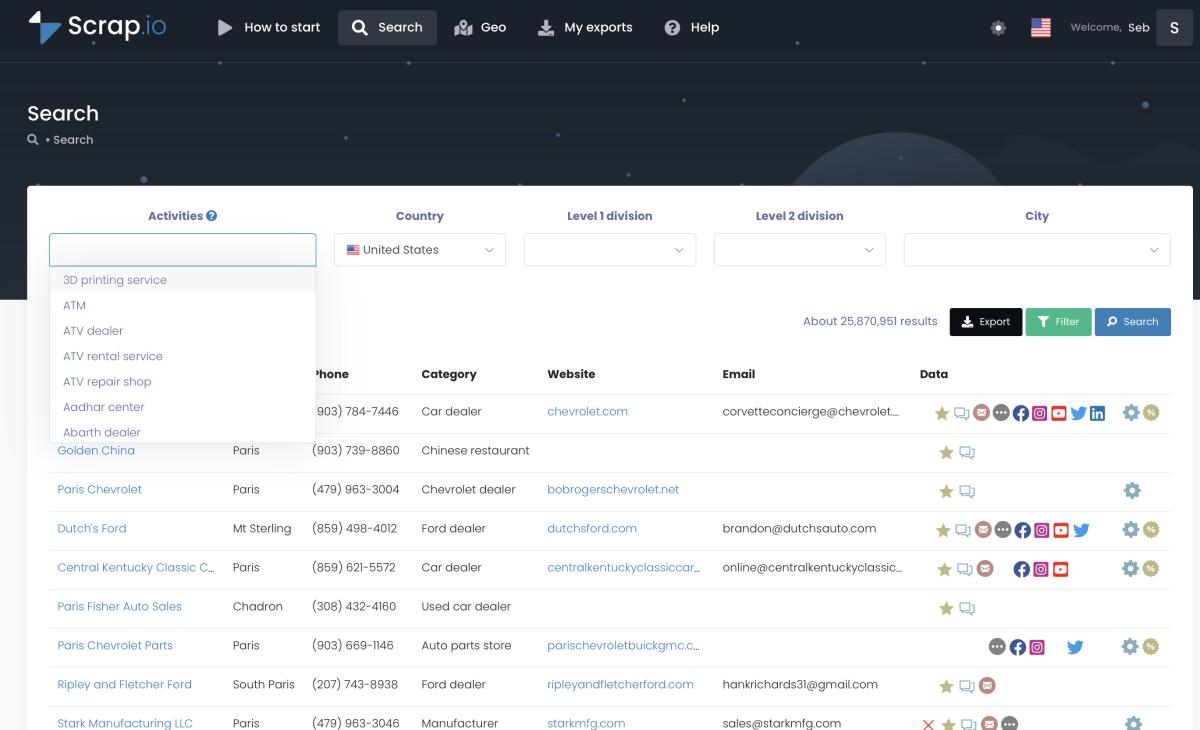
Step 1: Search by area or nationwide
Type "Hematologist" into the category field, pick your zone. A single city? Done. All of California? Two clicks. The entire US? Also two clicks, which still makes people blink. Scrap.io indexes 225 million+ business listings across 195 countries, so pulling every hematologist in the country is the same effort as pulling one town's worth.
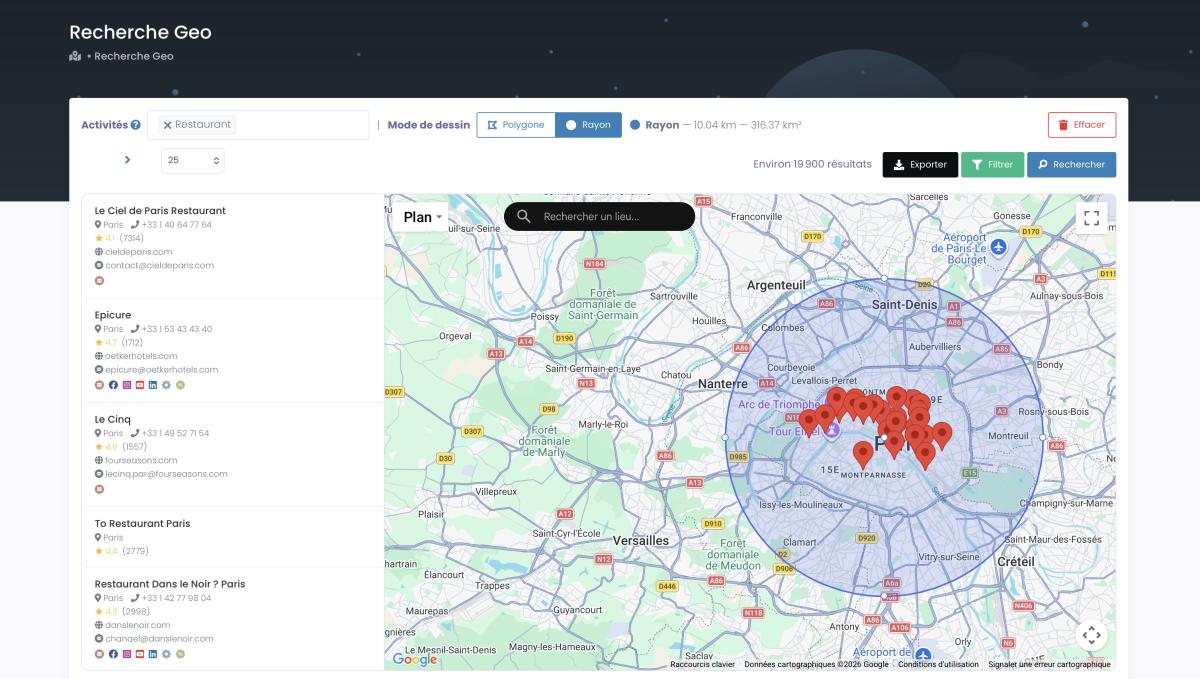
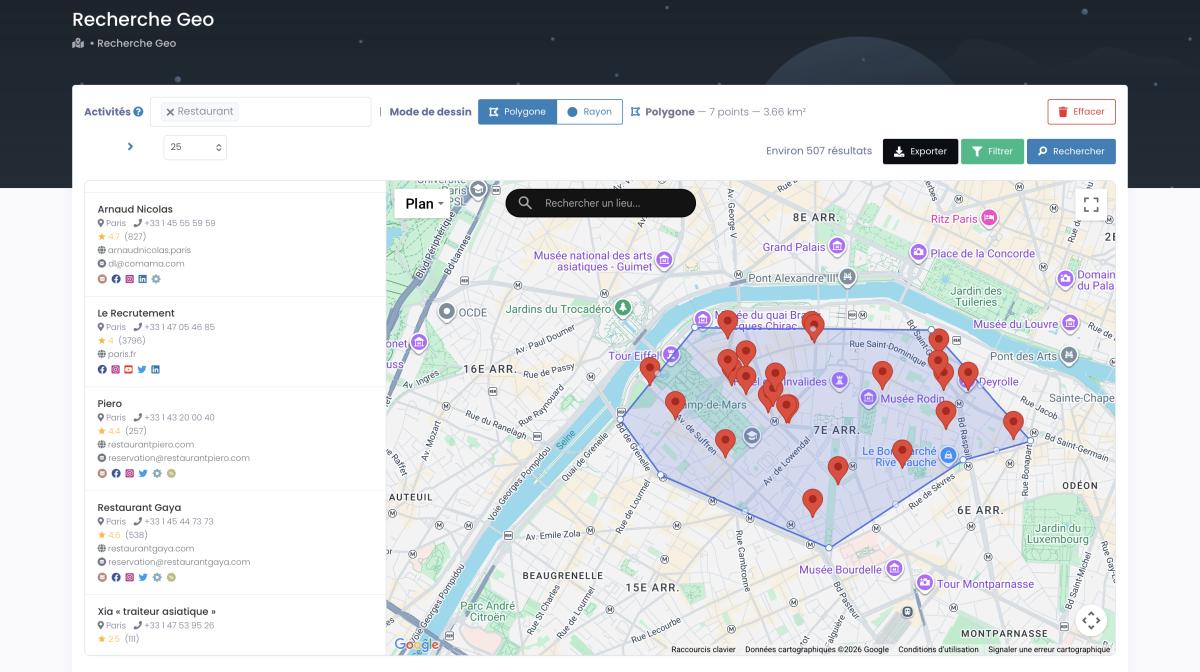
Need a precise catchment, say a hospital corridor or a custom sales territory that doesn't match any county line? GeoSearch handles it. Draw a radius around a point, or trace a polygon by hand on the map.
Step 2: Filter before you extract
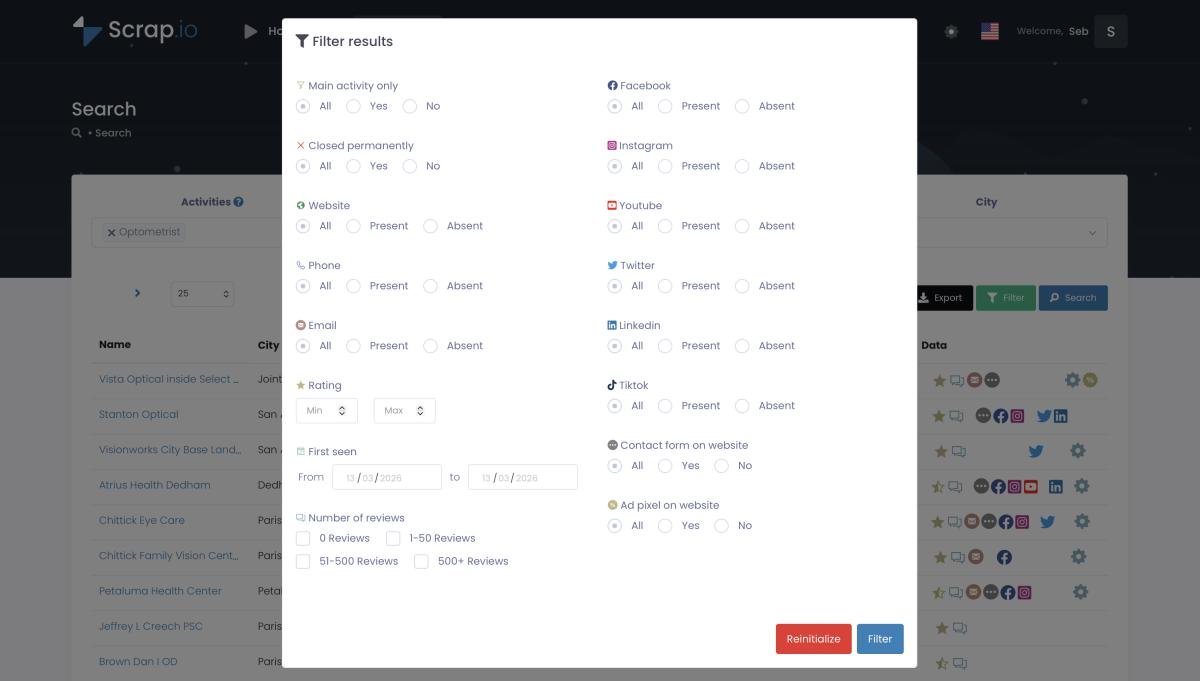
This is the step that saves your budget, so pay attention. Remember that only 405 hematologists show an email on the map, while 7,897 have websites to pull from? You toggle "email present" (which includes website-sourced emails) before you spend a single credit. You only pay for contacts you can actually email. Zero waste on dead-end rows.
You can stack filters too: has website, has phone, Google rating, review count, even whether the listing was recently created. Want only hematology practices in Florida with a website and a real email? That's a few toggles.
Step 3: Export fresh
Hit export. You get a CSV or Excel file, columns color-coded (yellow for map data, orange for website data), ready to drop into your CRM or cold-email tool. The data was verified at the moment of extraction, not last spring. That's the difference between this and a verified hematologist email list 2026 you'd buy pre-made: yours is current as of right now, and it's yours alone, because nobody else ran your exact search.
That's how you build a doctor email list that won't bounce. Not magic. Just fresh data instead of recycled data.
Build your hematologist list now, first 100 leads free. Pick the category, filter to email-present contacts, export in minutes. Real-time data from Google Maps, 7-day free trial with 100 export credits included. Start building on Scrap.io.
What Data You Get: Emails, Phones & Practice Details
A good hematologist contact list is more than a column of addresses. Here's what actually comes out of an extraction, per listing.
Identity first: practice name, full address, city, ZIP, GPS coordinates, main category and subcategories, website, opening hours, claimed-listing status. Then the reachability data, which is where the money is: phone number (classified as landline, mobile, or special), and emails sorted by type.
And that email classification is genuinely useful for a niche this small. You don't just get a blob. You get the main email, plus a labeled breakdown where available: an individual email with first and last name attached, a generic contact@ address, a sales@ line, a marketing@ line, and so on. For a hematology practice, that lets you skip the generic inbox and aim at a named person. On an audience of under 10,000, that precision is worth a lot.
You also get engagement signals (rating, review count, photo count) and website intel (CMS, detected tech, social profiles). Want to build a hematologist database with NPI-level targeting? You won't get the NPI field itself from map data, but you'll get everything you need to match and segment: name, practice, location, and a reachable email. Honest about the limit there, because overpromising is exactly what the vendors do.
Finding the Right Email: Segmentation for Hematology Outreach
Sending one generic blast to every hematologist in your file is a waste. Especially here. When your whole addressable market is ~10,000 people, you cannot afford to burn goodwill with a lazy "Dear Doctor." Segment, or don't bother.
The first split is by email type, which we just covered. A named individual email gets a personal note. A contact@ inbox gets a short, practice-level message that'll survive a receptionist. Different targets, different copy.
Video: How to Find the Best Email to Contact?
The second split is geographic. Build a hematologist email list for California, Florida, and New York separately, because those three states hold roughly a third of the entire specialty. A rep working the West Coast shouldn't be sending the same email as one working the Southeast. Market density changes the whole pitch.
Then there's timing and channel. Healthcare email performs well when you respect the audience: open rates run 34.6% to 44.6%, click-through 1.75% to 4.64%, and the ROI lands around $36 back for every $1 spent (WebFX). Those numbers only happen with relevance, though. Blast everyone and you'll sit at the bottom of that range, if you're lucky. Want the broader playbook across specialties? Our physicians email list guide covers send-timing and cadence in depth.
Who Buys a Hematologist Email List? (Real B2B Use Cases)
Who actually needs to reach hematologists? More companies than you'd think, and the audience being small makes each contact more valuable, not less. Here's where a hematology oncology practices email list earns its keep.
Diagnostics and lab equipment makers. The hematology analyzers market was worth $4.33 billion in 2025 and is projected to hit $7.28 billion by 2034, a 5.97% CAGR (Towards Healthcare). Think Sysmex, Beckman Coulter, or digital cell-morphology players like CellaVision. Every analyzer, every reagent line, every slide-imaging tool needs to land in front of the practices running blood panels. That's direct outreach to hematologists.
Pharma and biotech. Blood-disorder therapies, anticoagulants, treatments for anemia and clotting disorders, these get launched to the specialists who prescribe them. A targeted list beats a scattershot campaign every time.
Clinical trial recruiters. Hematology trials need investigators and sites with the right patient populations. Knowing how to reach hematologists for clinical trials, fast, with current contact data, is the whole game when a trial has a timeline and empty sites burn money.
Healthcare IT and practice-software vendors. EHR, scheduling, billing tools aimed at specialty practices, the kind of oncology-and-hematology workflow software Flatiron Health built its name on. With most hematologists tied to a group structure, software that fits that model has a clear audience. Selling to the institutions behind them? Pair this with our hospital email lists guide and target the admin layer too.
Join 50,000+ professionals building fresh lists instead of buying stale ones. Scrap.io is rated 4.8 on Capterra, 4.9 on G2, and 4.5 on Trustpilot, and pulls from 225M+ live listings. Filter to email-present hematologists before you spend a credit. Try it free.
Staying Compliant: HIPAA, CAN-SPAM & GDPR for Medical Outreach
Is it legal to email hematologists for B2B marketing? Short answer: yes, when you use public business data and follow the rules. Let's break it down, because people panic about the wrong regulation here.
HIPAA is probably not your concern. HIPAA governs protected health information, patient records, treatment data. Emailing a hematologist at their publicly listed practice address about your diagnostic tool isn't touching patient data. It's B2B outreach. Different universe. Just never imply you have access to anyone's health information.
CAN-SPAM is the one with teeth. Every commercial email needs honest headers, a truthful subject line, a real physical address, and a working unsubscribe you honor within 10 business days (FTC). Violations run up to $53,088 per email. Per email. That math gets ugly fast, so take list hygiene seriously.
GDPR applies if you reach EU-based contacts. B2B outreach can fall under legitimate interest, but you need a clear privacy notice and an easy opt-out. US-only campaigns on public business data are generally in the clear.
Here's why self-sourced data sits on firmer ground. When a hematologist publishes their practice email on Google Maps or their own website, that's public business information they chose to share. Scrap.io only extracts publicly available business data, every record traceable to its source, and the platform is GDPR and CCPA compliant. Compare that to a broker who won't tell you where a single row came from. For the deeper legal picture, the American Society of Hematology (hematology.org) is a solid reference point for how the profession organizes, and our wider healthcare guides cover compliance step by step.
Bought List vs. Self-Sourced: Which Wins in 2026?
Let's settle the "best hematologist email list" question with a straight comparison. Bought file versus one you build yourself.
| Factor | Bought Static List | Built with Scrap.io |
|---|---|---|
| Data freshness | Compiled months ago | Real-time at extraction |
| Contact count honesty | 5K to 18,869 (contradictory) | What's live on Maps, verifiable |
| You pay for | The whole file, bounces included | Only filtered, email-present contacts |
| Exclusivity | Resold to many buyers | Yours alone |
| Source traceability | Often unclear | Every record traces to Google Maps |
| Cost | $200 to $1,000+ per list | From $35/mo, free to start |
"But buying is faster," someone always says. In theory, sure. In practice, you lose that time back (and then some) cleaning bounces and nursing a damaged sender score. Building takes a few minutes and the data's fresh. If you also work adjacent specialties, the same method builds a cardiologist email list or a neurologist email list, identical workflow, different category.
The honest verdict? For a tiny, high-value specialty like this one, self-sourced wins on every axis that matters. Fresh beats stale. Verifiable beats padded. Yours beats shared.
FAQ
How many hematologists are there in the United States?
About 9,993 as of April 1, 2026 (rentechdigital). California leads with 1,140, Florida has 789, and New York 785. Only around 405 show an email directly on their Google Maps listing, but roughly 7,897 have a website you can extract a contact from, which is exactly why building your own list beats buying a padded one.
How can I find hematologists' email addresses?
Extract them yourself from public Google Maps listings and practice websites with a tool like Scrap.io. Search the "Hematologist" category, set your location, filter for "email present" before extraction so you only pay for reachable contacts, then export a fresh CSV. No broker, no stale file.
Is it legal to email hematologists for B2B marketing?
Yes, when you use publicly available business data and follow CAN-SPAM (US) or GDPR (EU). Include a real address, an honest subject line, and a working unsubscribe. HIPAA governs patient data, not B2B marketing to a doctor's business address, so just never reference or imply access to patient information.
Why do bought hematologist email lists bounce?
Because they're static snapshots. Doctors change practices, retire, and update emails constantly, and most are tied to group structures where a single merger invalidates many rows. Vendors also inflate counts (one claims 18,869 for a specialty with under 10,000 people), so a big chunk of the file was never real. Real-time extraction sidesteps the whole problem.
How much does a hematologist email list cost?
Bought lists run roughly $200 to $1,000+ for counts that contradict each other. Building your own with Scrap.io is free to start (7-day trial, 100 export credits included) and then from $35/month on the Basic plan, where you pay only per useful contact. For a specialty this small, paying per real contact beats paying for a padded file every time.
Stop paying for hematologists who don't exist. Build a fresh, verified hematologist email list straight from live Google Maps data, filtered to email-present contacts before you spend a credit. Try Scrap.io free for 7 days, 100 leads included, and see the real numbers for yourself. Start your free trial.
Generate a list of hematologist with Scrap.io