

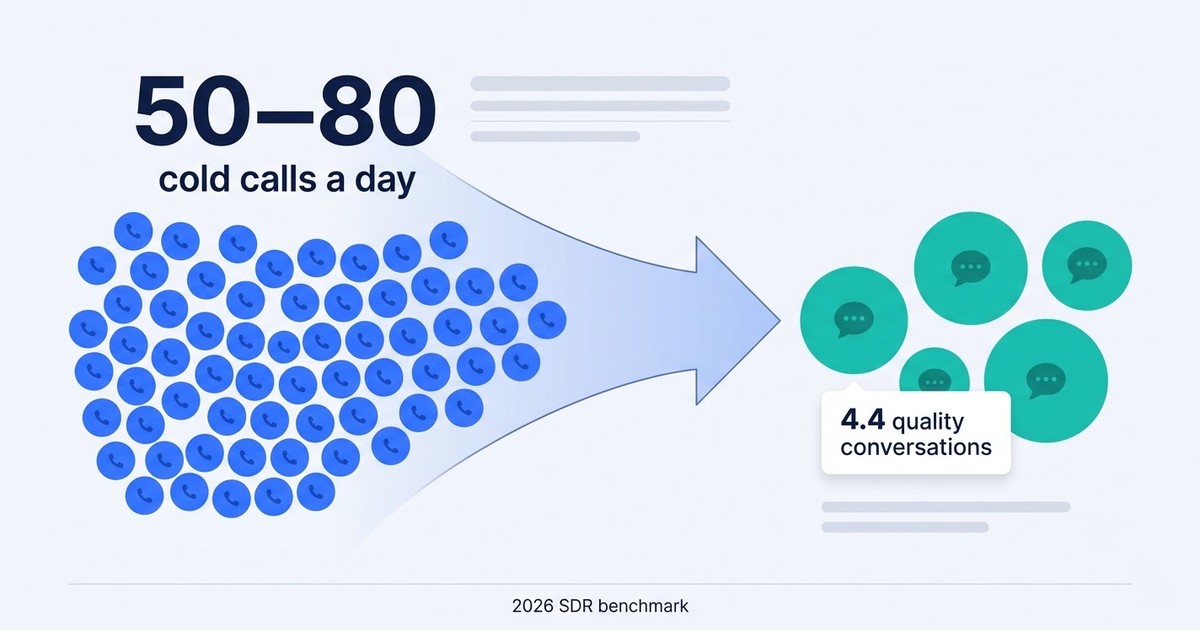
Here's the number nobody on your sales floor wants framed on the wall. The average rep who grinds out 50–80 cold calls a day walks away with roughly 4.4 quality conversations. That's it. Four and a half actual humans who talked back, out of dozens of dials, and that figure has fallen 45% since 2014 (The Bridge Group, via Cognism).
So when a manager asks how many cold calls a day you "should" be making, they're usually asking the wrong question. Dial count is the vanity metric. Conversations are the one that pays rent. (We'll get to why that distinction is worth money in a minute.)
And a quick opinion, because someone has to say it out loud: chasing 200 dials a day on a junk list is masochism dressed up as hustle. You burn your voice, your list, and eventually your best reps. Welcome to 2026, where the honest answer to "how many cold calls a day is good" depends on four things, and not one of them is simply "more."
Table of Contents
- So, How Many Cold Calls a Day? The Short Answer
- What Counts as a "Good" Number?
- 2026 Benchmarks by Role, Industry & Experience
- The Math: How Many Dials to Book a Meeting
- Why More Dials Don't Equal More Meetings
- Your Real Bottleneck Is Data, Not Effort
- How to Hit Your Daily Target Without Burning Out
- FAQ
So, How Many Cold Calls a Day? The Short Answer
How many cold calls a day should a B2B rep make in 2026? The industry baseline is 50–80 outbound calls per day for an SDR, with top performers pushing 80–100. But raw volume matters less than the outcome it produces: about 4.4 quality conversations a day on average. Hit that, and you're on pace.
That range holds up across the big 2026 datasets. Skipcall's consolidated benchmark lands on 50–80 for pure outbound. Cognism's data on the conversation side confirms the 4.4 number. And the moment you factor in your ICP, your channel mix, your data, and your dialer, that "right" number starts sliding around a lot. Which is the whole point.
Anyway, if you take one thing from this guide: the dial count is a floor, not a scoreboard. Set a minimum, then optimize everything downstream of it.
Curious how top reps keep their call lists full without burning credits on dead numbers? Scrap.io pulls phone numbers straight from Google Maps, verified in real time at export, across 225M+ businesses and 195 countries. Try it free for 7 days, 100 leads included, and see how many more of your daily dials actually ring.
What Counts as a "Good" Number?
"Is 40 a day good? Is 100?" Wrong frame. A good number is the one that produces enough real conversations to hit your meeting target, at a data and effort level you can repeat every day for a quarter without hating your job.
Here's the math that reframes it. If a rep makes 60 targeted dials and reaches 5 decent conversations, that's a good day. If another rep blasts 150 dials on a recycled list and scrapes together 3 conversations, that's a worse day with twice the effort. Same phone. Same market. Wildly different result. The number on the CRM dashboard lied to both of them.
So "how many cold calls should I make a day" has a boring, correct answer: enough to generate 4–8 quality conversations, given your connect rate. For most SaaS SDRs on decent data, that's 50–70. For high-velocity B2C or real estate, it climbs to 100–150 because the calls are shorter and more transactional. Different sports.
Is 100 Cold Calls a Day Realistic?
Yes and no. With a power or parallel dialer and a clean list, 100+ dials is easy. Trivially easy, honestly. But doing 100 manual dials with real pre-call research? That's mostly fiction. The math doesn't fit in an 8-hour day once you add wrap-up time and note-taking. Prospeo ran the numbers: at 93 seconds a call plus research, you land around 50 focused dials in three protected calling hours. Teams claiming 100 manual dials daily are usually skipping research or fudging the CRM. (You know it. I know it.) Push past 80 without excellent data and your conversion rate quietly craters. More on that below.
2026 Benchmarks by Role, Industry & Experience
Averages hide the good stuff. The number of cold calls per day you should target swings hard depending on who you are and what you sell. Focus Digital pegged the cross-industry average at 52 calls a day, but "average" is nearly meaningless here. A B2C telemarketer and an enterprise ABM rep live on different planets.
Start with role. This is where daily call targets by type actually separate:
| Role | Cold Calls Per Day | Why |
|---|---|---|
| Outbound SDR (net-new) | 50–80 | Cold lists, meeting-booking focus |
| BDR / ABM rep | 30–50 | Deep research, multi-threading strategic accounts |
| Inbound SDR / MDR | 40–60 | Warmer leads, higher qualification rate |
| B2C / high-velocity | 100–150 | Short, transactional calls |
| Real estate | 50–100 | Volume game, list freshness decides quality |
Now industry, because deal complexity changes everything. Focus Digital's 2026 breakdown shows the spread clearly: E-commerce/B2C runs about 125 calls a day, real estate 98, insurance 85, financial services 72, professional services 58, and technology/SaaS a lean 55. Complex sale, fewer but heavier calls. Simple sale, high volume. That's the whole logic in one sentence.
How Many Cold Calls a Day for Real Estate?
Real estate reps typically run 50–100 dials a day, sometimes more, because the conversations are shorter and the game is reach. But here's the catch nobody puts on the recruiting flyer: in real estate, list freshness decides everything. A stale list of numbers that changed hands two years ago will eat your morning alive. Volume only works when the numbers are alive.
Then there's experience. A rep in week two should not be judged against a two-year veteran. Ramping SDRs do well to hit 40–50 dials while they learn the script and the objections; push to 60–80 once the fundamentals are muscle memory. Forcing volume before the basics are solid just torches your list. If you want to benchmark the wider picture, our rundown of local prospecting KPIs for Google Maps covers the metrics that actually predict pipeline, not just activity.
The Math: How Many Dials to Book a Meeting
Time for the counterintuitive part. The number that should drive your daily quota isn't dials. It's the dials-to-meeting ratio, worked backwards from your target. And most reps have never done this calculation, which is wild given it takes ninety seconds.
The formula is simple. Connect rate times conversion rate tells you how many dials it takes to book one meeting. At a generic-data connect rate of 5–8% and a call-to-meeting conversion of 2–3%, you're looking at roughly 30–50 dials per booked meeting (Skipcall, Prospeo 2026). Top performers on verified data cut that to 15–25. Same effort, half the dials, because more of their numbers connect to the right human.
| Funnel Stage | Rate | Out of 40 dials |
|---|---|---|
| Dials | n/a | 40 |
| Connects (live conversations) | 5–8% | ~3 |
| Call → meeting | 2–3% | ~1 meeting |
| Top performers (verified data) | 15–25 dials | 1 meeting |
Want 15 meetings a month? Reverse-engineer it. At a 3% call-to-meeting rate you need about 500 conversations. At a 10% connect rate that's 5,000 dials a month, or roughly 250 dials a day across 20 working days. If that number looks insane for your stack, the problem isn't the quota. It's your tooling and your data. For the deeper numbers behind conversion, our breakdown of cold calling success rate benchmarks shows exactly where the average 2.7% comes from and how top teams reach 11.3%.
How Many Cold Calls Per Hour?
Manually, expect 15–25 dials an hour. A power dialer pushes that to 30–50. A parallel dialer running several lines at once can hit 60–80 an hour because it drops dead numbers and voicemails automatically and only connects you when a human picks up. So "how many calls can you make in 8 hours" has a huge range: 40 manual dials with research, or 250+ on a parallel dialer. The tool sets the ceiling. Your data sets whether any of it matters.
Why More Dials Don't Equal More Meetings
This is the part that stings, and the b2b cold calling statistics back it up. Cranking the volume dial usually makes your average cold call conversion rate worse, not better. Bridge Group's data, echoed by both Skipcall and Focus Digital, shows reps making 40–60 dials a day on good data convert at 2.8%. Push past 80 dials and conversion drops to 1.9%. You dialed more and booked less. Read that twice.
Why does it happen? Because volume without quality means corner-cutting. Prep goes out the window. The opener gets robotic by call 41. The prospect on the other end feels like a number, because to you, at that pace, they are. And rejection fatigue is real: hitting voicemail forty times in a row degrades your energy and your pitch on call 41. It compounds. Downward.
The reps on Reddit have been saying this for years. On the r/sales thread "Making 50-100 cold calls a day effective?", the recurring take is blunt: "quality of the list beats quantity of dials, every time." Over on "how many cold calls?" the consensus is that 50 well-researched dials outperform 150 sprayed ones. And in r/techsales, BDRs keep landing on the same conclusion: the dial number their manager worships is not the number that books meetings. They're not wrong.
Try defending 200 daily dials to a rep who books more meetings off 60. Go ahead. I'll wait. This is also why the tired "cold calling is dead" line keeps circulating, and why it's mostly nonsense. Random, unresearched cold calling is dead. Targeted cold calling is alive and converting at 11.3% for the teams doing it right, as we argued in is cold calling dead in 2026.
Here's a quick two-minute watch on the mistakes that quietly kill your call quality, worth it before you touch your dialer settings.
Video: Mistakes to Avoid when Cold Calling
Your Real Bottleneck Is Data, Not Effort
Let me tell you about a Scrap.io customer. GreyScout, an outbound team, was drowning in bounced numbers, roughly a 38% bounce rate. Then they cleaned up where their data came from. Bounce rate crashed to under 4%, and their pipeline jumped 140% (Prospeo case study). Same reps. Same scripts. Same daily dial target. The only thing that changed was the quality of the numbers on the screen.
That's the dirty secret behind every "how many cold calls a day" debate. Reps lose about 27% of their selling time to bad contact data (Leads at Scale, via Martal). More than a quarter of your day. Gone. So when your manager says "just dial more," what they really mean, whether they know it or not, is "let's waste more time faster." The connect rate tells the story: generic lists sit at 5–8%, while verified direct-dial data hits 18–25%. Gong's cross-dataset average lands around 5.4% on generic data. The gap between those numbers is the gap between a good day and a soul-crushing one.
So the objection "I already make 100 calls a day" misses the point entirely. The question was never how many numbers you dial. It's how many valid numbers you reach. Dialing 100 dead lines is not prospecting. It's phone lottery with rigged odds.
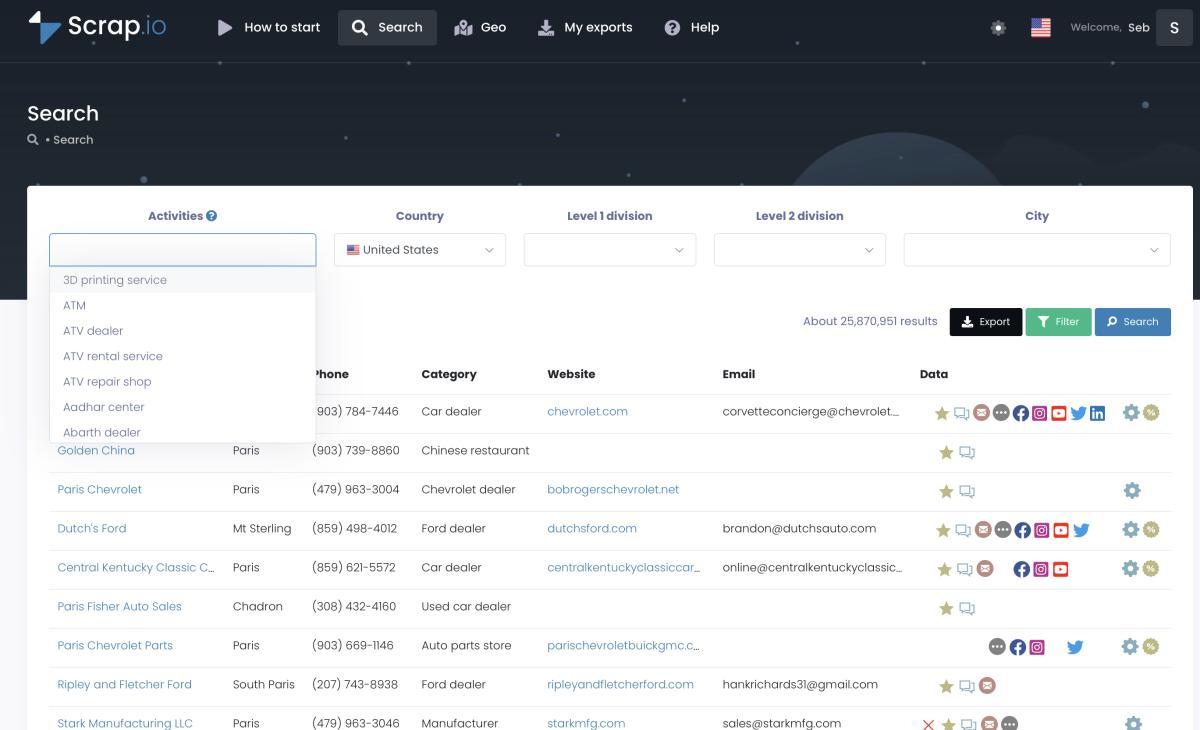
This is where the sourcing side earns its keep. Scrap.io pulls business phone numbers and emails directly from Google Maps, verified in real time at every export, not cached from some database that went stale eight months ago. You target by category (4,000+ of them) and by territory, right up to an entire country, and you filter before extraction so you only spend a credit on a fiche that actually has a phone number. Here's the search step, category plus location:
And the filter panel, where you keep only the listings with a phone number present before you export, so no credit is wasted on a lead you can't call:
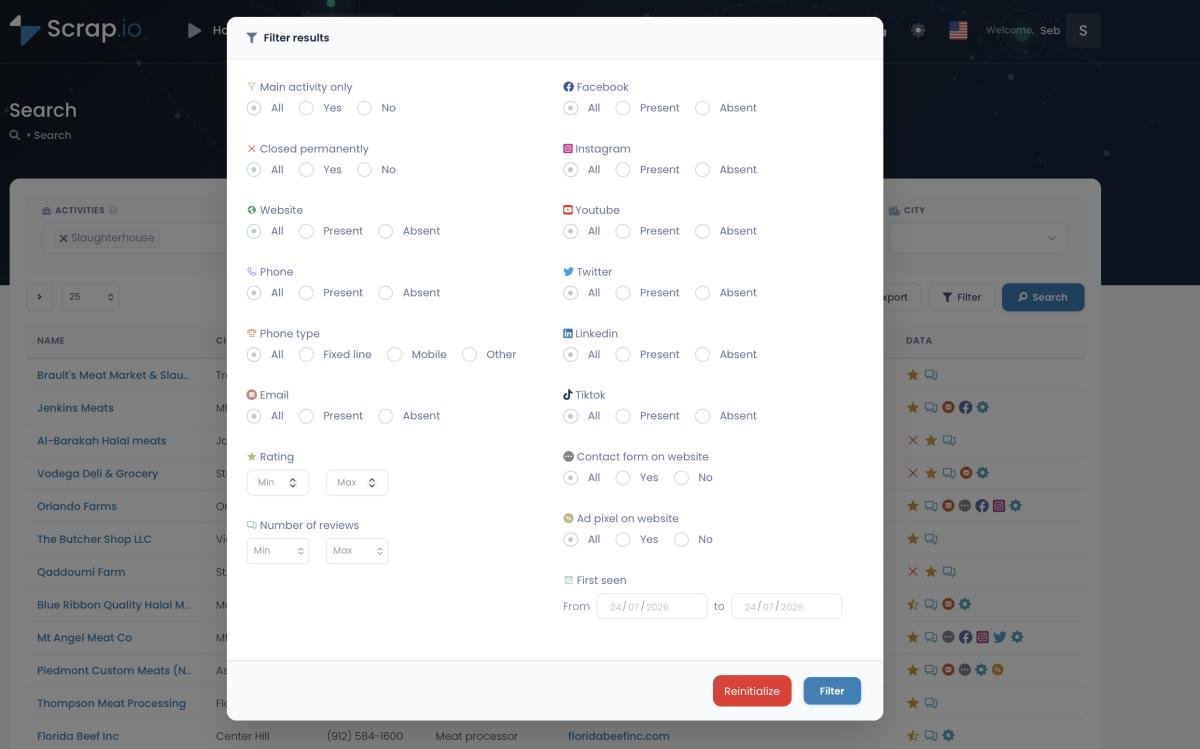
One honest note for US and Canada teams: the fixed-versus-mobile phone classification isn't available there, so don't build a workflow around a "mobile only" filter in those markets. What you get instead is presence of a number, freshness, category and territory targeting, plus the email for a multi-channel follow-up. For the full phone-based workflow, our guide to sales prospecting techniques maps the whole thing out.
Build a fresh, phone-verified call list in a couple of clicks. Scrap.io extracts real-time business data from 225M+ Google Maps listings across 195 countries, filtered before export so every dial can actually ring. Try Scrap.io free for 7 days, 50 searches and 100 leads included, and stop paying for numbers that go nowhere.
New to the tool? Two short walkthroughs. First, the sourcing side end to end:
Video: Scrap.io - How to Start?
And if finding the right number is your bottleneck, this one's on point:
Video: How to Find Someone's Phone Number by Name in 2026
How to Hit Your Daily Target Without Burning Out
Volume you can't sustain is worthless. Here's how the reps who last actually structure the day, and none of it involves white-knuckling 200 dials.
Block your calling. Two or three protected windows, no internal meetings allowed to invade them. The data on when to call is unusually consistent: Tuesday and Wednesday account for 44% of demos booked across 1.4 million calls (ZoomInfo), and the peak windows are 10–11 AM and 4–5 PM in the prospect's local time. Not yours. Theirs. A New York rep dialing Seattle at 4 PM Eastern is hitting a 1 PM lunch slot, and wondering why nobody answers.
Persist, but stop wasting effort past the point of return. Cognism's data shows 93% of the conversations that will ever happen occur by the third attempt, and over 98% by the fifth. So build an 8–12 touch cadence across phone, email, and LinkedIn, but don't dial the same dead number fifteen times. Rotate the angle. Space it out.
Then sharpen the parts that actually move conversion. Your opener decides the call in the first seven seconds, so steal from the ones that test well in our roundup of cold call opening lines. Your structure should hold up under pressure, which is what cold call scripts that work are for. And when the pushback comes (it will), a calm framework beats a scramble, so keep the plays from our guide to handling objections close.
One more thing, and it's not soft-skills fluff. If you dread the phone, your prospects hear it. Reps who genuinely enjoy the work convert better, and a lot of that enjoyment comes from not wasting 40% of the day on wrong numbers. If Monday mornings feel like a dental appointment, our piece on how to make cold calling enjoyable has real tactics, not affirmations.
Last, stay legal. In the US, B2B cold calling runs under the TCPA and the National Do Not Call Registry. Call inside the 8 AM–9 PM window in the prospect's local time, scrub your list against the DNC regularly, and treat a decision-maker's personal cell differently from a published business line. Gartner has long noted it can take up to 18 dials to reach a prospect when you only have the switchboard, which drops to a handful with a verified direct number. Clean sourcing makes compliance easier, not harder. Scrap.io only pulls publicly available business data (GDPR and CCPA compliant), and every record traces back to its source. The dialing side is on you.
FAQ
How many cold calls a day is normal?
For a B2B outbound SDR, 50–80 dials a day is normal, dropping to 30–50 for junior reps or ABM roles and climbing to 100–150 for B2C. But "normal" is really defined by your connect and conversion rates, not a raw number. Sixty targeted dials on clean data beat 150 on a stale list.
Is it possible to make 100 cold calls a day?
Yes, with a power or parallel dialer and a clean list. Doing 100 manual dials with proper pre-call research is mostly unrealistic in an eight-hour day, though; 40–60 quality calls is more honest. And once you push past 80 dials without excellent data, your conversion rate tends to drop, so volume alone works against you.
What is the 80/20 rule in cold calling?
Roughly 80% of your results come from about 20% of your activity, specifically the best-targeted calls to the right-fit accounts. It's a nudge to stop spraying and prioritize list quality. A second reading: listen 80% of the call, talk 20%. Both point the same way, toward quality over raw volume.
How many cold calls should I make to book a meeting?
At a 5–8% connect rate and a 2–3% call-to-meeting conversion, expect roughly 30–50 dials per booked meeting. Top performers on verified data cut that to 15–25 dials, because more of their numbers connect to the right person on the first try.
How many cold calls a day for real estate?
Real estate reps typically run 50–100 dials a day, since conversations are shorter and the game is reach. Quality still hinges on how fresh the data is, though. Numbers that changed hands two years ago will burn your morning no matter how many you dial.
Stop dialing dead numbers. The fastest way to fix your cold calls a day is to fix the list feeding them. Scrap.io gives you fresh, phone-verified leads from 225M+ Google Maps businesses across 195 countries, filtered before you spend a credit. Start your free 7-day trial, 100 leads included, and fill tomorrow's call list today.
Generate a list of restaurant with Scrap.io