

Download a list of oil and gas companies right now. Go ahead, I'll wait. Wikipedia has one. Investopedia has one. A dozen directories have one. In about ninety seconds you'll have a tidy ranking of supermajors by revenue. Now try to actually email one of them. That's where it all falls apart.
Every public list of oil and gas companies is built for investors and students, not for the person who has to reach these businesses and sell them something. This guide fixes that. We'll cover who the giants are, because you came here partly for that. But mostly we'll build something the rankings never give you: a fresh, contactable oil and gas companies list you can drop into a cold email tool this afternoon.
One thing before we start. Oil and gas means producers, drillers, pipeline operators and oilfield services. It does not mean the gas station on your corner. Different industry entirely. If retail fuel is your target, that's a separate list and a separate guide.
- What Counts as an "Oil and Gas Company"? (Upstream, Midstream, Downstream & Services)
- The Biggest Oil and Gas Companies (US & World) at a Glance
- Why Most "Lists of Oil and Gas Companies" Are Useless for B2B Prospecting
- How Many Oil and Gas Companies Are There in the US? (2026 Data)
- How to Build Your Own List of Oil and Gas Companies (Step by Step)
- Emails, Phones & Websites: Turning the List into an Outreach-Ready Database
- Who Sells to Oil and Gas Companies? (Real B2B Use Cases)
- Is It Legal to Build and Email a List of Oil and Gas Companies?
- FAQ
What Counts as an "Oil and Gas Company"? (Upstream, Midstream, Downstream & Services)
"Oil and gas company" isn't one thing. It's four very different businesses, and mixing them up is the fastest way to waste a prospecting list.
Pitch a drilling-automation tool to a gas-station chain and you'll hear crickets. Pitch pipeline-inspection software to an exploration startup that owns zero pipe and you'll hear the same. So before you build any oil and gas companies list, you need to know which of the four segments you're actually after. Here they are.
| Segment | What they do | Typical examples |
|---|---|---|
| Upstream (E&P) | Exploration and production. Finding oil and gas, then drilling it. | ConocoPhillips, Devon Energy, Continental Resources |
| Midstream | Moving and storing it. Pipelines, terminals, storage tanks. | Energy Transfer, Kinder Morgan |
| Downstream | Refining and distribution. Turning crude into fuel and chemicals. | Valero Energy, Marathon Petroleum |
| Oilfield services | The suppliers. Rigs, equipment, well services, data. | Halliburton, Baker Hughes |
Upstream, midstream, downstream: build the list that matches your offer
If you're assembling a list of upstream oil and gas companies, you're after E&P operators and the independents drilling the shale basins. A list of offshore oil and gas companies narrows that further to the ones working rigs in the Gulf. Midstream and downstream are smaller in headcount but huge in spend. Each one buys completely different things. Match your segment to your product first, or the rest of this is wasted effort.
Don't forget the independents
Here's the part the global rankings bury. Alongside the supermajors sits a long tail of independent producers, the Hilcorps and Matadors and Mewbournes of the world. If you want a list of independent oil and gas companies or you're chasing the top 10 independent oil and gas companies by output, these are rarely on any "top 10" page. They're exactly the mid-market firms most likely to answer a well-targeted email. Keep them in mind.
The Biggest Oil and Gas Companies (US & World) at a Glance
Just over 430 publicly traded oil and gas companies are worth a combined $8.6 trillion (CompaniesMarketCap, 2026). Enormous. And the ones you can actually sell to almost never show up on that list.
Still, you came here partly for the rankings, so here they are. By 2023 revenue, the list of largest oil and gas companies by revenue looks like this (Wikipedia):
| Company | Country | Revenue (2023) |
|---|---|---|
| Saudi Aramco | Saudi Arabia | ~$604 billion |
| ExxonMobil | United States | ~$414 billion |
| Shell | United Kingdom | ~$386 billion |
Top oil and gas companies in the USA
Narrow it to the US and the top oil and gas companies in usa conversation circles the same names: ExxonMobil, Chevron, ConocoPhillips, Marathon Petroleum, Phillips 66, Valero. Want the top 10 oil and gas companies in usa or the top 20 oil companies in usa? You can rank them by market cap in an afternoon. The problem comes the second you want to reach anyone at these companies, or the thousands of smaller firms that make up the rest of the market worldwide.
Because a ranking of the biggest oil and gas companies in the world is a trophy case. It is not a prospect list. And that distinction is the whole reason you're still reading.
Why Most "Lists of Oil and Gas Companies" Are Useless for B2B Prospecting
You can download a dozen "lists of oil and gas companies" in five minutes. Not one of them will help you close a single deal. Harsh, but true.
Here's why. The Wikipedia tables and the market-cap rankings give you names and share prices. No emails. No phone numbers. No small or mid-size operators. The directories go a little deeper, sure, but a static PDF list of U.S. oil and gas companies is frozen the day it's published. And B2B data does not age gracefully.
It rots. B2B databases lose between 22.5% and 70% of their accuracy every year, and email addresses rot fastest of all at roughly 43% a year (ZoomInfo, 2026). So that "verified" oil and gas list you bought last spring? A big slice of it is already dead. Here's the contrast that matters.
| Static bought/PDF list | Fresh self-built list | |
|---|---|---|
| Freshness | 🔴 Decays 22.5–70% / year | 🟢 Real-time at export |
| Contact details | ❌ Rankings have none | ✅ Email + phone + site |
| Mid-market & local firms | ❌ Supermajors only | ✅ Every segment |
| Exclusivity | 🔴 Sold to everyone | 🟢 Yours alone |
This is the exact trap we warn about across our whole email list by industry hub, and it plays out the same in every vertical. We saw it with our manufacturer email list guide too: the sector changes, the data-decay math does not. Fresh beats cheap. Every time.
How Many Oil and Gas Companies Are There in the US? (2026 Data)
There are roughly 67,900 oil drilling and gas extraction businesses in the US (Zippia, 2026). And that's before you count the services firms and the distributors. The sector is worth about $463.8 billion and supports around 10.3 million jobs across the wider economy, with roughly 219,000 people working directly in drilling and extraction.
So when someone searches for a list of oil and gas companies in usa and expects fifty names, they're off by three orders of magnitude. The real list of us oil and gas companies is enormous, and it's heavily concentrated. Texas alone dominates. Which is why so much prospecting happens near Texas, near California, and across the Permian: a list of oil and gas companies in Houston, in Oklahoma, or in Midland TX will be denser than most entire countries.
Global demand backs the scale up. Crude consumption keeps climbing toward roughly 104 million barrels a day (EIA). This is not a shrinking market you need to worry about drying up.
Counting the real, contactable market is where it gets interesting. Pull a fresh count on Google Maps and you can size any slice of it in seconds, by city, county, state or the whole country, before spending a cent. Need an odd shape instead of an administrative zone, like the Permian footprint or a 50 km ring around Houston? GeoSearch draws it for you.
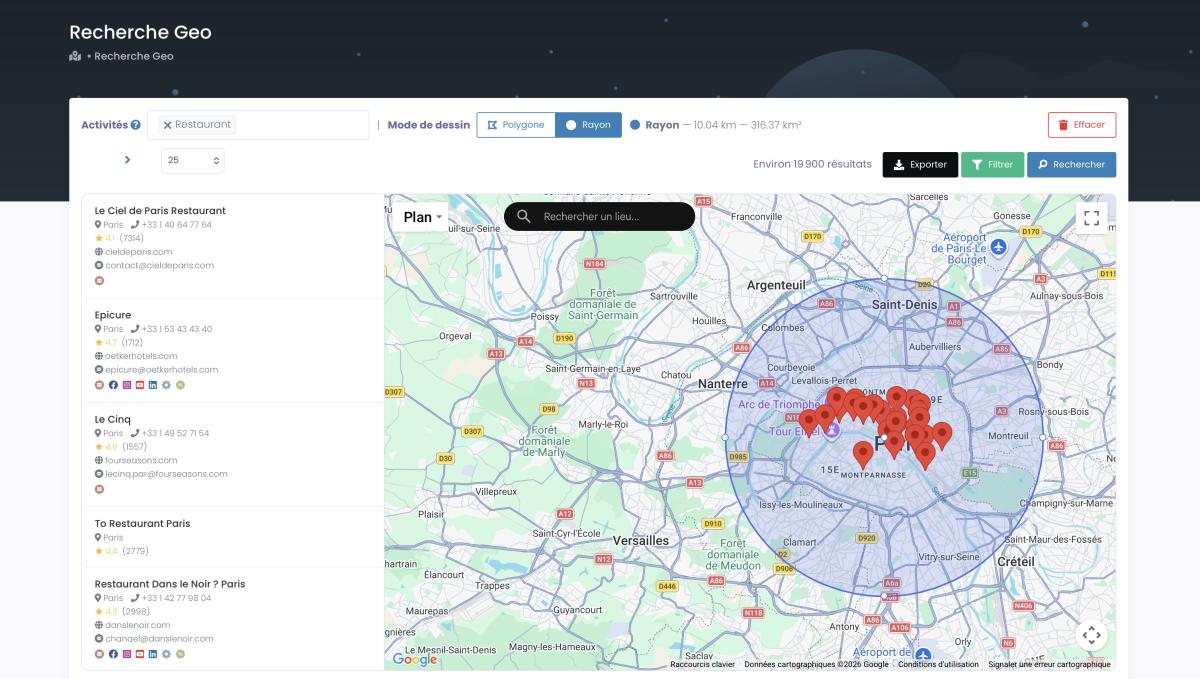
If you want to go wide across the country rather than one metro, a full USA business email database built this way covers a single state or every state at once.
How to Build Your Own List of Oil and Gas Companies (Step by Step)
What if you could pull every oil and gas company in a state, emails and phone numbers included, in about the time it takes to read this section? You can. No code, no scraper to maintain, no $3,000 broker invoice. Three steps.
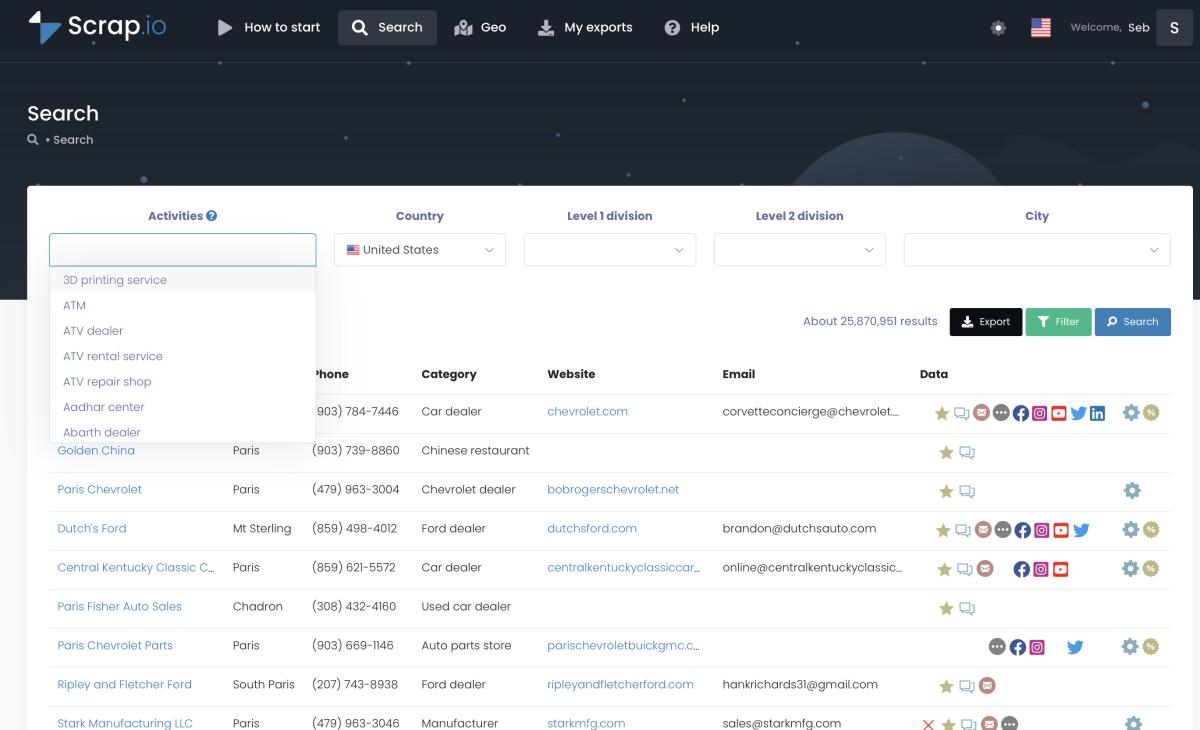
Step 1: Pick your category and zone
Choose an oil and gas category (exploration services, drilling contractors, pipeline companies, whatever matches your segment from section one) and a location. A city, a county, a state, or the entire US. Scrap.io works from an index of 225,676,406 businesses across 195 countries and 4,000+ categories, so your target zone is yours to set. It shows the exact count before you spend anything. Counting is always free.
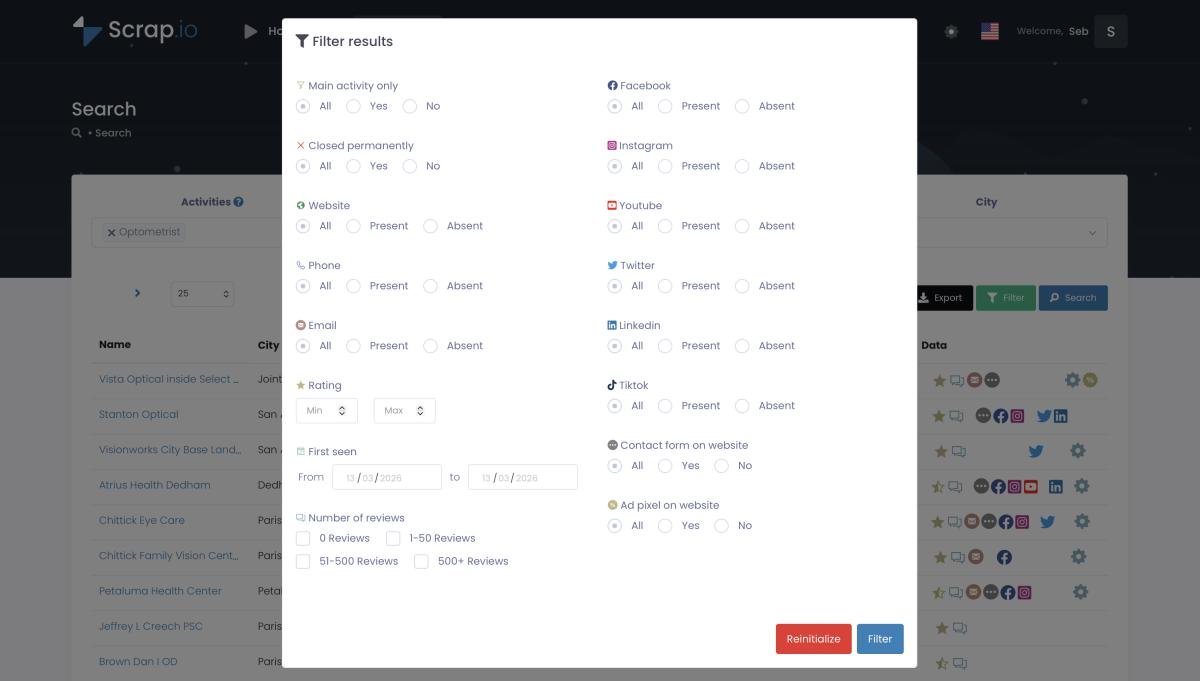
Step 2: Filter before you extract
This is the part that saves your budget. Only want firms that actually have an email on file? Toggle the email filter. Need a website, a certain rating, a specific state? Stack the filters. Every one of them applies before a single credit is consumed, so you never pay for a dead-end row. The complete Google Maps scraping guide breaks down each filter if you want the deep version.
Step 3: Export to CSV or your CRM
Hit export. CSV or Excel, ready to load into a cold email tool or a CRM. The file carries the lot: company name, address, phone with type, up to five classified emails per business, social links, website tech stack. Re-export the same business within 30 days and it costs zero extra credits.
And when your target area isn't shaped like a city, draw a polygon by hand around a basin, a corridor, a county cluster. Every filter still works inside the shape.
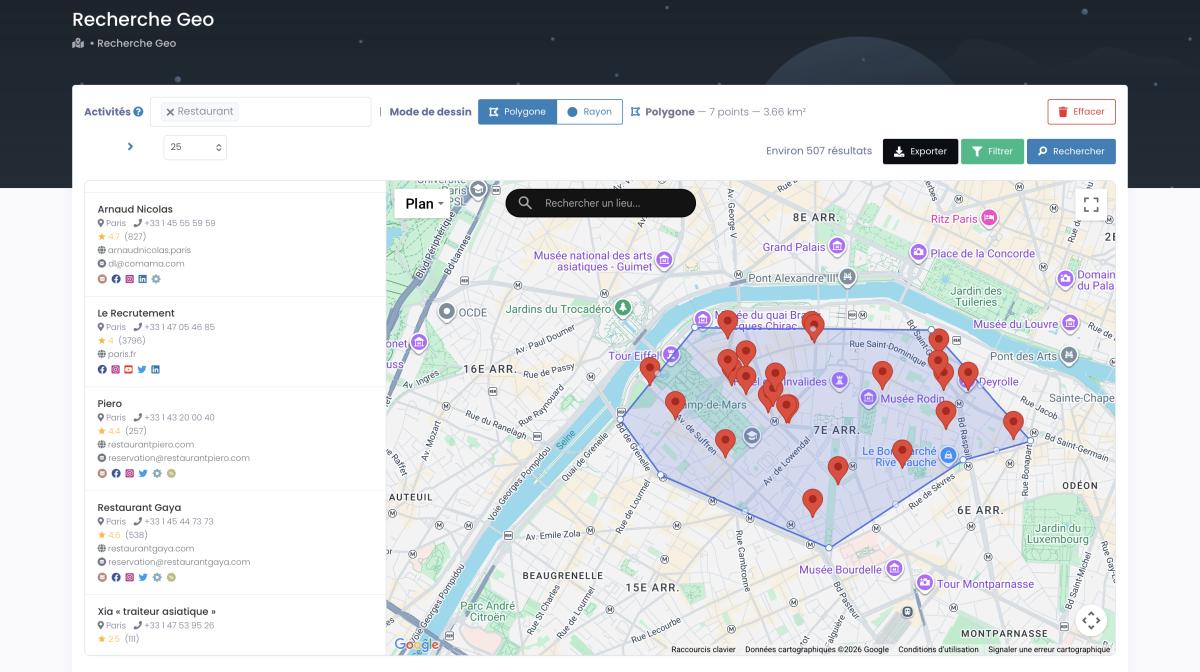
Here's the country-level version in action:
Video: How to Scrape Local Leads at the Country Level
That's genuinely the whole loop. For a wider playbook on turning map data into pipeline, our guide on how to get local business leads goes further than I can here.
Emails, Phones & Websites: Turning the List into an Outreach-Ready Database
Of the roughly 2,000 US oil and gas exploration companies on the map, only about 44% show an email. That number should change how you think about buying lists.
Here's the live breakdown for one Google Maps category, "Oil and gas exploration service," across the US (Scrap.io, September 2026):
| Filter | US establishments | Share |
|---|---|---|
| Total "Oil and gas exploration service" | 2,015 | 100% |
| …with a phone number | 1,572 | ~78% |
| …with a website | 1,144 | ~57% |
| …with an email | 882 | ~44% |
That one category is just a sample, not the whole sector (remember the ~67,900 businesses Zippia counts across all of oil and gas). But the lesson scales. Buy a raw list of all 2,015 and you'd delete more than half before your first send. Filter to "email present" first, and you pay only for the ~882 you can actually contact. That's the entire argument for a proper oil and gas email list, built fresh, instead of a bought oil and gas industry email list that's already decaying.
And the emails aren't just dumped in one column. Scrap.io classifies them: the primary email, an individual email with first and last name pulled automatically, plus contact@, sales@ and marketing@ inboxes, each labeled. You send the pitch to a named person or the sales desk, not the info@ address nobody reads. The full method is in our guide to extracting emails from Google Maps.
One honest limitation, since the brief here is B2B accuracy: the fixed-versus-mobile phone type filter isn't available in the US and Canada. Everywhere else it is. For the US you still get the number, just not the line type.
Video: Get Emails from Google Maps for Free
Once the list is clean, the sending is its own craft. If you're wiring the whole thing together from scratch, start with how to build a cold email list.
Who Sells to Oil and Gas Companies? (Real B2B Use Cases)
Picture a marketing agency in Houston. Two thousand local energy firms on their doorstep, and they were still buying a stale national list for three grand. Sound familiar? It should, because selling to oil and gas is a massive market in its own right.
Look at who does it. Enverus (formerly Drillinginfo) sells data and analytics, and its entire customer base is oil and gas operators. Software giants like SAP and AI vendors like C3 AI run whole practices aimed at energy firms. And specialist agencies market to the sector directly. Elevation Marketing, which runs a dedicated oil-and-gas B2B practice, points out that 94% of B2B buyers research purchases online before they ever talk to sales. Translation: the energy firm you want to reach is already on the web. You just have to find its inbox.
The people doing this at volume are blunt about the alternative. On r/coldemail, one operator's advice on bought lists was, word for word: "Do not send cold emails from your primary company domain... buy trycompany.com" (r/coldemail). Read that again. Pros who do this for a living assume a purchased list will torch their domain, so they plan around the damage instead of avoiding it. Over on r/SaaS, the perennial "where do I find an email list?" thread always ends the same way: there's no magic file, and hand-building one eats months. Bon. The answer is to build it fresh, on demand.
So who wins here? Agencies pitching energy firms, SaaS vendors with a vertical product, equipment suppliers, recruiters, compliance consultants. Any of them can skip the registries and the stale databases, the LakeB2B and ContactMetrix "oil and gas email lists" of the world, and build their own instead.
Is It Legal to Build and Email a List of Oil and Gas Companies?
Short version: yes, if you use publicly available business data and respect CAN-SPAM, CCPA and GDPR.
You're collecting business information that companies published themselves: names, addresses, phone numbers, business emails. In the US, CAN-SPAM lets you send unsolicited commercial email to business addresses as long as your sender details are accurate and every message carries a working unsubscribe link. California's CCPA largely carves out publicly available business data. And in the EU, B2B outreach usually rests on legitimate interest, provided you offer an easy opt-out.
The part that keeps you safe is traceability. Scrap.io only surfaces publicly available business data, GDPR and CCPA compliant, with every record traceable to its source. If you're emailing into Europe, our GDPR cold email B2B guide walks through the legitimate-interest paperwork line by line. None of this is legal advice, obviously. But stick to public business data and honor opt-outs, and you're on solid ground.
FAQ
Who are the top 10 oil and gas companies?
By revenue and market cap, the top 10 oil and gas companies globally are typically Saudi Aramco, ExxonMobil, Chevron, PetroChina, Shell, TotalEnergies, CNOOC, ConocoPhillips, Petrobras and BP. Rankings shift year to year with oil prices, but these names dominate the biggest oil and gas companies in the world.
What are the top 100 oil and gas companies in the USA?
For a ranked registry of publicly listed firms, directories like Evaluate Energy and ShaleXP cover the top 100 oil and gas companies in usa and beyond. But if you want a full, contactable list of US oil and gas companies with emails and phones, you build it yourself from Google Maps in a few clicks rather than copying a frozen table.
Who are the "big 5" or "7 major" oil companies?
The "supermajors" are usually counted as ExxonMobil, Chevron, Shell, BP and TotalEnergies, with ConocoPhillips and Eni often added to make up the "seven majors." They're integrated, meaning they operate across upstream, midstream and downstream.
What is the largest oil company in the US?
ExxonMobil is the largest US oil and gas company by revenue, reporting roughly $414 billion in 2023.
How do I get a list of oil and gas companies with contact details?
Pick an oil and gas category and a location in Scrap.io, filter to businesses that have an email (so you don't pay for blanks), and export to CSV. You get names, addresses, phones and classified emails pulled in real time from Google Maps, for a city, a state, or the whole US. That's a contactable list of oil and gas companies, not a static ranking.
Stop downloading rankings. Start building pipeline.
The giants will always be one search away. But a trophy list of supermajors never booked anyone a meeting. The firms you can actually sell to, the independents, the services suppliers, the mid-market operators across Texas and beyond, are sitting on the map right now with their emails and phone numbers attached. Rankings won't give you those. A fresh, filtered extraction will.
Generate a list of oil and gas exploration service with Scrap.io