

Marc runs a four-person agency in Austin. Last Tuesday he had two tabs open: lobstr.io and scrap.io. Two scraping tools born in France, two very different philosophies, and one budget that had to cover both a client campaign and his own rent.
He'd read the sales pages. Both promised leads from Google Maps without a line of code. Both flashed impressive numbers. And both, on the surface, looked like they did the same job.
They don't.
So we did what Marc didn't have time to do: put them side by side on pricing, cost per lead, filtering, country-level coverage, and the boring stuff nobody screenshots for their landing page. No fluff. If Lobstr.io is the better pick for you, we'll say so out loud. Here's the honest 2026 comparison.
TL;DR: Lobstr.io vs Scrap.io at a Glance
No time? Here's the whole article in one table. You're welcome.
| What matters | Lobstr.io | Scrap.io |
|---|---|---|
| Focus | Multi-platform scraping suite (Maps, Sales Nav, X…) | Google Maps specialist, nothing else |
| Coverage model | 🟡 One search URL per zipcode, run by batches | 🟢 195 countries indexed, whole country in 2 clicks |
| Filtering | 🔴 Applied after extraction (you pay per row first) | 🟢 Applied before extraction, free counts |
| Data freshness | 🟡 Run-based, 7–28 day retention | 🟢 Real-time at export, exports are yours |
| Email verification | 🟢 Native, ~97% accuracy on "valid" | 🟡 Classified emails, no in-app verify score |
| Headline price | $0.5 / 1,000 leads (raw, no emails) | From $35/mo, 10,000 credits, everything included |
| Best for | Multi-source scraping on a tight entry budget | Google Maps leads at scale, filtered, real-time |
Short version? There's no single "best google maps scraper" for everyone. If your world is bigger than Google Maps, Lobstr.io earns its spot. If Google Maps is the job (country-wide, filtered, contactable), Scrap.io is built for exactly that and it shows.
What Is Lobstr.io? (Honest Overview)
Let's be fair: Lobstr.io is a genuinely good product. Here's what it actually does well.
It's a French no-code scraping platform, founded around 2019 (confirmed by Outscraper's roundup), and its Google Maps Leads Scraper is the piece that concerns us here. As of September 2026, that single scraper shows 10,964 users and 6,142 runs on its store page. Not a toy, a tool people run in production.
The specs are loud and, to their credit, mostly accurate: 200 leads per minute, a 99.95% task success rate, and 87 data attributes per lead. You paste a Google Maps search URL, it scrapes every business behind it, and it drops the result straight into a Google Sheet. Emails and phones included, if you turn those steps on.
And the emails part is a real strength, not marketing gloss. Lobstr only bills email extraction if it actually finds at least one email for a business. It also verifies them: each address is tagged valid, risky or unknown, and Lobstr claims roughly 97% accuracy on the "valid" bucket. Native verification like that is something a lot of Maps scrapers, Scrap.io included, don't do in-app.
There's an SDK, a CLI, a Chrome extension, and an official Make.com partnership for automation. If you already live in Sales Navigator, Twitter/X and Vinted exports, Lobstr scrapes those too, same dashboard. That breadth is the whole pitch.
The catch? Coverage works by generating one Google Maps search URL per zipcode, then deduplicating. Clever engineering. But it's still a run you launch and babysit, not a database you query. Independent reviewer SyncGTM, in its April 2026 review, praised the price and the no-code flow while flagging raw data that needs cleanup. That's a fair take on a fair tool. (For the multi-platform crowd, it also lands on our PhantomBuster alternative shortlist.)
What Is Scrap.io?
225,676,406 businesses indexed across 195 countries. That's the database you query before spending a single credit. Not a run. A query.
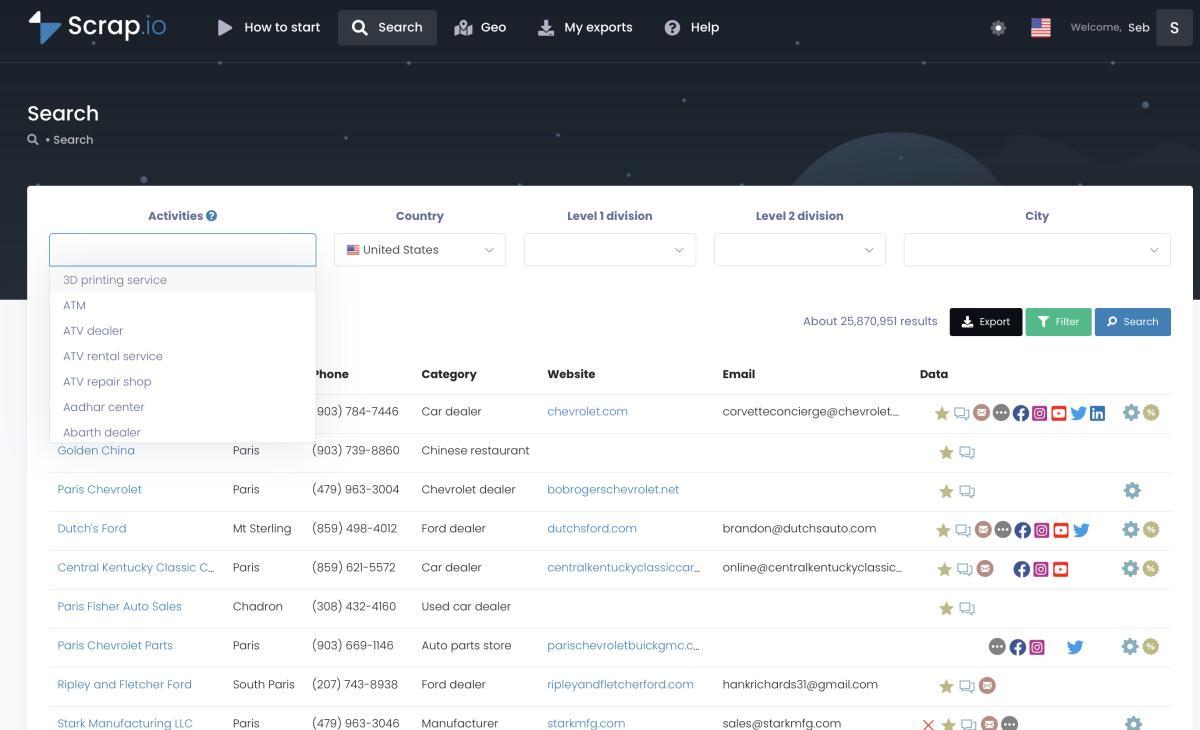
Scrap.io does one thing: Google Maps lead generation. No LinkedIn. No Amazon. Just Maps, 4,000+ categories, whole-country extraction, real-time data at the moment you export. Around 50,000 professionals use it, and the ratings back the focus up: 4.8 on Capterra, 4.9 on G2, 4.5 on Trustpilot.
Four things set it apart, and none of them are gimmicks.
First, scale without babysitting. Pick a category, pick a territory (up to an entire country on the Company plan) and export. A documented client pulled 11,734 businesses in 45 minutes. No zipcode URLs to stitch together.
Second, filtering before you pay. More on that below, because it's the argument that quietly wins the whole comparison.
Third, real-time freshness. Every export is extracted live from the listing and the associated website. No cached dataset going stale in a drawer.
And fourth, everything's included on every plan: all filters, all export columns, no feature gating. Want to see it move? Here's the two-click walkthrough.
Video: Scrap.io: How to Start
Feature-by-Feature Comparison
Want the two-minute version before the tables? We put both tools through a real head-to-head test on video.
Video: Is Lobstr.io the Best New Google Maps Scraper? I Tested It vs Scrap.io
Both tools scrape Google Maps without code. So why do power users end up with wildly different bills? Because the differences hide in four places nobody puts on a hero banner.
| Feature | Lobstr.io | Scrap.io |
|---|---|---|
| Country-level extraction | 1 search URL per zipcode, batched | 2 clicks, indexed database |
| Filtering | After extraction (Match Filters column) | Before extraction, free counts |
| Data freshness | Run-based, 7–28 day retention | Real-time at export, unlimited retention |
| Email verification | ✅ Native (~97% on valid) | ❌ (emails classified, not scored) |
| Email classification | Raw emails + status | ✅ Individual / sales / contact / marketing… |
| Phone type (mobile/fixed) | ❌ | ✅ (except US/Canada) |
| MCP for AI agents | SDK / CLI | ✅ Official MCP (Claude, ChatGPT, Gemini) |
| Make.com integration | ✅ | ✅ |
| Other platforms (LinkedIn, X…) | ✅ | ❌ Google Maps only |
Country-level scraping: zipcode URLs vs 2 clicks
This is differentiator number one, and it's bigger than it sounds.
Lobstr's "Smart Filters" generate one Google Maps search URL per zipcode, scrape each, then merge duplicates so you get full coverage of an area billed once. It's smart. It's also, fundamentally, a batch job: you're orchestrating runs across zip codes and waiting.
Scrap.io skips the whole choreography. Category + territory → export. Want every plumber in a country? Two clicks, no URL generation, no run queue. The video below shows a country-level pull start to finish.
Video: How to Scrape Local Leads at the Country Level
Filtering: before vs after extraction
Here's the one that quietly decides your budget.
On Lobstr, you extract first, then read a Match Filters column and a No Match Reasons column to see what stuck. You pay per unique row extracted. Then you find out which rows were worth it. (Geo-matching helps avoid billing out-of-area listings, to be fair.)
On Scrap.io, the order flips. You set filters (website present, email present, phone type, rating, review count, ad pixel, first-detection date) before a single credit moves. Then you count for free. Only matching leads consume credits. That's not a nicer UX. That's a different cost per contactable lead entirely.
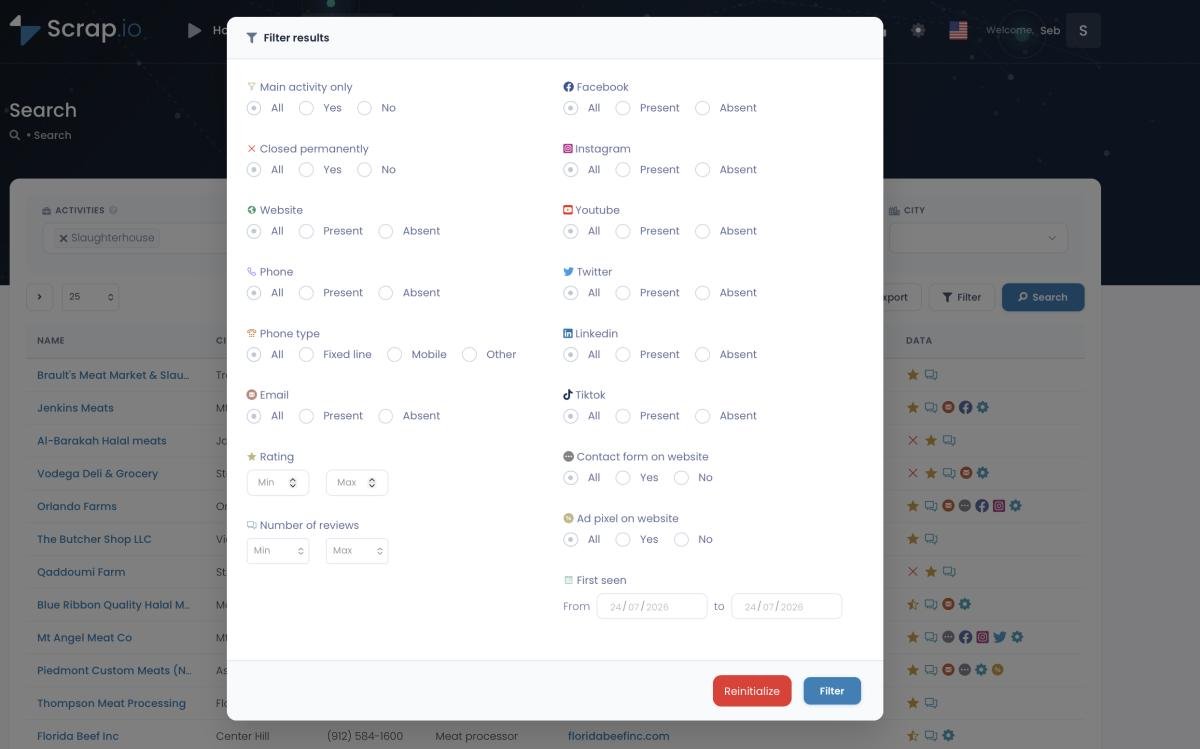
Curious how far the filtering goes versus other credit-based tools? Our OutScraper alternative breakdown runs the same test.
See how country-level extraction works. Pick a category, pick a country, and count your entire market for free before spending a credit. 225M+ businesses across 195 countries, no zipcode URLs required. Count your market on Scrap.io →
Data freshness: real-time vs run-based
Lobstr's data lives inside runs, and (per its own pricing FAQ) retention runs 7 to 28 days depending on plan. Miss the window, re-run it.
Scrap.io extracts live at export, straight from the listing and the website. Your file is yours, no size cap, all columns, every plan. Nothing expires in a drawer.
Emails, enrichment & integrations
Near-parity here, with real nuance on both sides. Lobstr wins on native email verification. That ~97% "valid" accuracy is a genuine plus for deliverability. Coverage is another story: SyncGTM found email hit-rates "typically under 20%" on Lobstr's LinkedIn scrapes, so the raw fill rate depends heavily on the source. As a google maps email extractor, Scrap.io wins on classification: it sorts each address into individual (with first and last name), contact, sales, marketing, finance, admin, so you know you're pitching sales@ and not info@.
Both plug into Make.com. And no, the MCP connector isn't a Lobstr exclusive. Scrap.io ships an official MCP server too (Claude, ChatGPT, Gemini), so an AI agent can build the search, apply filters, and pull results in plain English. Parity, honestly stated.
Pricing Compared: the Real Cost per Lead
"$0.5 per 1,000 leads" sounds unbeatable. In theory. In practice, the math is more interesting.
That headline rate is raw extraction, no emails, verified September 2026 on Lobstr's store page. It's real, and it's cheap. But it's the price of a row, not the price of a lead you can email. Lobstr's pricing page is a JavaScript simulator, so exact tiers shift; third-party reviews in 2026 peg entry plans around $25/mo for ~2,500 rows and $75/mo for ~10,000 (SyncGTM), while CazaLead's competitor comparison cites credit packs from ~€50/mo, with email enrichment chained through paid "squids." Treat those as directional and check the simulator on the day.
| Cost factor | Lobstr.io (credit packs) | Scrap.io (per lead) |
|---|---|---|
| Raw row | $0.5 / 1,000 (no email) | Included |
| Email extraction | Extra credits (billed if found) | Included |
| Email verification | Extra credits | n/a (classified, not scored) |
| Rows without site/email you still pay | Yes (filter after) | No (filter before) |
| Entry plan | ~$25/mo (per third-party, 2026) | $35/mo, 10,000 credits, all included |
| Free counts before paying | ❌ | ✅ Unlimited |
So run the real math. Add email extraction credits, add verification, and (here's the part nobody advertises) add the businesses with no website and no email that you paid to extract before you could filter them out. Suddenly "$0.5 per 1,000" describes almost none of the leads you'll actually contact.
Scrap.io's angle is simpler: one credit = one exported business, everything enriched, and you only spend it on rows that already passed your filters. Ratings, review counts, unlimited free counts before you commit a cent. For a deeper look at why the pricing model matters more than the sticker, see execution-time vs lead-based pricing.
Run the math yourself. On Scrap.io, count exactly how many contactable leads your market holds, unlimited free counts, before you spend a single credit. No simulator guesswork. Get your free count →
When Lobstr.io Is the Better Choice
I'll be honest with you: if you need LinkedIn, Twitter/X and Vinted data in the same dashboard, Scrap.io can't help you. At all.
That's Lobstr's home turf. It's a multi-platform suite, and if your prospecting spans several sources (Sales Navigator today, Google Maps tomorrow, a marketplace next week), one tool covering all of them beats juggling three. Lobstr is the better pick when:
- You scrape beyond Google Maps and want a single subscription for it.
- Native email verification (that ~97% accuracy on valid) is non-negotiable for your deliverability.
- You want the absolute lowest entry ticket and don't mind cleaning raw data.
- You're testing the waters. The permanent free plan works, as long as you accept its 30-rows-per-export cap and no scheduling.
- You're comfortable running batch jobs and living with 7–28 day retention.
And its reputation holds up. 30+ Capterra reviews back the no-code experience. No shade. It's a good tool being good at its thing. For the multi-platform generalists, we've also stacked up Bright Data, Octoparse and Lead Atlas against Scrap.io if you want the wider field.
When Scrap.io Is the Better Choice
What happens when you need every plumber in Texas, with an email, by Friday?
That's the scenario Scrap.io was built for. Google Maps, at scale, filtered to contactable, real-time, no code. If your job is local lead generation and Maps is the well you're drawing from, the specialist wins on coverage, on cost per useful lead, and on the sheer absence of run-babysitting.
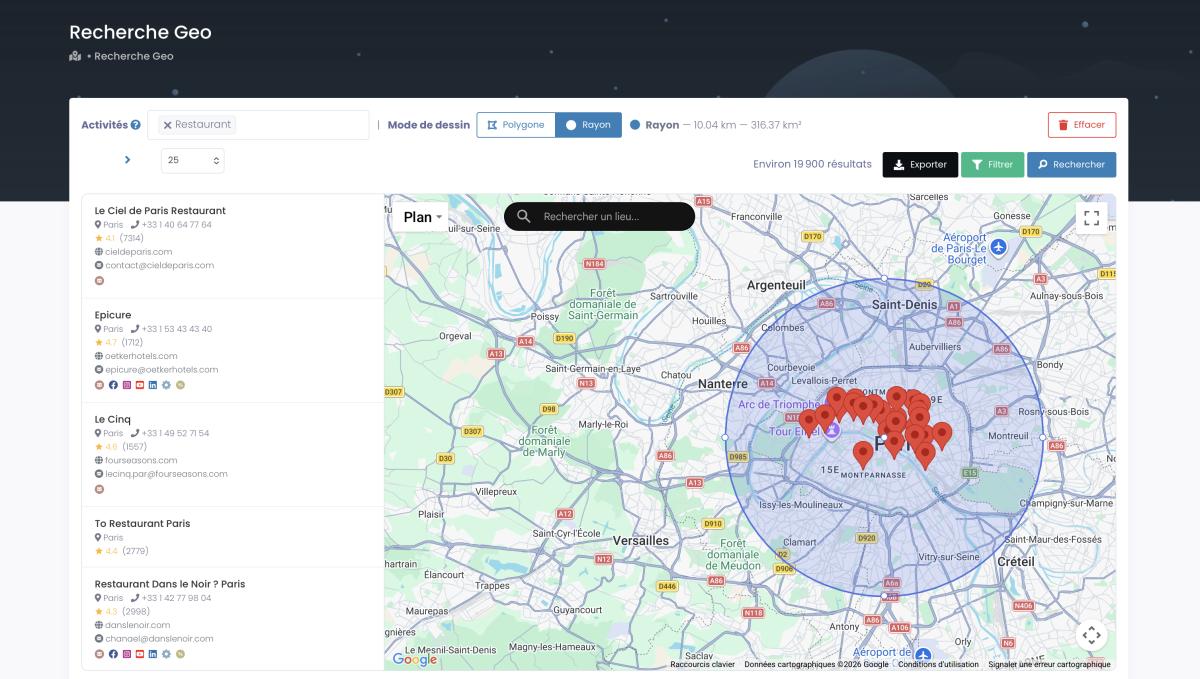
GeoSearch seals it for territory work: draw a radius around a point or a custom polygon around a district, and only businesses inside the shape get pulled. One of our clients did the manual version of Maps lead-hunting for weeks before switching, copy-pasting listings into a spreadsheet by hand. Painful. Don't be that person. Want proof of what a clean export looks like? Here's a real Scrap.io demo file. And if you're weighing another pay-per-row specialist, our LiveScraper alternative comparison runs the same honest math.
Try Scrap.io free for 7 days: 100 leads included. Pick a category, pick a country, filter to contactable, export. Real-time data, no code, unlimited free counts. Your Friday deadline just got easier. Start your free trial →
Don't Confuse Lobstr.io with LOBSTR Wallet
Quick sanity check. If you were looking for the Stellar crypto wallet, that's LOBSTR (lobstr.co), a completely different product, a Stellar/XRP wallet, no relation.
Lobstr.io (with the ".io") is the French no-code web scraping SaaS we've been comparing here. Same-sounding name, opposite universes.
This mix-up is why searching "lobstr io alternative reddit" is such a mess. Half the threads are people asking whether their Stellar wallet is down. If you landed here from that rabbit hole: you're in the right place now. Now you'll never fat-finger the wrong signup again.
FAQ
Is Lobstr.io good for Google Maps scraping?
Yes, genuinely. No-code, 87 data attributes, native email verification, low entry price. The weak spots: you pay per extracted row and filter afterward, coverage runs as batch jobs instead of a real-time query, and data retention caps at 7–28 days. Good tool. Just know the model before you scale.
What is the difference between Lobstr.io and Scrap.io?
Lobstr.io is a multi-platform scraping suite (Google Maps, Sales Navigator, Twitter/X and more) built around credit packs and scheduled runs. Scrap.io is a Google Maps specialist: 195 countries indexed, filter-before-export, whole-country extraction in two clicks, real-time data. Breadth versus depth.
Is Lobstr.io the same as LOBSTR wallet?
No. LOBSTR (lobstr.co) is a Stellar/XRP crypto wallet. Lobstr.io is a French no-code web scraping platform. Completely unrelated companies that happen to share a name.
How much does Lobstr.io cost per lead?
Base extraction is advertised at $0.5 per 1,000 leads (September 2026, without email extraction). Third-party reviews put credit-pack plans around $25–$75/mo. Email finding and verification consume extra credits. Compare on cost per contactable lead, not per raw row. That's where the real number hides.
Is scraping Google Maps legal?
It relies on public business data, and both vendors agree it's fine: Lobstr cites article L342-3 CPI in France, and Scrap.io is GDPR- and CCPA-compliant with every data point traceable to its source. B2B prospecting on public listings is legal in most jurisdictions; standard email rules (CAN-SPAM, unsubscribe) still apply. For deeper reading on the multi-tool landscape, see our SerpApi vs Scrap.io comparison.
The Verdict
Two French tools. One question: what are you actually scraping?
If it's a mix of platforms on a shoestring, Lobstr.io is a smart, honest buy, and we'd rather tell you that than pretend otherwise. But if Google Maps is the job, and you want contactable leads across a whole country without paying for the rows you'll delete, the specialist takes it. Filter before you pay. Data fresh at export. Two clicks, not a batch queue.
Export your first 100 leads free. No code, 2 clicks, real-time data across 225M+ businesses in 195 countries. See the cost-per-contactable-lead difference for yourself. Try Scrap.io free for 7 days →
Generate a list of restaurant with Scrap.io