

Lead Atlas isn't one product. Three separate tools use the name: leadatlas.io, a Google Maps scraper built for agencies; leadatlasapp.com, a city and ZIP code lead finder; and leadatlas.net, a US and Canada prospect list builder. Six unrelated companies share the name too. Only two of the three export email addresses.
Table of contents
- Wait, which Lead Atlas? A 60-second disambiguation
- The three Lead Atlas tools, side by side
- What each one actually exports (this is where it breaks)
- Lead Atlas pricing in 2026: the real cost per lead
- Where all three hit the same wall
- The trust gap: zero third-party reviews, anywhere
- The Lead Atlas alternative: what changes at country scale
- How to choose: a decision framework
- Is scraping Google Maps legal in 2026?
- FAQ
You searched "Lead Atlas." Google handed you nine results, seven companies, one UK corporate registry filing, and an Instagram account in Louisville, Kentucky. Exactly three of them are software you can actually buy.
That's not a search results page. That's a pile-up.
And the strangest part: the one tool of the three that markets itself explicitly as a Google Maps scraper doesn't even rank in the top ten for its own brand name. Meanwhile a dissolved British holding company does.
So here's what we did. We opened all three, read the pricing pages, listed the data fields each one publishes, and normalized everything to a single number — cost per lead. Prices verified July 20, 2026. By the end of this you'll know which Lead Atlas you were looking for, what it exports, what it costs, and where all three of them run out of road.
Wait, Which Lead Atlas? A 60-Second Disambiguation
Before we compare anything: are you even looking at the right company?
Here's the full top ten for lead atlas in the US, pulled July 20, 2026. Three tools. Six things that aren't tools. One AI Overview block that Google is clearly serving because it doesn't know either.
| Rank | Domain | What it actually is |
|---|---|---|
| 1 | leadatlasapp.com | 🟢 Tool — local leads by city, ZIP and industry |
| 2 | atlasleads.io | 🔴 Agency — "Atlas Digital", AI-driven B2B lead gen |
| — | AI Overview | ⚠️ AI block served (async) |
| 3 | Companies House GOV.UK | 🔴 Registry — LEAD ATLAS LTD (no. 15146623) |
| 4 | leadatlasai.com | 🔴 Agency — websites and AI assistants for small business |
| 5 | LinkedIn — Atlas Digital USA | 🔴 Company page |
| 6 | leadatlas.net | 🟢 Tool — US/Canada prospect list builder |
| 7 | Instagram @leadatlas | 🔴 Home services lead gen, Louisville KY |
| 8 | go-atlas.io | 🔴 Online arbitrage lists for Amazon sellers |
| 9 | leadatlas.ai | 🔴 Property intelligence for contractors |
The three that are actually tools
Two of them are on that list. The third isn't.
leadatlasapp.com— finds local business leads by city, ZIP code and industry. Sells credits that never expire.leadatlas.net— builds prospect lists for local outreach, US and Canada only, with an AI website audit attached to each record.leadatlas.io— a Google Maps lead scraper based in Brașov, Romania. It's the most on-topic of the three for Maps data, and it doesn't rank in the top ten for its own name. Which tells you something about how much SEO effort went into any of this.
So if you're asking which Lead Atlas is the real one — none of them, and all of them. There's no parent company. They're three unconnected products that happened to pick the same two words.
The six that aren't (and why they still outrank the tools)
Quick pass, no judgment, just so you can rule them out:
- atlasleads.io — Atlas Digital, a B2B lead gen agency. A service, not software.
- LEAD ATLAS LTD — a UK-registered company, number 15146623, since dissolved. It ranks third because Companies House has enormous domain authority and Google has nothing better to serve.
leadatlasai.com— websites and AI assistants for small businesses.- @leadatlas on Instagram — home services lead gen out of Louisville, Kentucky.
go-atlas.io— online arbitrage sourcing lists for Amazon sellers. Completely unrelated category.- leadatlas.ai — property intelligence for building trades.
Why do the non-tools outrank the tools? Because agencies and registries accumulate links and social signals as a side effect of existing, while three small SaaS products fight over an exact-match brand term none of them owns. Nobody wins. Google shrugs and serves an AI Overview.
There's a commercial irony buried in that. The brand term itself is barely searched, while the category term next door — google maps scraper — pulls 1,600 US searches a month at an $8.80 CPC (DataForSEO, July 2026). Three companies are competing for a name nobody types, in a category plenty of people do.
The Three Lead Atlas Tools, Side by Side
Same name, three completely different products, three completely different buyers. Only one of them is really a Google Maps scraper.
leadatlas.io |
leadatlasapp.com |
leadatlas.net |
|
|---|---|---|---|
| Positioning | "Google Maps Lead Scraper for Agencies & Freelancers" | "Find Local Business Leads by City, ZIP Code, and Industry" | "Prospect List Builder for Local Outreach" |
| Target buyer | Agencies, freelancers | SDRs, anyone comparing to Apollo / Lusha / ZoomInfo | Web and design freelancers |
| Based in | Brașov, Romania | Turkey (WhatsApp +90) | Not published |
| Geography | City / search-based | City and ZIP | 🔴 US and Canada only |
| Model | 🟢 One-time credits, never expire | 🟢 One-time credits, never expire | 🔴 Monthly subscription with quota |
| Signature feature | Maps-native extraction | Widest field set of the three | AI website audit report per lead |
| Free tier | ❌ None | ✅ 40 credits on signup | ✅ 14-day trial, 50 leads |
A note on leadatlas.net, the odd one out: it isn't really competing with the other two. It finds businesses with an outdated or missing website and hands you an audit you can paste into a pitch. That's a web agency product wearing a lead gen coat. Useful if that's your business. Irrelevant if it isn't.
And leadatlasapp.com — the one you'll find first if you go looking for a lead atlas app review — is the closest thing here to a general purpose best tool to find local business leads by zip code. Longest published field list of the three. Whether those fields are actually populated is a separate question, and we'll get to it.
If you'd rather skip the brand-name detour entirely, we ranked the 10 best Google Maps scrapers we tested — that's the wider field, tested and priced.
What Each One Actually Exports (This Is Where It Breaks)
The tool that markets itself hardest as a "Google Maps lead scraper" is the only one of the three that doesn't give you an email address.
Not buried in a footnote. It's right there in the published field list on leadatlas.io's pricing page, verbatim: "Business name, address, phone number, website, rating, and total reviews."
That's it. No email.
| Data field | leadatlas.io |
leadatlasapp.com |
leadatlas.net |
|---|---|---|---|
| ❌ | ✅ when available | ✅ when available | |
| Business name | ✅ | ✅ | ✅ |
| Address | ✅ | ✅ | ✅ |
| Phone | ✅ | ✅ | ✅ |
| Website | ✅ | ✅ | ✅ |
| Rating & review count | ✅ | ✅ | — |
| Social profiles | ❌ | ✅ IG, FB, LinkedIn, X | ✅ |
| Hours, price range, popular times | ❌ | ✅ | — |
| Website audit report | ❌ | ❌ | ✅ AI-generated |
So the honest answer to does Lead Atlas export emails is: two out of three do. Pick wrong and you've bought a phone list. If cold email is your channel, leadatlas.io is structurally unusable for you — not bad, not overpriced, just built for a different job. That's the whole leadatlas.io vs leadatlasapp.com decision in one line.
The "when available" asterisk nobody quantifies
Both of the other two say emails are included "when available." Fine. But what does available actually mean, as a number?
Nobody in this category publishes it. So here's ours, pulled live from Scrap.io on July 20, 2026: of 661,667 restaurants in the United States, only 193,907 have a detectable email address. That's 29.3%.
Seven records in ten with no email. That's the real weight behind "when available," and it's the single most expensive thing nobody tells you before you buy credits. Because you pay for all ten.
(While we're at it, from the same pull: 220,472 US restaurants — 33.3% — have no website at all. If you sell web design, that's not a gap, that's your entire pipeline.)
Worth knowing how the extraction itself works before you judge any vendor on it — we broke down the method in how to find emails on Google Maps. Short version: Maps listings don't display emails. To extract business emails from Google Maps, a tool has to visit the linked website and parse it. Tools that skip that step can't have emails, no matter what the landing page implies.
💡 Curious what real email coverage looks like in your niche, not in restaurants? Run a count on Scrap.io — counting results is free and spends zero credits, in the app, via the API, or through the MCP connector. Look before you buy anything, from anyone.
Lead Atlas Pricing in 2026: The Real Cost Per Lead
Same three-word product category. The cheapest entry plan costs $0.030 per lead. The most expensive costs $0.98. That's a 33x spread — for tools that describe themselves in nearly identical language.
| Tool | Entry plan | Leads included | Cost per lead | Email? | Model |
|---|---|---|---|---|---|
leadatlas.net | $49/mo | 50 | $0.98 | ✅ | 🔴 Subscription |
leadatlas.io | $15 one-time | 200 | $0.075 | ❌ | 🟢 Credits |
leadatlasapp.com | $9 one-time | 300 | $0.030 | ✅ | 🟢 Credits |
| Scrap.io | $35/mo (annual) | 10,000 | $0.0035 | ✅ | 🟡 Subscription |
Full ladders, if you want them: leadatlas.io runs $15 / 200, $30 / 500, $125 / 2,000. leadatlasapp.com runs $9 / 300, $29 / 1,500, $59 / 3,750, with a launch offer live at time of writing. leadatlas.net runs $49 / 50 leads, $99 / 200, $199 / 500 — monthly, and the quota resets rather than accumulates.
Now the part that makes the table above a little bit of a lie.
These models aren't directly comparable and pretending otherwise would be dishonest. The credits at leadatlas.io and leadatlasapp.com never expire — buy once, use them whenever. Ours reset every month. So if you need 300 leads, once, and then you're done? leadatlasapp.com at $9 is objectively the cheaper choice. Take it.
The subscription only wins when prospecting is recurring. At 10,000 leads a month, $35 versus $0.030 each isn't close — buying 10,000 leads from leadatlasapp.com at Scale tier pricing lands somewhere around $160.
💡 One more thing about how much a Google Maps lead costs: the number is meaningless until you subtract the unusable records. A $0.030 lead with no email costs infinity if email is your channel. Same for the 33% of listings with no website when your pitch is a website. Calculate cost per usable lead and half the market reprices itself instantly. That's how you find the cheapest Google Maps scraper per lead for real, rather than on a pricing page.
Free tiers, compared
If you're hunting for Lead Atlas free credits or just a Google Maps scraper free option to test with, here's the state of play:
leadatlasapp.com— 40 free credits on signup, first account only.leadatlas.net— 14-day trial with 50 leads, no card required.leadatlas.io— no free tier at all. You can register without a card, but you get zero credits.- Scrap.io — 7-day free trial: 50 searches and 100 export credits.
Where All Three Hit the Same Wall
Say you sell POS systems and your territory is "the United States." You open any of the three, and you're typing city names. Then more city names. There are roughly 19,000 incorporated places in the US.
Good luck.
This is the ceiling every one of them shares: search happens city by city, or ZIP by ZIP. None of the three offers a state, a region, or a country as a search unit. And leadatlas.net narrows it further — US and Canada, nothing else. If your market includes Mexico, or the UK, or anywhere in the EU, that tool is out before the conversation starts.
Video: How to Scrape Local Leads at the Country Level
Why "by city" pricing hides the real cost
Per-city search sounds harmless. It's an operational tax that nobody prices.
Forty markets means forty searches, forty exports, forty CSVs, and then a dedupe pass because chain locations and metro overlaps will duplicate records across your files. That's an afternoon, minimum, every single refresh cycle. Multiply by however often your data goes stale.
Any Google Maps lead scraper for agencies that can't handle a state in one query is quietly billing you in hours instead of dollars. We put real numbers on that trade-off in DIY vs professional Google Maps scrapers.
The 60-result cap problem (and where else you'll meet it)
There's a second ceiling, and it's sneakier because it doesn't announce itself: result caps per query. You search, you get a few dozen rows, and you assume that's the market. It isn't — it's the cap.
The most-discussed example right now is the Clay Google Maps scraper source, which returns a hard 60 results per query. Plenty of teams built entire territory plans on top of that number without realizing it was a limit and not a count. We wrote up Clay's 60-result Google Maps cap and how to route around it.
Video: Clay's Google Maps Source is Broken. Here's the Fix
The Trust Gap: Zero Third-Party Reviews, Anywhere
Here's a due-diligence exercise that takes ninety seconds and saves you a bad purchase: go look for a single independent review of any of these three tools. There isn't one.
We checked on July 20, 2026. No G2 listing. No Capterra listing. No Trustpilot page. Not for leadatlas.io, not for leadatlasapp.com, not for leadatlas.net. Zero, across all three platforms, for all three products.
Reddit, same story — no threads, no mentions, nothing in r/sales or r/agency. For a category where people complain loudly and constantly about data quality, total silence is its own data point. So when someone asks is Lead Atlas legit, the honest answer isn't yes or no. It's: there is currently no third-party evidence either way, and that's unusual.
One more verifiable detail, and we're going to be careful with how we phrase it. The three customer testimonials on the leadatlas.net homepage — attributed to "Sarah Chen," "Marcus Rodriguez" and "Emily Johnson" — use stock photographs. The Unsplash image URLs are visible in the page source (images.unsplash.com/photo-1494790108755-2616b612b786, photo-1472099645785-5658abf4ff4e, photo-1438761681033-6461ffad8d80).
That doesn't automatically mean the testimonials are fabricated — plenty of companies use stock photos for privacy reasons, and it's a common template default. But it does mean you can't use them as evidence. Which, when there's no third-party review to fall back on, leaves you with nothing to verify.
A three-point due-diligence checklist before you buy any lead tool
- Search the brand on G2, Capterra and Trustpilot. Not for a perfect score — just for existence. A tool with a real customer base eventually collects reviews, positive or otherwise.
- Reverse-image-search one testimonial photo. Ten seconds. Tells you whether the social proof is proof.
- Buy the smallest tier and check the file yourself. Count the populated email cells. That single number tells you more than any feature list.
The Lead Atlas Alternative: What Changes When a Google Maps Scraper Works at Country Scale
25,829,046 businesses in the United States. Not an estimate — a live count, pulled the day this article was written, in about four seconds.
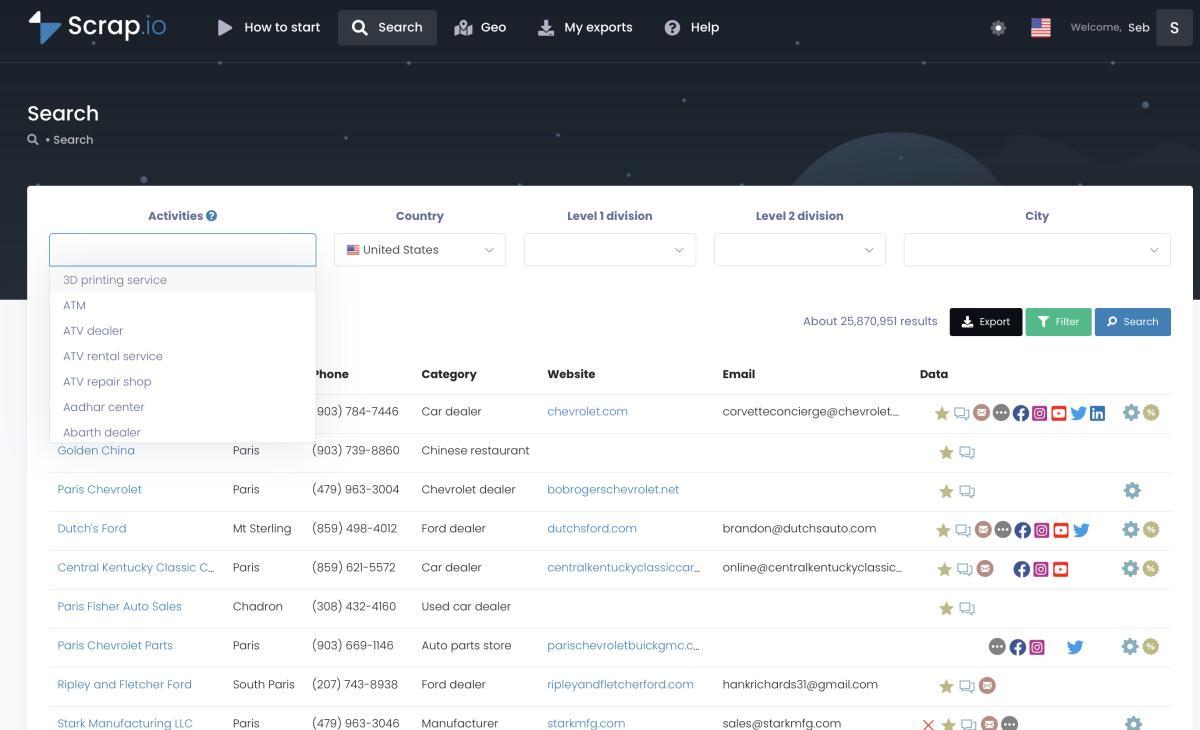
The short version, if you're comparing lead atlas vs Scrap.io: it's a Google Maps scraper that searches by city, county, state or entire country across 195 countries and 4,000+ categories, filters before it spends credits, and re-extracts data at export time rather than serving it from a stored database. Three things, each answering a ceiling we just demonstrated.
1. The geographic ceiling. Where all three Lead Atlas tools work city by city, the search unit here goes up to a whole country. 225,676,406 listings indexed across 195 countries. That's what it means to scrape an entire country from Google Maps without building a queue of 19,000 city queries. For an agency running multiple territories, this is usually the whole reason to switch — it's the practical definition of a Lead Atlas alternative for agencies.
2. The email problem. Remember the 29.3%? Filters apply before credits are consumed. Set "has email" and you never pay for the seven records in ten that don't. On US restaurants, that's the difference between paying for 661,667 listings and paying for 193,907.
3. The unit cost. 10,000 credits at $35/month works out to $0.0035 per lead. Against the $0.98 entry plan, that's a 280x gap. Against the $0.030 one, roughly 9x — and again, only if you're buying at volume.
Filtering before extraction — why it changes your unit economics
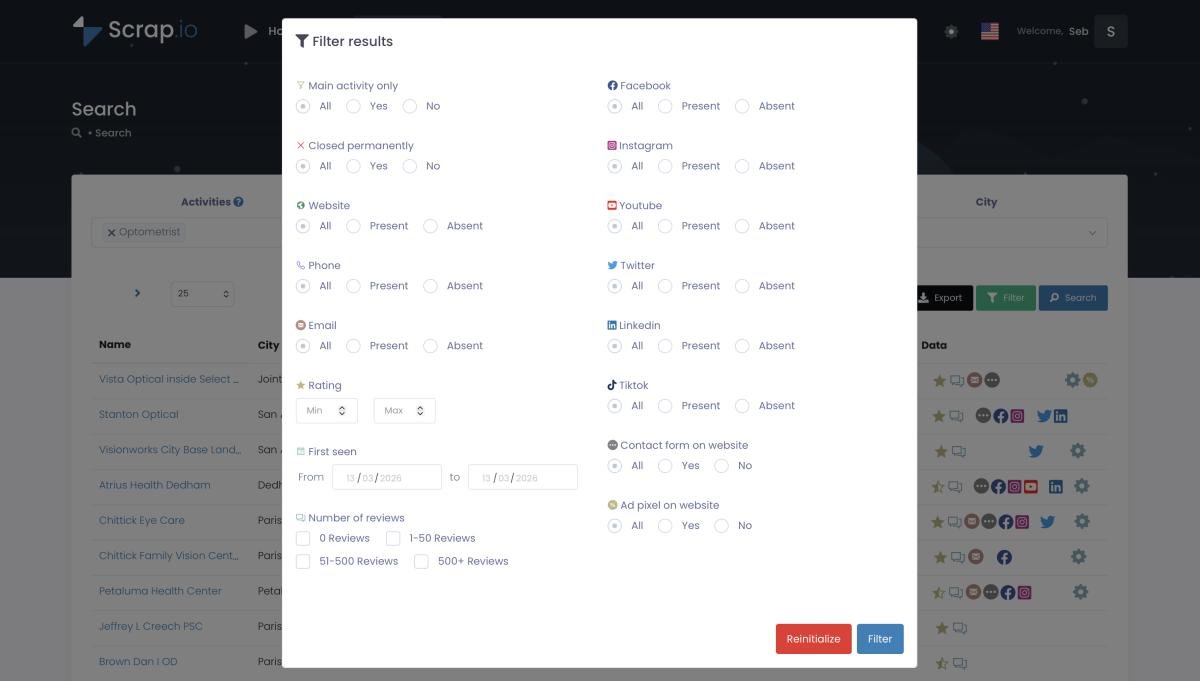
Every tool has filters. The question is when they run.
Filter after extraction and you've already paid for the rows you're about to delete. Filter before, and your credits only touch records that match. Has email, has no website, mobile number only, minimum rating, minimum review count, ad pixel present, contact form present, first seen in the last 90 days — pick your combination, then spend. Every filter is available on every plan, which is not something most of this category can say.
Want to see the actual output before committing to anything? There's a demo export file and the full documentation. Open the CSV, look at the columns, judge for yourself.
Searching a whole area without picking a category
Here's a capability none of the three Lead Atlas tools offer at all: searching a zone without specifying a business type.
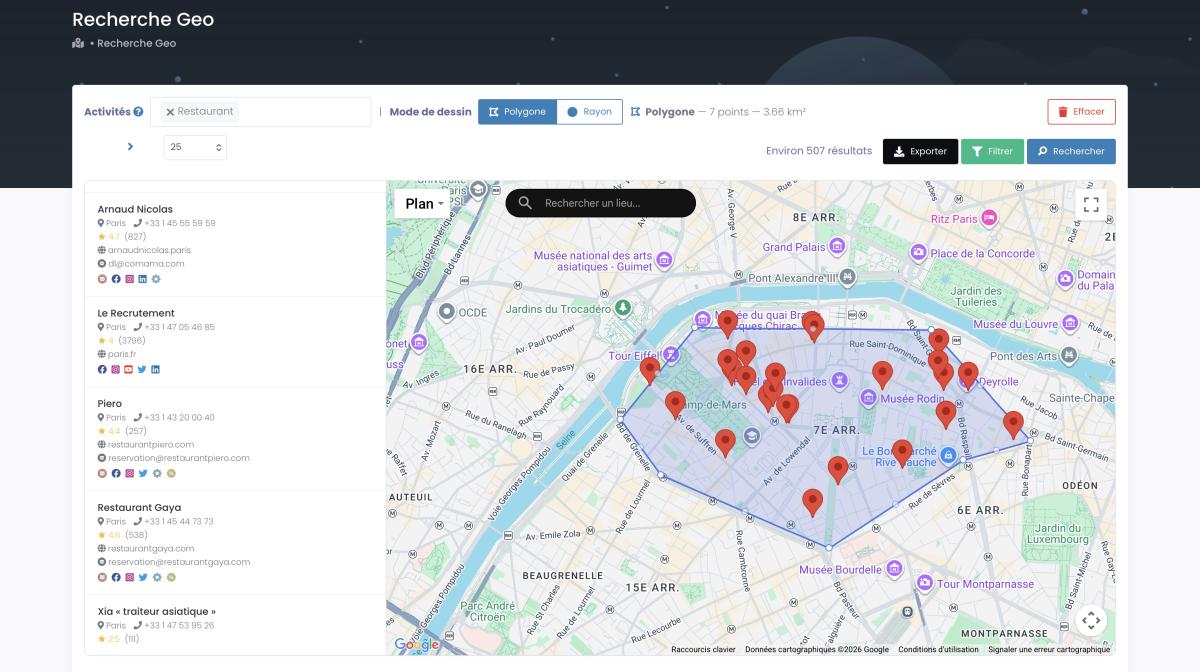
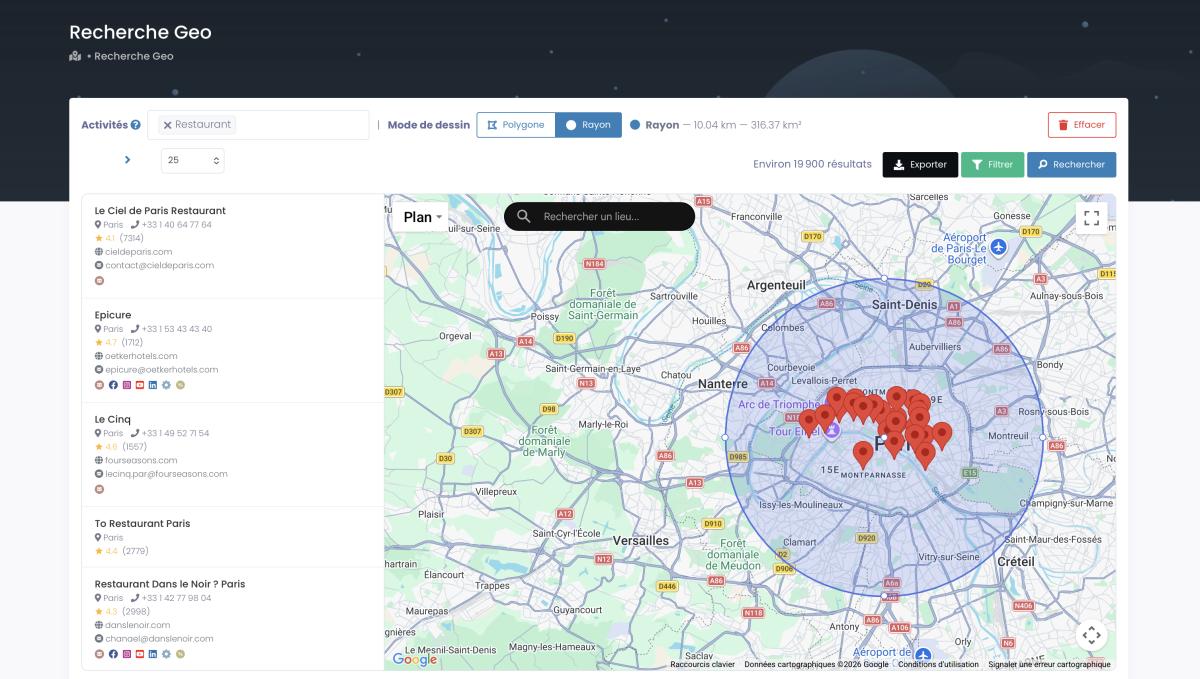
Every business in a city, county or country — no category filter. You get an economic map of a territory rather than a list of restaurants. Handy for market sizing, or for figuring out what's actually there before deciding what to sell into it. Add radius search (up to 500 km) or a hand-drawn polygon and you can target a single neighborhood, or an industrial corridor that matches no administrative boundary at all.
Video: Scrap.io - How to Start?
🚀 Free trial: 7 days, 50 searches, 100 export credits. Pull your first city, open the CSV, and compare it line by line to whatever Lead Atlas gave you. Real-time data across 225M+ listings in 195 countries, rated 4.8 on Capterra and 4.9 on G2 by 50,000+ users. Start your free trial →
How to Choose: A Decision Framework
Forget brand names for a second. Answer three questions and the choice makes itself.
If you just need one city, once
Buy leadatlasapp.com at $9. Seriously. 300 credits that never expire, emails included, no subscription to remember to cancel. For a single campaign in a single market, nothing here beats it on price and we're not going to pretend otherwise. Spend the $9, get your list, move on with your life.
If you're running cold email at any volume
Rule out leadatlas.io immediately — no email field, full stop. Then do the arithmetic on usable records rather than raw ones. At any recurring volume, the per-lead gap between one-time credits and a 10,000-credit monthly plan stops being close, and pre-extraction filtering stops being a nice-to-have.
If your territory is a state, a country, or several
None of the three will work, and you'll discover that around city number twelve. This is the cleanest break point in the entire comparison. County, state and country-level search, or an afternoon of manual queries every refresh. Pick one.
If you'd rather build it yourself
Legitimate option, and cheaper on paper. Go read our guide to open-source Google Maps scrapers on GitHub before you commit — the Google Maps scraper GitHub projects are genuinely good, but you inherit proxies, rate limits, CAPTCHAs and DOM changes that break on a Friday afternoon. If you just want emails visible while browsing Maps manually, there's a free Chrome extension for that — a Google Maps scraper extension is the right shape for small, occasional lookups and the wrong shape for anything at volume.
Is Scraping Google Maps Legal in 2026?
Every tool on this page claims compliance in a single line and moves on. That line is doing a lot of work.
The distinction that matters is public business data versus personal data. A company's name, address, phone number and generic contact address are business information. An identified individual's name and personal email is something else, and it's where GDPR and CCPA actually bite. B2B prospecting in the EU generally runs on the legitimate interest basis — which is real, and also conditional: you need an opt-out on every message and you should be contacting professional roles, not private inboxes.
Collection of public business data is broadly lawful. Usage is where the obligations live. Scrap.io extracts publicly available business data only, is GDPR and CCPA compliant, and every field is traceable back to its source — which matters more than it sounds when someone asks where a record came from.
Full breakdown here: is it legal to scrape Google Maps? (Factual information, not legal advice. If real money is on the line, talk to an actual lawyer.)
FAQ
Which Lead Atlas is the real one?
There isn't one "real" Lead Atlas. Three separate software products use the name: leadatlas.io (a Google Maps scraper based in Romania), leadatlasapp.com (a city and ZIP code lead finder), and leadatlas.net (a US/Canada prospect list builder with website audits). Six other unrelated companies and one UK-registered entity also share the name.
Does Lead Atlas give you email addresses?
It depends which one. leadatlasapp.com and leadatlas.net both include email addresses when available. leadatlas.io does not — its published data fields are business name, address, phone, website, rating and review count only. If your outreach channel is email, that matters.
How much does Lead Atlas cost in 2026?
Entry plans range from $9 to $49. leadatlasapp.com starts at $9 for 300 credits ($0.030/lead), leadatlas.io at $15 for 200 credits ($0.075/lead), and leadatlas.net at $49/month for 50 leads ($0.98/lead). The first two sell credits that never expire; the third is a monthly subscription.
Is Lead Atlas free?
None of the three is free, but two offer free starting credits: leadatlasapp.com gives 40 free credits on your first account, and leadatlas.net offers a 14-day trial with 50 leads and no card required. leadatlas.io has no free tier.
What's the best Lead Atlas alternative for large territories?
All three Lead Atlas tools search city by city or ZIP by ZIP. If your territory is a state, a country, or several countries, you'll hit that ceiling fast. Scrap.io searches at city, county, state or country level across 195 countries — 25,829,046 US business listings as of July 2026 — and applies filters before spending credits.
The Bottom Line
Three things to take away:
- Identify which Lead Atlas you're actually looking at before you compare anything. Use the domain, never the brand name —
leadatlas.io,leadatlasapp.com,leadatlas.netare three unrelated products. - Check the email field before you check the price. One of the three doesn't have one, and no discount fixes a missing column.
- Match the tool to your territory. One city once? The $9 option wins. A state or a country, on repeat? None of the three reaches that far.
Whichever you pick, pick it for a reason — not because it was the first "Lead Atlas" Google happened to show you. That search results page is a mess, and it isn't going to sort itself out for you.
And if you want the wider picture on sourcing local prospects, we covered the whole method in how to get local business leads with contact info.
🌍 If that reason is coverage, Scrap.io covers 195 countries and 4,000+ categories, with filters applied before a single credit is spent. Start free for 7 days — 50 searches and 100 export credits, cancel anytime.
Generate a list of restaurant with Scrap.io