

- What Is a NAICS Code (and Why You Can't Just Look It Up)
- Method 1: NAICS Association US Company Lookup Tool
- Method 2: U.S. Census Bureau NAICS Search
- Method 3: SAM.gov Entity Search
- Method 4: Business & Library Research Databases
- Method 5: AI & Web-Based Lookup Tools
- Which Method Should You Use?
- From One NAICS Code to a Full Prospect List
- NAICS Lookup: Common Mistakes to Avoid
- FAQ
Here's a thing nobody warns you about. You go looking for one company's NAICS code, figuring it'll take thirty seconds, and forty minutes later you're six tabs deep in a government database arguing with yourself about whether a bakery counts as "retail" or "manufacturing." Been there. More than once.
There are more than 1,000 six-digit NAICS industries in the US, and businesses pick their own code (U.S. Census Bureau). That's exactly why a plain name lookup is harder than it sounds. There's no master phonebook that maps "Joe's Plumbing" to a tidy number. You have to go find it.
So let's skip the runaround. To do a NAICS code lookup by company name, start with the NAICS Association US Company Lookup Tool, which searches by name directly. If the company isn't listed, check SAM.gov for federally registered firms, or search the company's main activity on the U.S. Census Bureau NAICS tool. All five methods below are free, and the last one handles the question every other guide forgets: what to do once you actually have the code.
What Is a NAICS Code (and Why You Can't Just Look It Up)
NAICS stands for the North American Industry Classification System. It's a six-digit number that describes what a business does, used across tax forms, loan applications, grant paperwork, and government contracting. The US, Canada, and Mexico built it together under NAFTA, and it officially replaced the older SIC system in 1997 (U.S. Census Bureau).
The structure reads like a zoom lens. The first two digits are the broad sector. Each extra digit narrows it down, until the full six digits land on a single national industry.
Take 541511. The 54 means Professional, Scientific & Technical Services. By the time you reach 541511, you're looking at Custom Computer Programming Services specifically. Same first two digits, wildly different businesses underneath.
And here's the catch that trips everyone up: codes are self-assigned. A business picks the code that matches its primary revenue activity. Nobody from the government hands you one. So "how to determine NAICS code" for another company isn't a database query, it's detective work, because that company made a judgment call about itself and you're trying to reverse-engineer it. The current version in effect is NAICS 2022, and the system gets revised every five years, with the next update due in 2027 (U.S. Census Bureau). The 2022 revision alone changed more than 100 codes, mostly across Retail (sectors 44-45) and Information (sector 51).
NAICS vs SIC Codes
Quick disambiguation, because tools often return both. SIC codes came first, back in 1937, and they're four digits. NAICS arrived in 1997 with six digits and more granularity. Some federal agencies and older databases still run on SIC, which is why a decent lookup tool shows you the NAICS and SIC codes side by side. Short version: if you see a four-digit code, it's SIC; six digits, NAICS.
Method 1: NAICS Association US Company Lookup Tool
If you only try one tool, try this one first.
It searches by company name directly, which is the whole reason you landed on this page.
The NAICS Association company lookup tool lets you type in a business name (or name plus zip, or name plus address to break ties between companies that share a name). It returns the matched firm with its NAICS and SIC codes and descriptions. This is the closest thing there is to a free NAICS code lookup by company name that actually works from the name alone.
How to run it:
- Go to the NAICS Association US Company Lookup Tool.
- Pick a search method. "Company/Zip" or "Company/Address" are the ones that take a name.
- Type the company name, add the zip or state if the name is common, and search.
- Read off the primary NAICS code (six digits) plus any SIC codes listed.
The honest caveat: the free search surfaces the match, but the company runs on selling data, and pulling a full detailed record prompts a paid option (around $9.95 for a single record). For most people who just need the six-digit code, the free result does the job. For a private mom-and-pop shop that isn't in their database, though, you'll come up empty. That's when you move to Method 2.
Method 2: U.S. Census Bureau NAICS Search
What do you do when the company-name search comes back empty? You go to the source.
The U.S. Census Bureau NAICS Search is the official home of the classification. It doesn't search by company name, though. It searches by activity. You type a keyword that describes what the business does ("landscaping," "custom software," "coffee shop"), and it returns the matching codes with their full descriptions. You can also browse the whole tree from sector down to national industry.
So the workflow flips. The whole trick to how to find a company's NAICS code this way is simple: instead of "find NAICS code by company name," you figure out the company's main activity first, then search that. Look at their website, their Google listing, their tagline. A firm that says "we build custom dashboards for hospitals" is writing software, not providing healthcare. Search the activity, not the client.
This is also the authoritative move for "what is my NAICS code" when the business is your own. You know your primary revenue activity better than anyone, so you type it in, grab the six-digit code, and you're done. It's also the real answer to "how to get a NAICS code" for a brand-new small business: there's no application and nobody assigns you one, you just find the code that fits and start using it. If you'd rather find your NAICS code online somewhere friendlier, plenty of state portals (New York's NAICS lookup, for one) just redirect you here anyway.
Want the full list of NAICS codes and descriptions, or the complete 6-digit NAICS code list for a sector? This is where it lives, no middleman.
Method 3: SAM.gov Entity Search
The most reliable code often isn't on the company's website at all. It's buried in a federal database.
Any business that wants to work with the US government has to register on SAM.gov, the System for Award Management. And part of that registration is declaring its NAICS codes. So for federally registered firms, SAM.gov is a goldmine: the codes are self-reported by the company, attached to its legal name, UEI, and CAGE code, and visible through the public Entity Information search.
To use it, open SAM.gov, run an Entity search by the company's legal name (or UEI if you have it), and open the entity profile. The registered NAICS codes sit right there, usually one primary plus several secondary ones.
The obvious limit: this only works for companies that do business with the government. A neighborhood bakery won't be on SAM.gov. A defense subcontractor absolutely will. If you're researching govcon firms, this is the single best free source, full stop. If you're prospecting restaurants, skip it.
Method 4: Business & Library Research Databases
Paywalled business databases. The expensive kind. Except you can often access them for free.
Your local or university library very likely pays for subscriptions to heavyweight business databases, and a library card gets you in at no cost. The go-to options for industry codes are Data Axle Reference Solutions, Orbis, and Nexis Uni. University research guides spell out exactly which ones do what, like this NAICS research guide from UNC.
Why bother when the first three methods are faster? Coverage. These databases index millions of private companies that never register on SAM.gov and may not show up cleanly on the NAICS Association tool. If you're trying to find the NAICS code for an LLC that keeps a low profile, a library database is often the only place the data exists. (Data Axle, for the record, typically caps you at a few hundred records per export on the library version, so it's great for lookups, less so for bulk pulls.)
It's not instant, and you need a card. But for stubborn private-company research, this is the method the pros lean on, and it costs you nothing. For a broader rundown of commercial options, we compared the best B2B data providers with real pricing.
Method 5: AI & Web-Based Lookup Tools
Static census tables make you guess. A newer breed of tools reads the company's website and matches the code for you.
Instead of asking you to interpret a business's activity, these tools do the interpreting. You feed in a company name or a domain, and the tool crawls the site, reads what the business actually says about itself, and matches it against the NAICS 2022 taxonomy, usually returning ranked codes with a confidence score. One free example is context.dev's NAICS/SIC lookup, which takes a name or a website and returns both code types.
A quick reality note: domain searches beat name searches here. Feed it the actual website and the match is far more accurate, because the tool is reading real content instead of guessing from a string. Hand it just a name and results get fuzzier. These tools are genuinely useful for a quick first pass, especially when a company's activity is ambiguous. Just verify the result against the Census description before you treat it as gospel, because an AI confidence score is a suggestion, not a ruling.
Which Method Should You Use?
Five methods, five jobs. No single one wins every time, so here's the honest breakdown of which door to walk through first.
| Method | Searches by | Best for | Free? |
|---|---|---|---|
| NAICS Association Lookup Tool | Company name | A fast name-based lookup | 🟡 Free search, paid full record |
| U.S. Census Bureau Search | Activity keyword | The official, authoritative code | 🟢 Fully free |
| SAM.gov Entity Search | Legal name / UEI | Government-registered firms | 🟢 Fully free |
| Library Databases | Name / industry | Hard-to-find private companies | 🟢 Free with a library card |
| AI & Web-Based Tools | Name / website | Ambiguous activities, quick passes | 🟡 Free tier, API paid |
Rule of thumb. Known company that works with the feds? SAM.gov. Random private business? NAICS Association tool, then a library database if it's missing. Your own company, or you just need the right code for an activity? Census search. Need it fast and the activity is murky? An AI tool for a first guess, verified against Census.
Looking up codes one company at a time? If your real goal is a whole industry, not a single business, there's a much faster way. Keep reading.
From One NAICS Code to a Full Prospect List
So you found the code. Now what?
Here's the part no other guide bothers to tell you.
Nine times out of ten, people don't look up a NAICS code for fun. They look it up because they want to reach companies in that industry. A code tells you which industry a business belongs to. It does not hand you the other 50,000 businesses in the same industry. That's the gap. And it's exactly where a tool like Scrap.io earns its keep.
Let me be straight about how this works, because the honest version matters. Scrap.io doesn't export "by NAICS code," and no tool really should pretend to, since codes are self-assigned and inconsistent. Scrap.io organizes businesses by Google Maps category instead, across 4,000+ of them. The upside of that? You never have to juggle a code at all. You describe the activity ("plumbers in California," "dental clinics in Miami"), and you get the list.
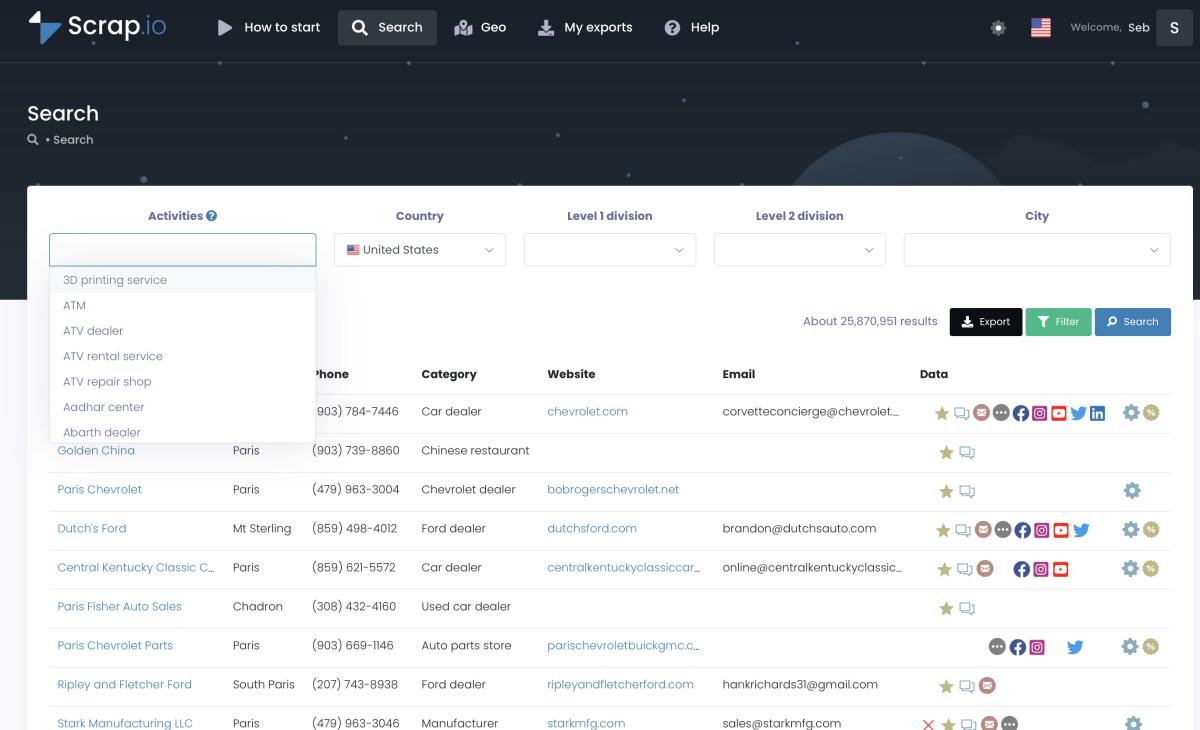
And the scale is the real argument. Scrap.io indexes 225,676,406 establishments across 195 countries and 4,000+ categories (Scrap.io, October 2026), pulled in real time from Google Maps at the moment you export. Pick a category, pick a territory (a single city, a county, a whole state, or the entire US in two clicks), and you get every matching business with its name, address, phone, website, email, and ratings.
Here's the money-saver most people miss: the filters run before extraction. Only want businesses that already list an email? Toggle it. Only ones without a website (hello, web agencies)? Toggle that. You only spend a credit on a contact that already matches, and counting how many match is free. No burning budget on records you'd throw away.
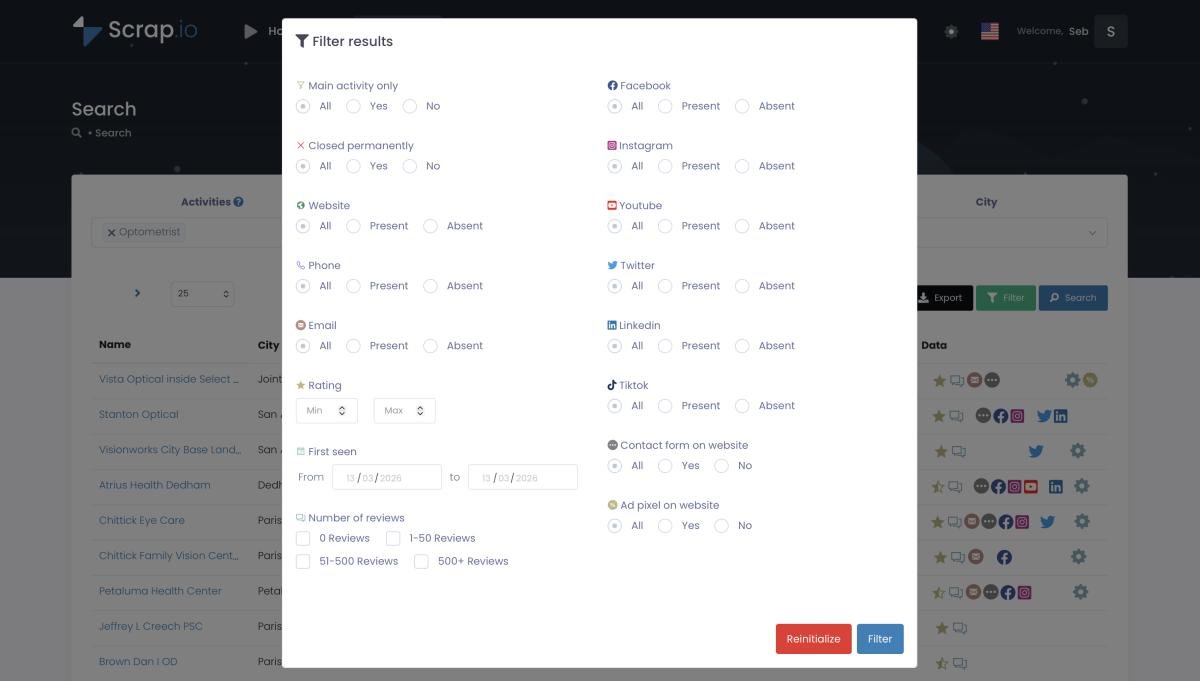
Concrete example. Say the code you looked up was in manufacturing (NAICS sectors 31-33). Searching the matching Google Maps categories gets you a ready-to-use manufacturer email list for your territory. Looked up construction (NAICS 23)? Same deal, a targeted construction company email list, filtered and fresh. The export comes out as CSV or Excel, ready for your CRM or cold email tool. If you want the step-by-step on the extraction itself, here's our guide on how to find emails on Google Maps, and the broader playbooks on building an email list by industry and tapping the full USA business email database.
Video: How to Scrape Local Leads at the Country Level?
Scrap.io pulls every business in a category across a city, state, or the entire US, filtered and fresh. Try it free for 7 days, 100 leads included. Start your free trial.
Why Industry Lists Go Stale
Quick warning, because this is the trap. A bought industry list is a photograph. The moment it's taken, it starts aging. Businesses close, move, rebrand, or change their email every single week, and a static file has no way to keep up. That's why so many "verified" lists bounce a third of the time by the time you actually send.
Real-time extraction sidesteps the whole problem. Because Scrap.io reads Google Maps and the associated website at the moment you export, there's nothing to "go stale." You pull today's data, not last quarter's. The data is also drawn only from publicly available business sources, traceable to where it came from, and compliant with GDPR and CCPA. Fresh and clean beats big and old, every time.
NAICS Lookup: Common Mistakes to Avoid
A contractor once lost a bid over a single wrong digit. That's not a scare story, that's the actual stakes with NAICS, and it's the part people breeze past.
The biggest mistake is assuming the code barely matters. For most tax and admin purposes, a slightly-off code causes nothing (it's self-assigned, after all). But in government contracting, the wrong NAICS code can knock you out of a set-aside contract, scramble your small-business size-standard eligibility, or misclassify you for lending and insurance. The anxiety is real and it shows up constantly in contractor communities. On the GovCon Forum, one new registrant laid it out plainly: "I picked 561730 as primary because it felt like the best fit, but I am worried I chose wrong" (GovCon Forum). Three codes seemed to fit his business, and he had to gamble on one. That's the normal experience, not the exception.
Second mistake: trusting a single source. The NAICS Association tool, SAM.gov, and a company's own filings can disagree, because the company may have picked different codes in different places. If the code actually matters for you (a bid, a loan), cross-check at least two sources before you commit.
Third: confusing "how to check LLC NAICS code" with picking a brand-new one. If your LLC is already registered somewhere (SAM.gov, a state portal, a past tax return), the code already exists, go read it, don't invent a second one. And if you genuinely need a fresh one, determine it from your primary revenue activity on the Census tool and move on. Overthinking it is its own mistake.
FAQ
How do I find a company's NAICS code for free?
Use the NAICS Association US Company Lookup Tool (naics.com), which searches by company name. If the company isn't listed, try SAM.gov for federally registered firms, or search its main activity on the U.S. Census Bureau NAICS tool. All three are free. Library databases like Data Axle add private-company coverage at no cost with a library card.
What is a NAICS code for an LLC?
It's the six-digit number describing the LLC's primary business activity. It's self-selected rather than assigned, and it shows up on tax forms, loan and grant applications, and SAM.gov registration. An LLC can list one primary code plus several secondary codes for its other activities.
How do I find my own 6 digit NAICS code?
Identify your main revenue-generating activity, then search that activity on the Census NAICS tool to get the matching six-digit code. If you're already registered on SAM.gov or filed it on a past tax return, the code is on record there, so check those first before assigning a new one.
What happens if I use the wrong NAICS code?
Usually nothing legal, since the code is self-assigned. But a wrong code can disqualify you from set-aside government contracts, skew your small-business size-standard eligibility, or misclassify you for insurance and lending. Review it carefully before bidding on any federal contract.
Is there a difference between NAICS and SIC codes?
Yes. SIC codes (from 1937, four digits) are the older system. NAICS (from 1997, six digits) replaced them and is updated every five years by the US, Canada, and Mexico. Some agencies still use SIC, so many lookup tools return both codes together.
Looking Up Codes Is the Start, Not the Goal
So that's the full toolkit. Five free ways to run a NAICS code lookup by company name: the NAICS Association tool for name searches, the Census Bureau for the official activity-based code, SAM.gov for government-registered firms, library databases for the hard-to-find private ones, and AI tools for a fast first pass. Pick the door that matches who you're researching, and cross-check when the code actually matters.
But here's the honest closer. A code is a means, not an end. You almost never want the number for its own sake, you want to reach the companies behind it. Once you know the industry, the real work is building the list, and that's where real-time, filtered data leaves a static spreadsheet in the dust.
Video: Scrap.io - How to Start?
Stop copy-pasting codes. Start building lists. Try Scrap.io free for 7 days, 100 leads included. 50,000+ pros already pull fresh, filtered business data from Google Maps across 195 countries. Start your free trial.
Generate a list of restaurant with Scrap.io