

There are roughly 4.8 million notaries in the United States. So why is it almost impossible to get a single, usable list of them?
Think about that number for a second. 4.8 million commissioned individuals, according to the National Notary Association. And yet the moment you try to pull a real, exportable notary public database — names, phone numbers, emails, something you can actually work with — you hit a wall. Fifty states. Fifty separate systems. None of them talking to each other.
Here's the twist most people miss. Those 4.8 million are individuals holding a commission. But only about 51,000 "notary public" businesses show up as real, contactable establishments on Google Maps — mobile notaries, signing services, agencies with a phone and a storefront. That second number is the one that matters if you're prospecting. And that's the one nobody sells.
This guide walks through the three real ways to get a notary database: official state lookups, national directories, and building your own from scratch. One of them is dramatically better than the other two. (Spoiler: it involves a coffee break.)
Video: Scrap.io - How to Start?
- What is a notary public database (and why it's so fragmented)
- Route 1: Official state notary databases (SOS lookups)
- Route 2: National directories & signing platforms
- Route 3: Build your own from Google Maps
- US notary data by the numbers (2026)
- Is it legal to use notary data for outreach?
- Who actually uses a notary public database?
- FAQ
What is a notary public database (and why it's so fragmented)
When people search for a "notary public database," they're usually after one of three very different things. Someone who needs a document signed today. A notary hunting for more signings. Or a business that wants a whole list of notaries to sell to.
Quick definition, for the record: a notary public database is a searchable record of commissioned notaries — name, commission status, location, and sometimes contact details. In the US, each state runs its own through the Secretary of State. There's no single national database, so businesses often build their own from public sources like Google Maps.
That last part is the whole problem. There is no federal registry. Every state guards its own records, in its own format, with its own search box. Some let you download the entire file. Some make you type a name one at a time into a form that looks like it was built in 2004. (A couple of them genuinely were.)
So "the" notary public database doesn't exist. What exists is fifty of them, plus a scattering of private directories, plus the messy, living, real-time reality of Google Maps. If you've ever compared business database search tools, you already know the pattern: fragmentation is the enemy. Notary data is fragmentation on hard mode.
Route 1: Official state notary databases (SOS lookups)
Every US state keeps its own notary database. That's exactly the problem.
These are the secretary of state notary search tools — the official, government-run lookups. They're authoritative. They're free — so if you've been wondering where to find a notary public for free, this is your answer. And they're where you go to verify that a specific notary is real, active, and who they say they are. If you need a u.s. notary public search that holds up in court, this is it.
The catch? You get one state at a time. Here's where the big ones live:
| State | Official notary database / search | Exportable? |
|---|---|---|
| California | sos.ca.gov/notary/notary-public-listing | Yes (ZIP download) |
| Texas | sos.state.tx.us/statdoc/notary-public.shtml | Yes (open dataset) |
| Florida | notaries.dos.fl.gov/not001.html | No (search only) |
| New York | data.ny.gov (Commissioned NYS Notaries) | Yes (open data) |
| Pennsylvania | notaries.pa.gov | No (search only) |
Search by name or commission number
Need a notary public search by name? Go to your state's Secretary of State page, type in the first and last name, add the commission number if you have it, and hit submit. California, Texas, Florida, New York, Pennsylvania — each has its own portal, each slightly different.
The notary commission number lookup works the same way in reverse. That commission number is printed on the notary's official stamp. Feed it into the state's search and you'll get the name, status, and expiration date. It's the fastest way to confirm someone is legit before you hand over a document. And if you're trying to find a notary commission number you've misplaced, the state lookup is your friend — it's all public record.
The hard limits of official databases
Here's the thing nobody tells you upfront. Official databases are built for compliance, not marketing.
They'll give you a name and a mailing address. Maybe a commission date. What they won't give you: an email. A phone number that actually reaches the person. A website. A "this notary travels to you" flag. And they definitely won't let you pull all fifty states into one clean file. Florida's florida notary public database doesn't know New York exists.
The california notary public search can't see Texas. And the new york notary public database — the NYS notary public lookup — is its own separate island of data. Fifty portals, fifty logins, zero interoperability.
So if your goal is to find a notary public near me for a one-off signing, these are perfect. If your goal is to build a notary public list for outreach across multiple states? You're going to spend a very long week copying and pasting. There's a better way. Two of them, actually.
Route 2: National directories & signing platforms
Take Marcus, a mobile notary in Ohio. Listed on four directories — and still hunting for signings every evening. That's the reality of the directory world: it's built for the notaries listing themselves, not for you trying to reach them at scale.
Still, national directories fill a gap the state databases don't. They aggregate mobile notaries and signing agents across the country, often with filters for location and service type. The main players:
- National Notary Association (NNA) — the biggest notary organization in the US, founded in 1957. Its Find a Notary tool is the go-to national notary directory, and the NNA is the source of that 4.8 million figure. Great for finding one notary. Useless for exporting a list.
- Snapdocs — a signing/closing platform with a national network of mobile notaries. Their notary lookup feeds a system that, by their own numbers, handles tens of thousands of signing jobs a month. It's a notary signing agent database aimed at the mortgage world.
- Notary Rotary — a nationwide directory and community of signing agents, searchable by ZIP with filters like "has email address."
- 123notary.com — a free directory of mobile notaries with geolocated listings.
Are these directories worth it? Depends who you ask. Spend ten minutes in notary communities and you'll see the same debate on repeat: notaries wondering whether paying for a premium directory listing actually generates signings, and signing services quietly admitting they source most of their people from two or three platforms and direct outreach. The consensus is messy. Some swear by the directories. Others call them a slow leak of monthly fees.
But notice what all of this has in common. Every directory is organized for the notary. You can look people up one by one. You cannot download a filtered list of mobile notaries in my state with verified emails and hit export. That's just not what they're for.
Route 3: Build your own from Google Maps
The most complete notary database isn't sold by anyone. You build it yourself, in about the time it takes to grab a coffee.
Stay with me. Every mobile notary, signing service, and notary agency that wants business has a Google Maps listing. Name, address, phone, website, hours, reviews — all public, all sitting right there. The problem has always been extracting it at scale without copying 51,000 rows by hand. (Please don't do that. One of our own users tried the manual route for a single county before switching — it took them the better part of a day for a few hundred rows.)
This is exactly what Scrap.io was built for. It pulls business data from Google Maps in real time — no code, no API keys, no 120-result cap. You pick a category ("notary public"), pick a location (a city, a state, or the entire country), apply filters, and export to CSV or Excel. It's the same principle as building your own B2B email database — and the same local business lead generation workflow agencies already use for plumbers and restaurants, just pointed at notaries.
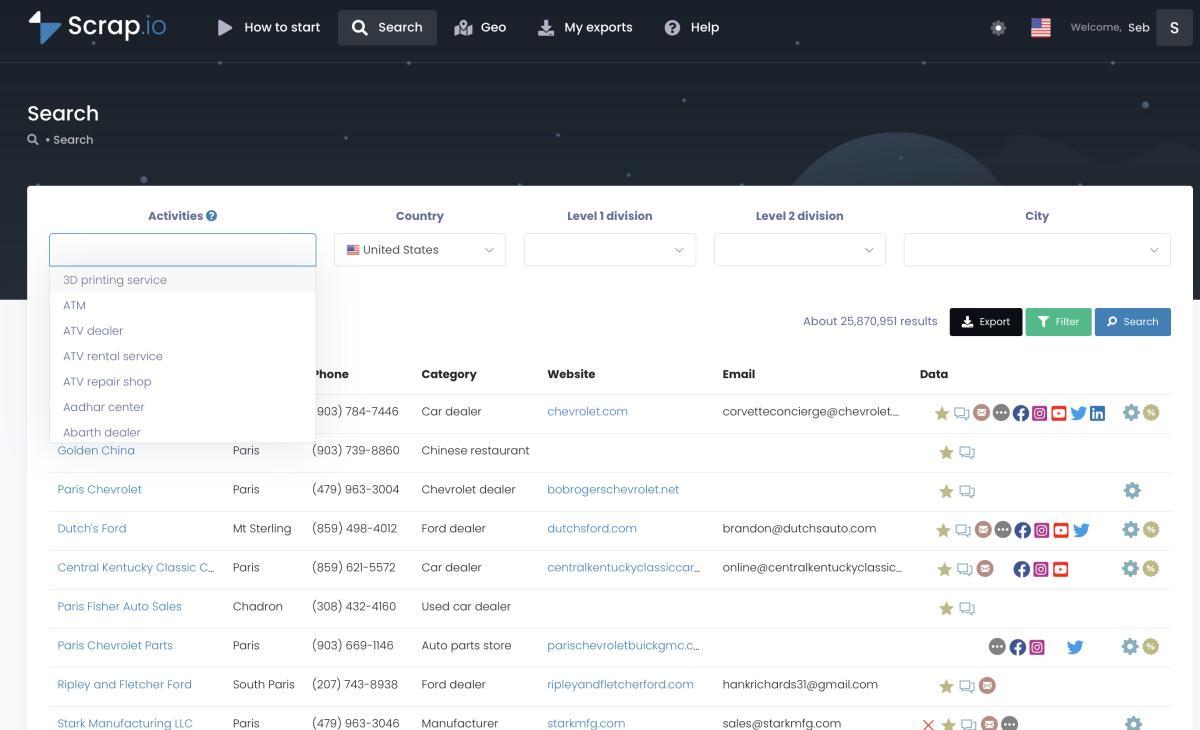
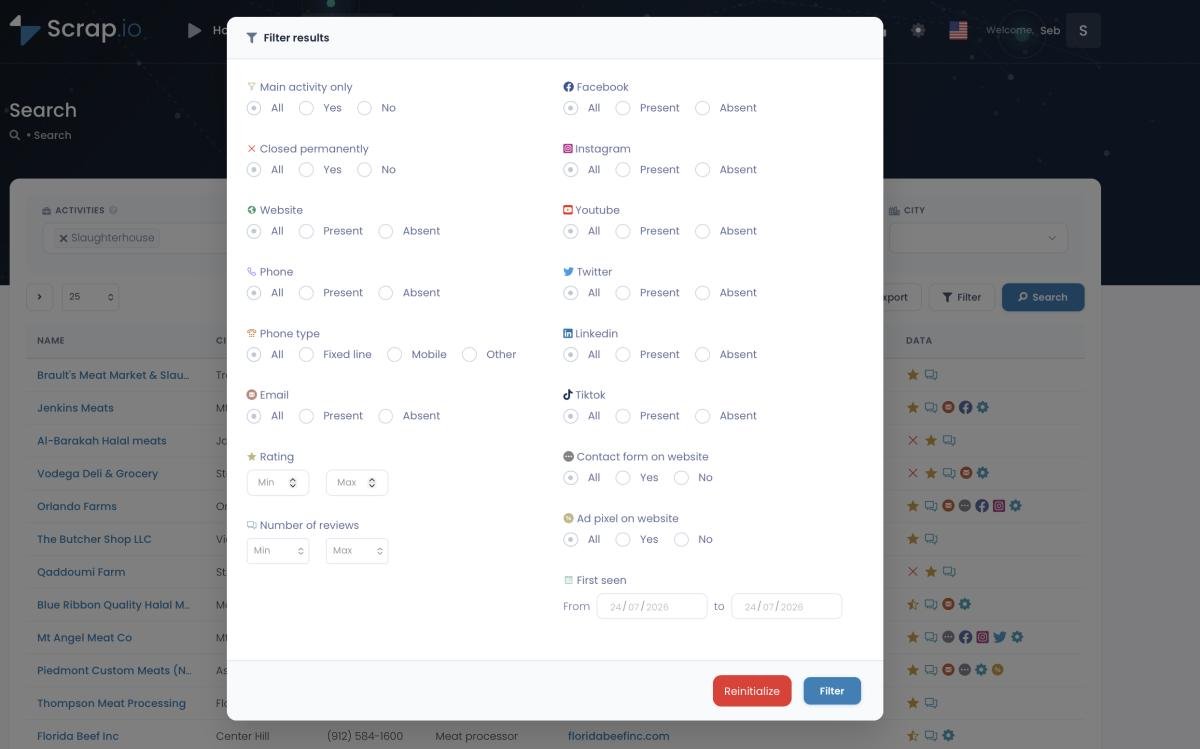
And here's the part that saves you money: you filter before you extract. Only want notaries with a public email? Toggle it on. Only want the ones with a website (a decent signal they're an active business)? Filter for it. You never burn a credit on a listing you can't use.
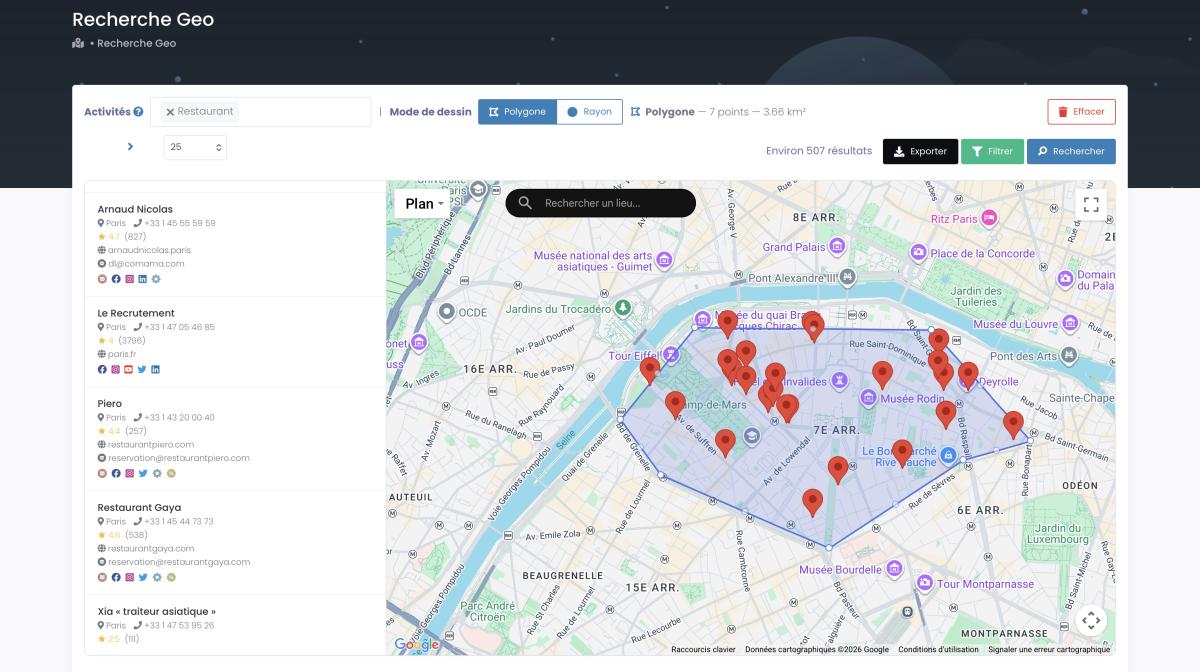
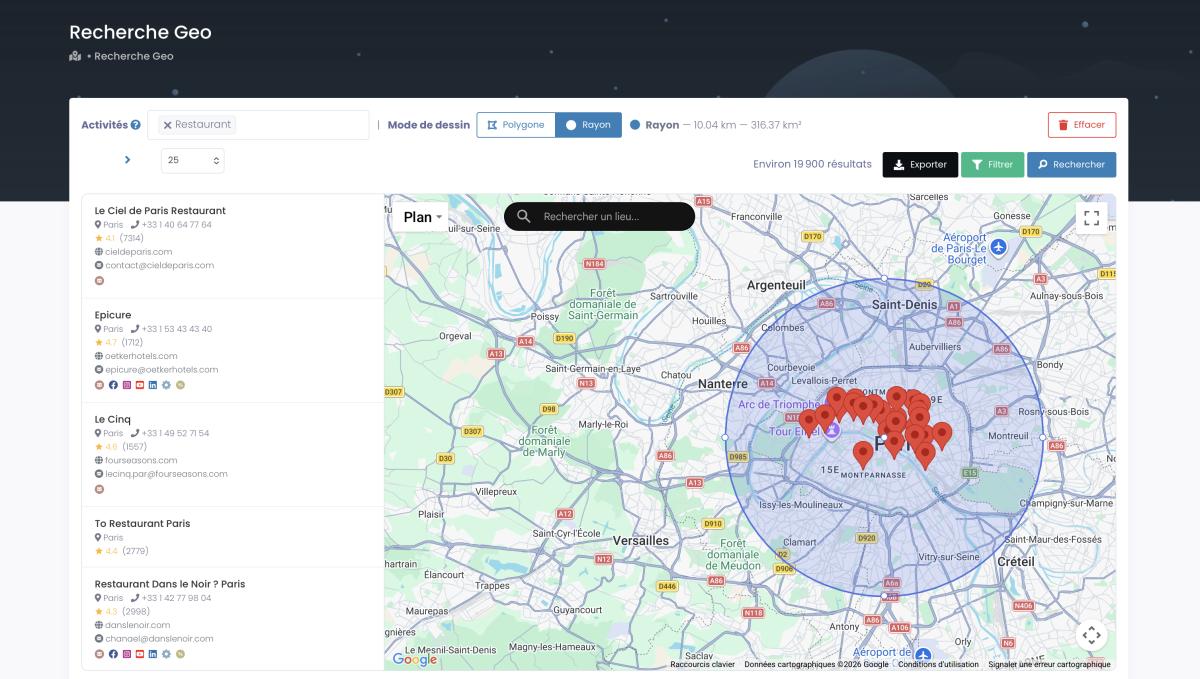
Need to carve out a weird service area — say, a metro that spills across county lines? Draw it. The polygon tool lets you trace any shape on the map and pull every notary inside it. Same for building a national notary public database with email addresses in one shot.
Video: How to Scrape Local Leads at the Country Level?
Step-by-step: from search to export
Here's how to build a notary public list for marketing from Google Maps, start to finish:
- Pick the category. Search "notary public" (Scrap.io maps it to the right Google Maps category automatically).
- Pick the zone. A single city, a county, a full state, or the whole US. Country-level search covers all 51,000+ US notary businesses in one go.
- Filter before extracting. Toggle "has email," "has website," minimum review count — whatever fits your campaign. Zero credits spent yet.
- Check the count. Counts are always free. See exactly how many notaries match before you commit.
- Export. Hit go, and Scrap.io returns a CSV/Excel with names, phones, emails, addresses, categories, and 30+ other fields — refreshed at the moment of extraction.
That's it. That's how to export a list of notaries without a developer, a scraper script, or a week of your life. Want to fold it into a bigger prospecting engine — say, an automated pipeline that pulls fresh leads every Monday? That's doable too.
Video: How to Scrape Local Leads with Claude & Vibe Prospecting?
US notary data by the numbers (2026)
Of the ~51,000 notary businesses on Google Maps in the US, only 44% expose an email. Here's why that matters.
These are the numbers you won't find anywhere else on the search results page — they don't exist on any government site. This is a live snapshot from Scrap.io, pulled in July 2026:
| Metric | Count | Share | Source |
|---|---|---|---|
| Commissioned notaries (individuals) | ~4,800,000 | — | NNA, 2026 |
| Notary "businesses" on Google Maps | 51,095 | 100% | Scrap.io, Jul 2026 |
| With a website | 30,927 | 60.5% | Scrap.io, Jul 2026 |
| With a usable email | 22,373 | 43.8% | Scrap.io, Jul 2026 |
| With a phone number | 49,691 | 97.2% | Scrap.io, Jul 2026 |
Read those rows again, because the gap between them is the entire story. 4.8 million individuals hold a commission. But only about 51,000 operate as a contactable business on Google Maps. The other 4.75 million? They notarized a document for their employer once a month and never thought of it as a business. They're not reachable, and honestly, they're not your prospects anyway.
Now the actionable bit. Nearly all of those 51,000 businesses have a phone — 97.2%. But fewer than half surface an email. So if your entire outreach plan is cold email, you're writing off more than half the market before you start. The ~40% with no findable email aren't dead leads. They're a cold-call or SMS list. Different channel, same prospect.
One more layer worth knowing: the market splits hard by state. California, Texas, Florida, and New York are the big basins — and each keeps its own SOS portal, which is exactly why a national view is so hard to assemble by hand. Want a fresh count for your state? You can run one without spending a cent.
Is it legal to use notary data for outreach?
Let's be honest about the part nobody likes: is any of this legal? Short answer — yes, if you do it right.
Notary business contact details published on Google Maps and company websites are public business data. Extracting them isn't the gray area people assume it is. US courts have consistently held that scraping publicly available business information doesn't violate the Computer Fraud and Abuse Act — we cover the full breakdown in our guide on whether scraping Google Maps is legal. Scrap.io only touches public data, and every record traces back to its source.
Using it for outreach is a separate question with its own rules. In the US, the CAN-SPAM Act lets you cold email a business without prior consent — as long as you identify yourself honestly, include a physical address, and give a working unsubscribe link. For contacts with EU ties, GDPR applies, and generic business inboxes are treated differently from personal ones. Both CCPA and GDPR are satisfied when the data is public business data with a traceable origin, which is exactly what Google Maps listings are.
The practical version: use business emails, honor opt-outs immediately, follow CAN-SPAM, and keep your data sourced. That last one is where most compliance problems actually start — not the copy, the list. For the full playbook, see our cold email compliance guide. Do it right and a notary outreach campaign is no riskier than any other B2B prospecting.
Who actually uses a notary public database?
Who's actually buying lists of notaries — and why? More people than you'd guess.
Title, escrow & lending. This is the big one. Title companies and signing services need a bench of mobile notaries in every market they close in. A bulk notary contact list for prospecting — filtered by city, by "has phone," by review count — is how they staff signings without scrambling. It pairs naturally with a realtor email database, since real estate closings are where notaries and agents intersect.
Legaltech & legal services. Companies selling software, e-notarization tools, or services to the legal world treat notaries as a channel. They're also cross-selling into adjacent audiences — the same buyers who'd want an attorney and legal contacts list or a law firm email list. Notaries, attorneys, law firms: overlapping orbits.
Insurance & E&O providers. Notaries carry errors-and-omissions insurance and surety bonds. Providers want the whole addressable market, filtered and fresh.
Web agencies. Remember that 40% of notary businesses with no email — and the chunk with no website at all? For a web agency, that's not a gap. That's a pitch list. A notary with a Google listing and no website is a warm prospect who visibly needs help.
FAQ
What is a notary public database?
A notary public database is a searchable record of commissioned notaries — name, commission status, and location. In the US, each state runs its own through the Secretary of State. There's no single national database, so businesses often build their own from public sources like Google Maps.
Is there a national notary public database in the US?
No. There's no unified federal database — each of the 50 states runs its own lookup. For a nationwide view, you either aggregate all 50 sources manually or use a tool like Scrap.io to compile every notary business on Google Maps into one export.
How do I search for a notary public by name?
Go to your state's Secretary of State notary search page and enter the first and last name (plus the commission number if you have it). California, Texas, Florida, New York, Pennsylvania and the rest each have their own portal. A secretary of state notary search by name returns the commission status and expiration.
How do I find a notary's commission number?
It's printed on the notary's official stamp and available on your state's notary lookup page. Search by name on your SOS database to pull the commission ID, current status, and expiration date.
Can I build a notary list with emails for marketing?
Yes. Notary business contact details published online are public business data. With Scrap.io, you can filter for notaries that have a public email before exporting — CCPA and GDPR compliant, with every record traceable to its source. Just follow CAN-SPAM when you send.
The bottom line
Fifty state portals, a handful of directories, and one live map with 51,000 contactable notary businesses on it. The official databases verify. The directories connect. But only one route hands you an exportable, enriched, national notary public database — and it's the one you build yourself.
Stop hunting scattered state portals one search box at a time.
Generate a list of notary public with Scrap.io