

A $50 shared lead, blasted to four competitors, won one time out of five, then closed at a 30% rate. Do the math on that. It actually costs you around $833 per booked job (Pipeline On, 2026). That's not a lead. That's a slot machine with a service van.
And yet the entire search result for "pest control leads" sells you the same thing: recycled contacts, resold three or four times, dressed up as "exclusive." Nobody explains the alternative. So let's do that here — how to stop renting the same customer as the shop across town and start owning a pipeline that's actually yours.
What's inside
- Why buying pest control leads is broken in 2026
- The 3 ways to get pest control leads (compared)
- How much do pest control leads cost in 2026?
- The overlooked goldmine: commercial pest control accounts
- How to build your own exclusive pest control lead list
- Selling TO pest control companies? Build a pest control email list
- Cold outreach that actually converts (email + phone)
- FAQ
Why buying pest control leads is broken in 2026
Here's the dirty secret nobody in the lead business says out loud: when you buy a pest control lead, you're renting the same homeowner as the two guys down the road.
That's the whole model. A homeowner fills out one form on a marketplace, and that single "lead" gets sold to three or four companies at once. Shared leads from the big platforms run $20 to $60 each and close somewhere around 10 to 15% of the time, because you're in a footrace to dial first (Minyona / Pipeline On, 2026). The prospect's phone rings five times in ten minutes. They're annoyed before you say hello. Great start.
Scroll through r/PestControlIndustry and the same complaint keeps surfacing — owners venting that the leads they paid good money for went straight to three other trucks too, and that the "qualified" ones weren't. The threads on how to generate leads, on lead generation, and the Quora thread on how to generate leads for pest control all read like a support group for people who bought the terrible list. (We've all been there. Twice.)
The biggest mistake in lead generation isn't spending too little. It's casting too wide a net — buying a giant pile of unqualified contacts and treating volume like strategy. A thousand shared leads that don't fit your service area or your margins is worse than fifty you actually chose. Precision beats poundage, every single time.
So the fix isn't to buy better shared leads. It's to stop renting entirely and build something you own. If you want the strategic overview first, our guide on local lead generation strategies lays out where owned pipelines fit.
The 3 ways to get pest control leads (compared)
Marketplaces, agencies, or your own pipeline — which one actually pays off? Because "pest control lead generation" gets sold as one thing, but there are really three very different roads, and they end in very different places. If you've searched for the best way to get pest control leads — or just typed "leads for pest control" into Google at 11pm — you've met all three, usually with nobody explaining the trade-offs.
Marketplaces (Angi, Thumbtack). Fast to start. You plug in a card and leads trickle in. But they're shared, the quality is a coin flip, and you're bidding against everyone in your zip. LeadTruffle pegs an Angi pest control lead at roughly $25 to $50 — and it's the same lead your competitor just bought.
Agencies. Hand it to the pros. Listicles like Built-Right Digital's "8 best pest control lead generation agencies" line up shops like Scorpion, Coalmarch, and Blue Corona. They can work — if you've got the budget. Retainers routinely start around $1,500 a month, and when you stop paying, the pipeline evaporates (surprise). You're renting again, just at a higher tier.
Your own pipeline. You extract the businesses you want to reach, contact them directly, and own every row forever. More work up front. Way cheaper per booked job. Nobody else has your list.
| Approach | Speed to start | Cost over time | Exclusive? | You own the data? |
|---|---|---|---|---|
| 🟡 Marketplaces | 🟢 Instant | 🔴 High per job | ❌ Shared 3–4x | ❌ No |
| 🟡 Agencies | 🟡 Weeks | 🔴 $$$ retainer | 🟡 Sometimes | ❌ No |
| 🟢 Own pipeline | 🟡 A day | 🟢 Pennies per lead | ✅ 100% yours | ✅ Yes |
The first two options rent you attention. The third builds an asset. And the tool that turns "businesses on a map" into a filtered list of local business leads with contact info is what makes option three practical for a busy operator who doesn't code.
Curious what an owned list actually looks like? Scrap.io pulls one straight from Google Maps — 225M+ businesses across 195 countries, filtered before you pay, and counting results is always free. See how it works →
How much do pest control leads cost in 2026?
Angi and Thumbtack: $20 to $60 a lead. Exclusive leads: $45 to $150. But the number that actually matters isn't the sticker price. It's the cost per booked job. And that number is brutal.
Walk it through. A shared lead costs $50. It goes to four companies, so your realistic odds of winning it are about one in five. Win it, and you still only close roughly 30% of the time. Multiply that out and a single booked job cost you around $833 in lead spend (Pipeline On, 2026).
Eight hundred and thirty-three dollars for one signed contract.
Exclusive leads flip the math a little. They run $45 to $150 apiece, but because nobody else has them, they convert at 30 to 50% (Minyona, 2026). Better. Still, you're paying per lead, forever, on someone else's terms.
| Lead type | Price each | Close rate | Shared with rivals? |
|---|---|---|---|
| Shared (Angi/Thumbtack) | $20–$60 | ~10–15% | Yes, 3–4 times |
| Exclusive (pay per lead) | $45–$150 | ~30–50% | No |
| Owned (you extract it) | Pennies | You control it | Never |
Pay-per-call brokers push the same "buy pest control leads" logic, just billed by the phone call. ResultCalls, for example, advertises calls "as low as $24.85" and openly states that most pest control leads cost around $53.50 each. Fine for instant volume. But that's pay per lead pest control at its purest — you never own a thing, and the meter never stops.
So what does "owned" cost? When you extract the businesses yourself, a lead runs a fraction of a cent. Pay once for the tool, prospect forever. These are exclusive pest control leads — yours alone, never resold — and that's the shift that changes your whole cost structure.
The overlooked goldmine: commercial pest control accounts
Everyone fights over one-off homeowner leads. Meanwhile, a single restaurant contract renews every single month.
Every single month.
That's the angle almost nobody in this space talks about. The whole shared-lead economy is built around residential — a homeowner sees a roach, panics, fills out a form. One job, done.
Zoom out for a second. The US pest control market is worth about $29.7 billion in 2026, growing roughly 1.8% this year (IBISWorld), and it's been climbing 5–6% a year — the structural side alone grew 6% in 2025 (NPMA). Residential is still roughly 70% of that revenue (Briostack). But here's what the lead brokers won't tell you: recurring service already makes up 85.4% of residential revenue, and the commercial segment grew nearly 7% in 2025.
Recurring is the whole game. Commercial is where recurring lives at scale.
Here's the thing though — you cannot buy commercial pest control leads from a residential lead broker. They don't have them. A restaurant, a warehouse, a nursing home… those aren't filling out "get a quote" forms on Thumbtack. They're just sitting on Google Maps, running their business, legally required to keep pests out.
What's the best way to land commercial pest control accounts? Target the verticals that need recurring service by law or by liability, then reach out directly:
- Restaurants and food service — health-code inspections, monthly minimum.
- Hotels and hospitality — one bed-bug review is a PR crisis.
- Warehouses and food storage — rodents ruin inventory.
- Property managers and syndics — one contact, dozens of buildings.
- Clinics and healthcare — compliance is non-negotiable.
- Schools — often mandated to use IPM (integrated pest management).
Every one of those is on Google Maps right now, with an address and often a phone and email. Pull the property managers in a 50-mile radius and you're not chasing one-off jobs — you're chasing portfolios. Define who you want first (our define your ICP template helps), then go get exactly that.
Video: Finding Clients Through Google Maps Filters
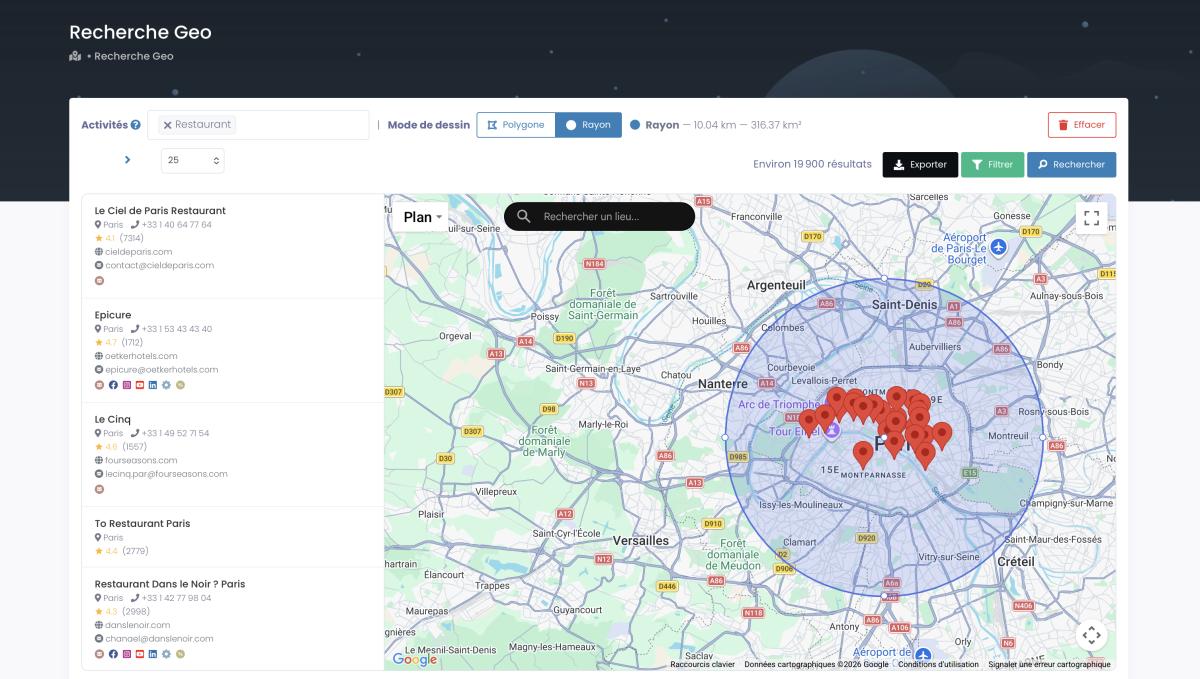
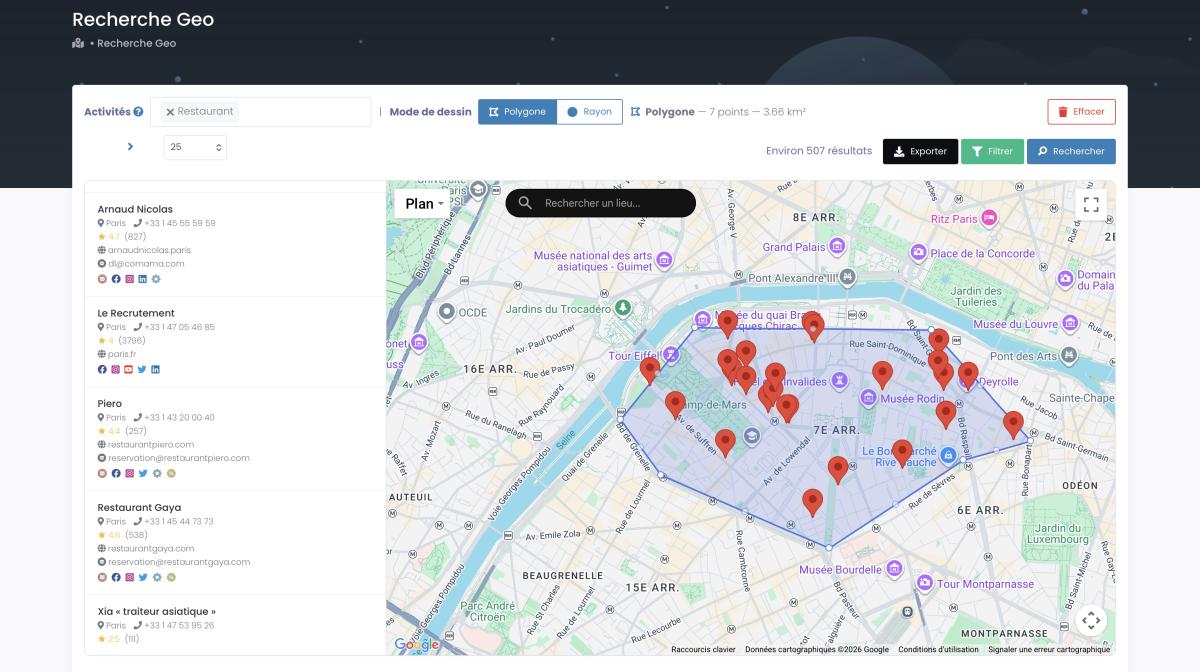
And when your target zone isn't a tidy city or county — say, every commercial kitchen within 30 miles of downtown — GeoSearch lets you draw a radius or a custom polygon straight on the map and pull everything inside it.
How to build your own exclusive pest control lead list
Take a pest control company in Houston. They didn't want a marketplace. They wanted every restaurant, hotel, and property manager within a 50-mile radius — with phone numbers and emails — so their sales guy could work a real list instead of waiting for the phone to ring. In one afternoon, they had it. No broker. No shared contacts. Just a clean file that was theirs.
That's how to get pest control leads without renting them — no scrolling "pest control leads near me" and hoping a broker's ad is legit, no hunting for the "best pest control leads" vendor. You become the source. Here's the exact flow, and yes, it's genuinely this short:
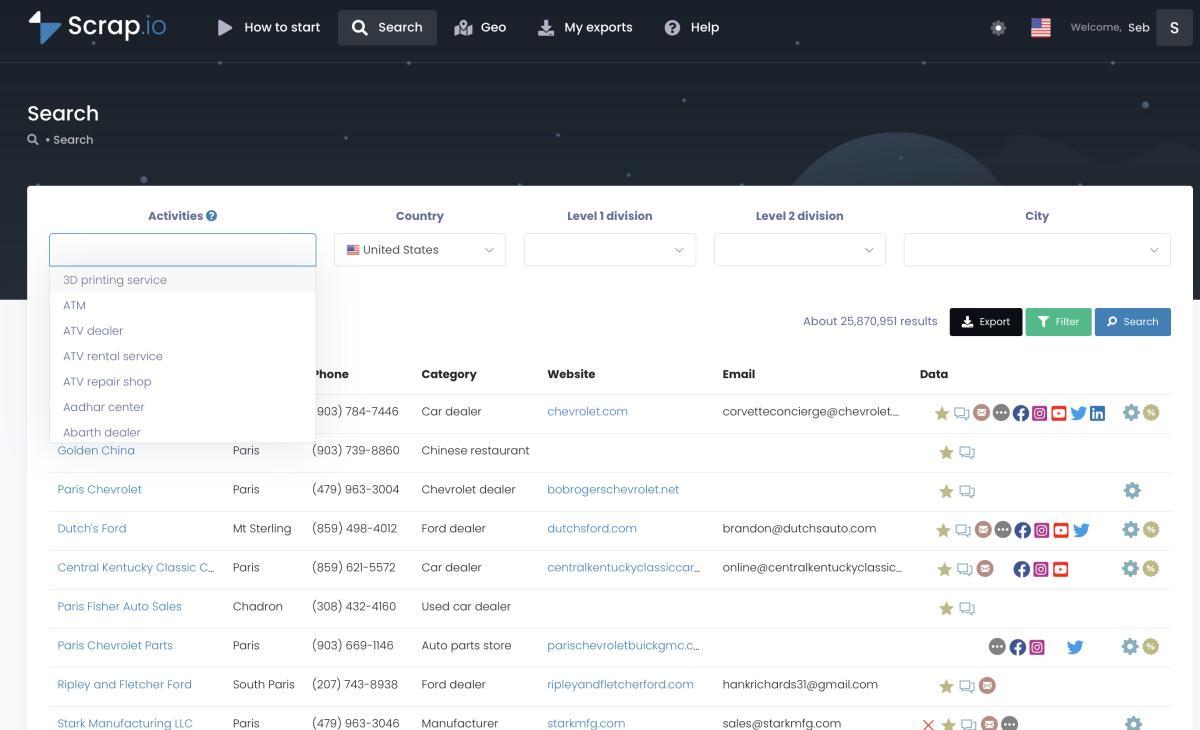
- Pick your category + zone. Choose "pest control service" if you're building a companies list, or your commercial targets (restaurants, hotels, property managers) if you're prospecting. Then set the area — a city, a county, a whole state, or a custom radius.
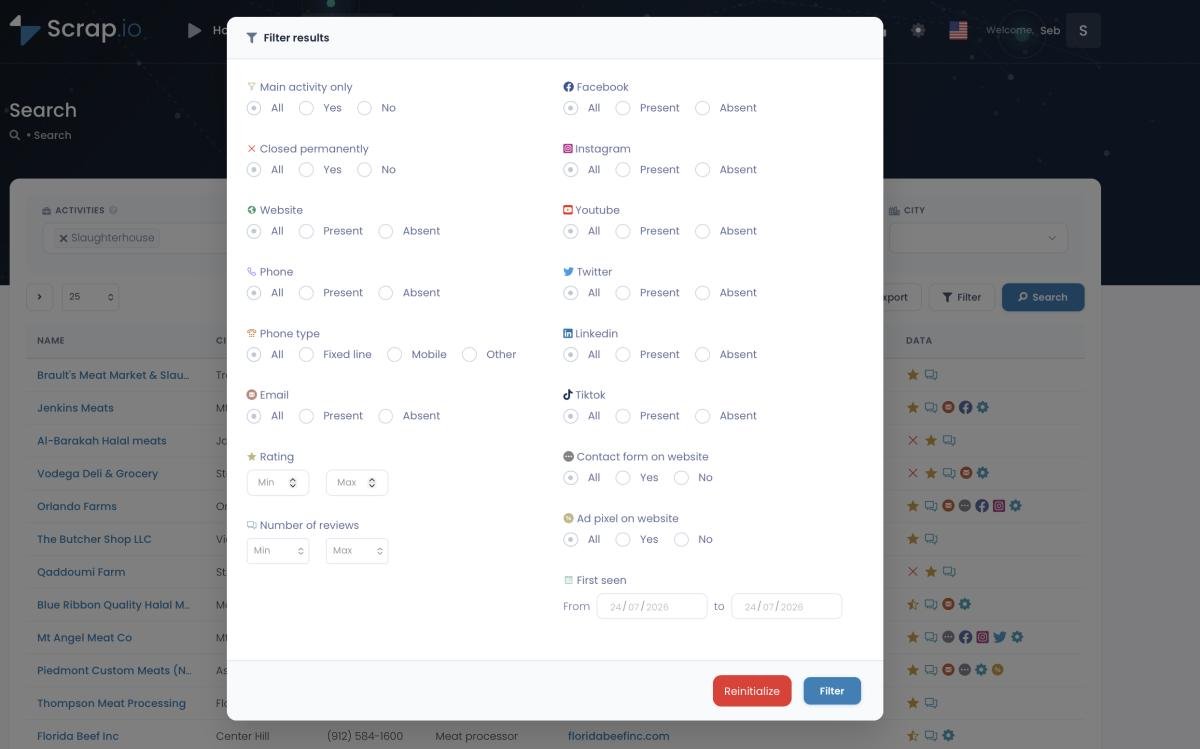
- Filter before you extract. This is the part that saves your money. Only want businesses with a real email? Toggle it. Want to skip the ones flagged permanently closed, or target only listings with 4+ stars, or only businesses without a website? Stack the filters — all applied before a single credit is spent.
- Count for free. Hit count. It tells you exactly how many matching businesses exist, across a whole state if you want, and it costs zero credits.
- Export. One click. CSV or Excel, ready to drop into your CRM or cold email tool.
- Work the list. Same afternoon. No proxies, no code, no 3 a.m. debugging.
How much is actually out there? Fresh Scrap.io data pulled on July 27, 2026 shows 28,434 "pest control service" establishments in the US on Google Maps — of which 21,631 have a website (76%), 13,625 carry a usable email (48%), and 6,803 have no website at all (24%). That last group? Gold for anyone selling websites or marketing to the trade. The point is, you can slice all of it before you pay, so you only ever export leads you can actually use. This is generating leads from Google Maps at scale, and the email side works exactly the way our guide on finding emails on Google Maps describes — it crawls each business's site to surface the address.
One honest note for US operators: the mobile-vs-landline phone filter isn't available in the US and Canada. Everywhere else, yes. Here, you filter on email, website presence, rating, reviews, and location — which is plenty to build a razor-sharp list. Want to go bigger than one category? Here's how to extract every business in an area, full stop.
Video: How to Scrape Local Leads at the Country Level
Video: Scrap.io - How to Start?
Ready to move? Try Scrap.io free for 7 days — 50 searches and 100 export credits, no strings, 100 leads on us. Filter by email, rating, no-website, and more before you spend a credit. Start your free trial →
Selling TO pest control companies? Build a pest control email list
Flip the script for a second. Maybe you're not a pest control operator at all — you sell software, insurance, trucks, or marketing services to them. There are more than 32,700 pest control companies in the US (IBISWorld / Briostack, 2026), most of them local, independent, and pulling around $400,000 a year.
That's a serious market. And most lead vendors can't hand you a clean list of them.
The classic route is buying a static pest control companies list from a data broker. Salesgenie sells exactly that — verified, CCPA and CAN-SPAM compliant, updated by 300+ researchers. Salesfully offers "unlimited" business and consumer lists with a CSV export and a free trial. Both are legit. But you're buying a file that was compiled on someone else's schedule and sold to whoever else wanted it.
Building your own list of pest control companies flips that. You pull all 28,434 "pest control service" listings — or just the 6,803 without a website if you're a web agency, or the 13,625 with a real email if you're running cold outreach — straight from the map, fresh at the moment of export. It's the same two-click flow as above, just pointed at the trade itself. If you want the mechanics, our guide on building a cold email list and the one on extracting every business in an area cover it end to end.
The difference is freshness and exclusivity. A broker's "pest control leads for sale" file is shared and aging the day you buy it. A list you extract yourself is yours alone, current to the minute, and you can re-pull it next quarter to catch every newly opened shop.
Cold outreach that actually converts (email + phone)
A perfect list with a lazy first line is just an expensive way to hit the spam folder. The list gets you in the room. The message decides whether anyone talks to you.
First, the legal floor, because people panic about this needlessly. Is cold emailing pest control prospects legal in the US? Yes. Under CAN-SPAM, B2B cold email is allowed as long as you identify yourself honestly, use a truthful subject line, include a real physical address, and give a working opt-out. Use only publicly available business data and honor unsubscribes immediately. That's it. Scrap.io only pulls publicly available business info, keeps every record traceable to its source, and is GDPR and CCPA compliant — which puts you on solid ground before you send a thing.
Now the message. The difference between "Dear Business Owner" and a reply is one specific detail. Compare:
- ❌ "Hello, we offer pest control marketing solutions to help grow your business."
- ✅ "Hey Mike — saw your shop has 4.7 stars but no booking link on the site. We helped a 6-truck outfit in Dallas fix that and they added 11 recurring accounts."
The second one proves you looked. That's the whole trick. Pull the phone numbers for the callers on your team (here's how to scrape phone numbers for cold calling), then go multi-channel — email, then a call, then a follow-up. And if you want proven structures instead of a blank page, borrow from our cold email templates that convert.
"But cold email doesn't work in my industry." Sure it does — the problem is almost never the channel. It's the list plus the message. A recycled shared lead with a generic template? Dead on arrival. An exclusive, well-targeted list plus a first line that references their actual business? That's the opposite of a recycled lead. That's how you get pest control sales leads that answer.
FAQ
How much do pest control leads cost in 2026?
Shared leads on Angi and Thumbtack run $20–60 each but get sold to 3–4 competitors at once (close rate ~10–15%). Exclusive leads cost $45–150 with a 30–50% close rate. Building your own list with a tool like Scrap.io shifts the math from "pay per lead" to "pay once, prospect forever" — a fraction of a cent per contact.
How do I get pest control leads for free?
There's no such thing as truly free pest control leads, but you can get near-zero-cost exclusive ones by extracting local businesses (your commercial targets) yourself instead of paying a broker. That's really how to get leads in pest control on a budget: Scrap.io's free 7-day trial includes 100 export credits, enough to build a real list for one campaign before spending anything.
Is buying pest control leads worth it?
Sometimes — for instant volume. But shared leads inflate your true cost per booked job, often to $500–800 and up. Exclusive and owned pipelines win on ROI over time, because you stop paying a toll on every single contact.
What's the best way to get commercial pest control accounts?
Target businesses that need recurring service — restaurants, hotels, property managers, warehouses, clinics, schools — then reach out directly. Extract them by category and area from Google Maps, filter for email, and run a focused cold outreach sequence. Commercial accounts renew monthly, so one signed contract pays off for years.
Is cold emailing pest control prospects legal in the US?
Yes. B2B cold email is legal under CAN-SPAM as long as you identify yourself, use a truthful subject line, include a physical address, and provide a working opt-out. Use only publicly available business data and honor removal requests promptly.
Stop renting the same customer as your competitor. The 28,434 pest control firms and every commercial account near you are already sitting on Google Maps — Scrap.io turns them into a filtered, exclusive list in two clicks. Build your own pipeline today: 7-day free trial, 100 leads on us, 225M+ businesses across 195 countries, filtered before you pay. Start free now →
Generate a list of restaurant with Scrap.io