

What's in this guide
- What exactly is a printing industry email list (and why most are broken)
- The US printing industry in 2026: big, fragmented, mostly local
- Buy vs. build: why purchased printing lists let you down
- How to build your own printing industry email list from Google Maps
- Filter before you extract: get only email-ready print shops
- From local print shops to a nationwide list: scaling by geography
- Turning the list into replies: cold outreach for print shops
- Staying compliant: CAN-SPAM, GDPR and deliverability
- FAQ
Somewhere in America, a print shop is quoting a job right now. The commercial printing trade is worth roughly $132 billion in 2026, climbing toward $169.49 billion by 2033 at a 3.6% clip (Grand View Research, 2025). That's a lot of businesses buying ink, paper, software, equipment, and services they can't make in-house.
And yet most people trying to sell to printers are working off a contact file that went stale two reorganizations ago. They bought a printing industry email list, loaded it up, hit send, and watched a third of it bounce before lunch. Sound familiar?
Here's the thing nobody selling those lists will tell you: you can build a fresher, cleaner, cheaper list yourself, pulled live from Google Maps, filtered down to the shops that actually have an email on file. This guide shows you how. Real numbers, a real workflow, and the honest trade-offs. No fluff.
What exactly is a printing industry email list (and why most are broken)
Most bought lists are dead on arrival.
A printing industry email list is supposed to be simple: a file of print shops, commercial printers, sign companies, and related businesses, each with a usable email address you can pitch. A printing companies email list that lets you skip the cold-calling and land straight in an inbox. In theory, lovely. In practice, the file you buy is a snapshot of who ran a business and published an address at some frozen moment in the past.
And printing is a brutal sector for that. Shops merge, rebrand, change owners, or quietly shut the roll-up door for good. The info@ address that worked last spring forwards to nobody now. So the "verified" printing industry mailing list you paid for behaves like any other aging database: it decays, fast, and takes your sender reputation down with it.
There's a second problem, quieter but just as expensive. A generic print shop email list treats a 400-person packaging plant and a two-person screen-printing garage as the same lead. They are not. One needs enterprise workflow software, the other needs a new supplier of blank tees. Pitch them the same email and both ignore you.
So a list that actually works has two jobs. Be fresh (the contact exists today, not in some archived export) and be segmented (you know whether you're emailing the owner, a sales@ box, or nobody). Buy a static file and you get neither. Build it from live data and you get both. Which is the whole point of this guide.
The US printing industry in 2026: big, fragmented, mostly local
Start with a number that reframes the whole thing: 50,404. That's how many printing businesses the US has in 2026, down about 1.2% on the year (IBISWorld, 2026). The sector employs around 338,500 people as of August 2026 (US Bureau of Labor Statistics).
Now here's the part that matters for prospecting. This market is tiny at the unit level. According to PIworld, more than half of US printing establishments (11,679 out of 22,651 counted in 2022) employ fewer than five people. Fewer than five. The payroll across the sector was $21.6 billion that year, but the headcount is scattered across thousands of micro-shops.
Translation: you are not selling to a handful of giant corporate buyers. You're selling to a long, long tail of small local businesses, the kind you'll never find neatly tagged on LinkedIn. They're on a map. That's where they live, and that's where you go find them, the same way you would for any manufacturer email list built from real-world locations instead of a corporate directory.
And the shops are doing fine, which is what counts when you're selling to them. Per PIworld, 61% of commercial printers reported revenue up year over year, climbing to 77% among wide-format specialists. A buyer base that's growing its top line is a buyer base with budget.
One caution on the headlines. You'll see two different stories about "printing," and they contradict each other. The broad "Printing" category sits around $81.5 billion in 2026 and is sliding (down 4.6% on the year, per IBISWorld), while commercial printing specifically is growing toward that $132 billion figure. Both are true. They measure different things. Don't let a doom headline about "printing decline" fool you into thinking the buyers dried up, because the shops writing checks are very much still open.
If you've ever gone looking for a clean list of printing companies in USA and come up with a stale directory, this fragmentation is why. The public lists capture a few big names and miss the thousands of small printing companies in USA that make up most of the market, precisely the shops you can actually win.
And the fragmentation is good news, honestly. A market of 50,000 mostly-small, mostly-local shops is a market you can carve up by city, by niche, by trade. Which is exactly what a map-based list lets you do.
Buy vs. build: why purchased printing lists let you down
Why does a "100% verified" list bounce half the time?
Let's look at what you're actually buying. The big printing-list vendors all sell the same shape of product: a huge static file, priced per contact, compiled at some point and resold to whoever pays. LakeB2B advertises 768,190 printing-professional contacts with 614,552 emails, stamped "100% Verified." ReachStream claims 544,000+ contacts, refreshed every 45 days at best. Coldlytics hand-builds a list and ships it in about 24 hours.
Sounds fine until you check the coverage math. The SERP's own number-one result, RevenueBase, lists 98,467 contacts for book-printing services, of which just 12,361 have a verified email. That's 12.6%. You're paying for the whole database and getting a usable address on roughly one record in eight.
Then there's the freshness tax. "Refreshed every 45 days" means that, on a bad day, the contact you email left the company six weeks ago. A hand-built list delivered in 24 hours is fresh the morning it lands and starts rotting that afternoon. This isn't a knock on any one vendor. It's just how static files work, and we've written at length about why buying email lists rarely pays off the way the seller promises.
The question keeps surfacing in the trade's own communities, too, from threads on r/CommercialPrinting about mailing-list vendors to Quora posts asking where to find a commercial printing email list. People want the shortcut. They also keep getting burned by it.
| Factor | Buy a printing list | Build it from Google Maps |
|---|---|---|
| Freshness | Compiled once, refreshed every 45 days at best | Pulled live the moment you export |
| Email coverage | As low as 12.6% usable (RevenueBase) | Filter to email-present only, before you pay |
| Targeting | Broad, generic, sold to everyone | By city, niche, rating, web presence |
| Exclusivity | Your competitors bought the same file | You pick the segment, nobody else has it |
| Cost model | Per contact, pay for dead rows too | Subscription, only email-ready rows |
My honest take? Buying a printing list is mostly renting a problem. There are narrow cases where a pre-built file makes sense as a starting seed. But as a strategy, it's a slow leak in your deliverability and your budget.
Curious how many print shops are actually reachable in your target area? Count them free on Scrap.io. Counting never costs a credit, so you can size the market (a city, a state, the whole US) before you commit to anything. Then start your free trial with 100 leads included.
How to build your own printing industry email list from Google Maps
Meet Dave. He runs a small agency selling design and web services, and he wants every print shop in a handful of states by Friday, with real emails, not contact forms. He's tried the directories. He's tried LinkedIn (chefs posting plating photos, printers posting almost nothing). So he builds the list from the map instead. Here's the exact flow he used.
Every print shop that matters is already on Google Maps. Name, address, phone, website, reviews, hours. And the website linked from that listing usually has an email sitting right there in the footer. A proper Google Maps scraper reads both layers at once: the map listing and the site behind it. That's the raw material for your commercial printing email list, and the fastest way to find printing companies emails at scale, because it updates itself every time a shop touches its profile.
The workflow is genuinely three steps:
- Search by category and location. Pick "Print shop" (or screen printing, sign company, whatever niche you're after) and set your area: a city, a county, a state, or the entire US.
- Filter before you extract. Toggle "has email" so only shops with a usable address get counted. More on this in the next section, because it's where the money is saved.
- Count, then export. Preview the exact number for free, name your file, export to CSV or Excel, drop it into your sequencer.
No code. No proxies to babysit. Dave pulled his multi-state list in one sitting. If you want the longer version with every option explained, there's a complete Google Maps scraping guide that walks through the whole thing, and a dedicated playbook on building a cold email list from scratch.
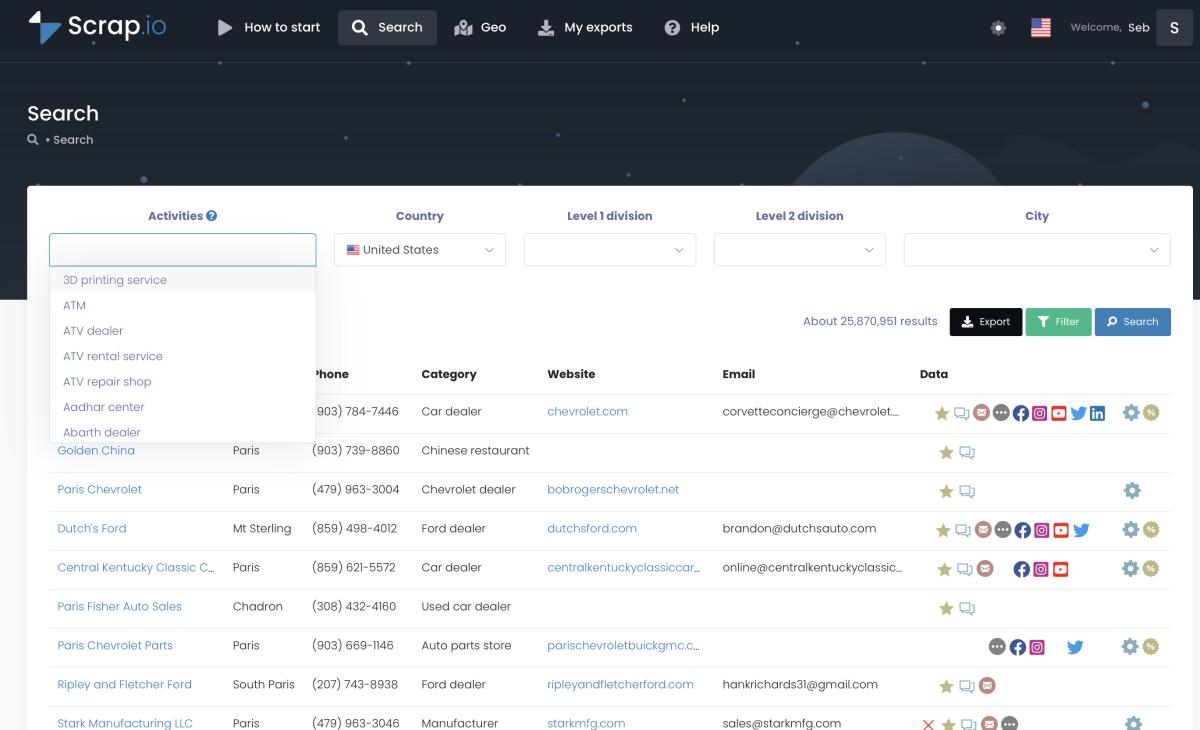
Here's the two-minute version from a cold start, if you'd rather watch than read:
Video: Scrap.io - How to Start?
Build your first printing list the same way Dave did. Try Scrap.io free for 7 days, 100 leads included, and pull a fresh, email-present list of print shops from any category and any zone, from a single city to the whole country. Real-time data across 225M+ businesses in 195 countries.
Filter before you extract: get only email-ready print shops
Extract fewer. The right ones.
This is the counterintuitive bit that saves people the most money, so stay with me. When you search "Print shop" across the United States, the live count on Scrap.io is 66,886 shops (pulled 27 September 2026). Impressive number. But you don't want to pay to export all of them, because not all of them are contactable.
Here's the breakdown on that same live search:
| US print shops (Scrap.io, Sept 2026) | Count | Share |
|---|---|---|
| Total print shops | 66,886 | 100% |
| With a website | 57,570 | 86% |
| With an email | 37,116 | 55% |
| With a phone | 64,888 | 97% |
Look at the email row. Only 55% of US print shops have an email that can be found and classified. So the smart move is to flip the "email present" filter to yes before extraction, and export 37,116 instead of 66,886. You skip paying for 29,770 shops you could never have emailed anyway.
Now put that next to the vendors. RevenueBase gives you a 12.6% email hit rate on a file you've already paid for in full. Filter-before-you-pay gives you a file that's 100% email-present, because the dead rows never enter it. That's not a small difference. That's the difference between a campaign and a bonfire of credits.
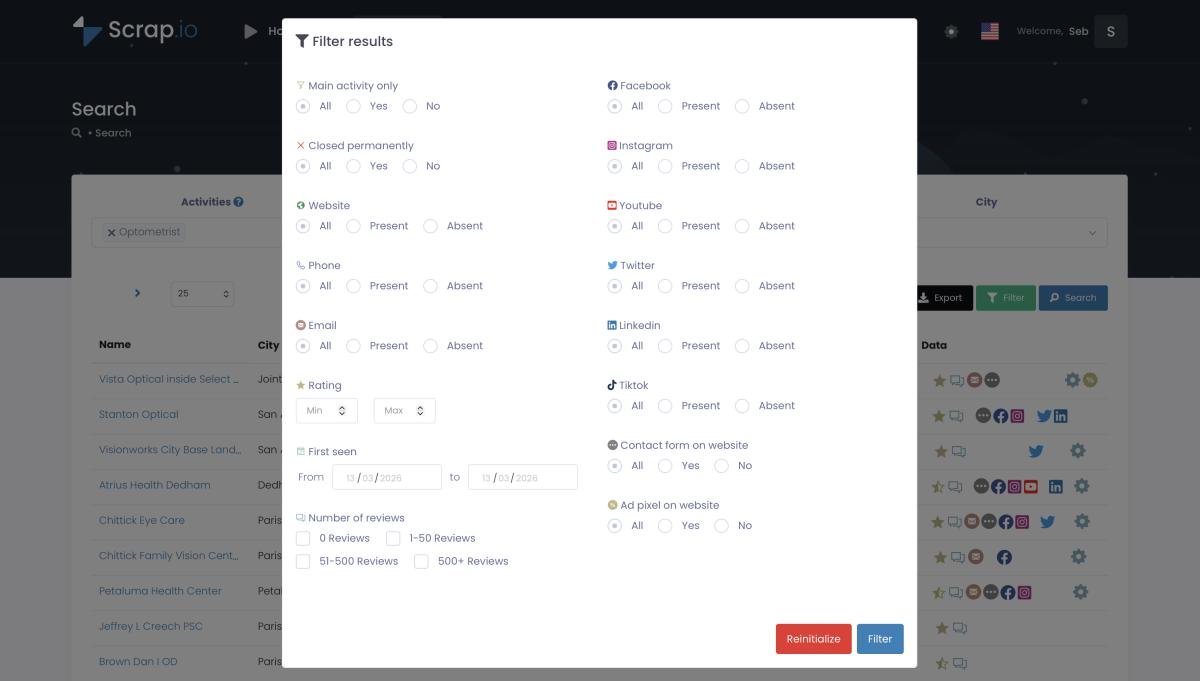
The filtering goes well beyond email, too. Only shops with fewer than 20 reviews (the smaller independents)? Toggle it. Only ones with a website (so you know they're established)? Done. Minimum rating, recently opened, has a contact form, runs ad pixels: all filterable up front. The complete filtering guide covers every option, and it's the same discipline you'd apply before you ever check whether an email is valid downstream.
Watch it narrow a search in real time here:
Video: Finding Clients Through Google Maps Filters
Stop paying for shops you can't reach. On Scrap.io, the "has email" filter runs before a single credit moves, so your export is 100% email-present from the start. 7-day free trial, 100 leads included. Filter first, then spend.
From local print shops to a nationwide list: scaling by geography
One print shop is a lead. Every print shop in Texas is a pipeline.
Because this market is so local and so fragmented, geography is your sharpest targeting tool. And you can slice it however the campaign needs. Start with a single city when you're testing a pitch. Widen to a county, a state, or the full country once something works. The data's the same; you just move a dropdown.
When administrative borders don't match your actual service area, GeoSearch handles the odd shapes. Want an email list of printers near me, literally the shops a few miles down the road? Draw a radius around a point (say, every print shop within 40 miles of your warehouse) and every filter still applies inside it.
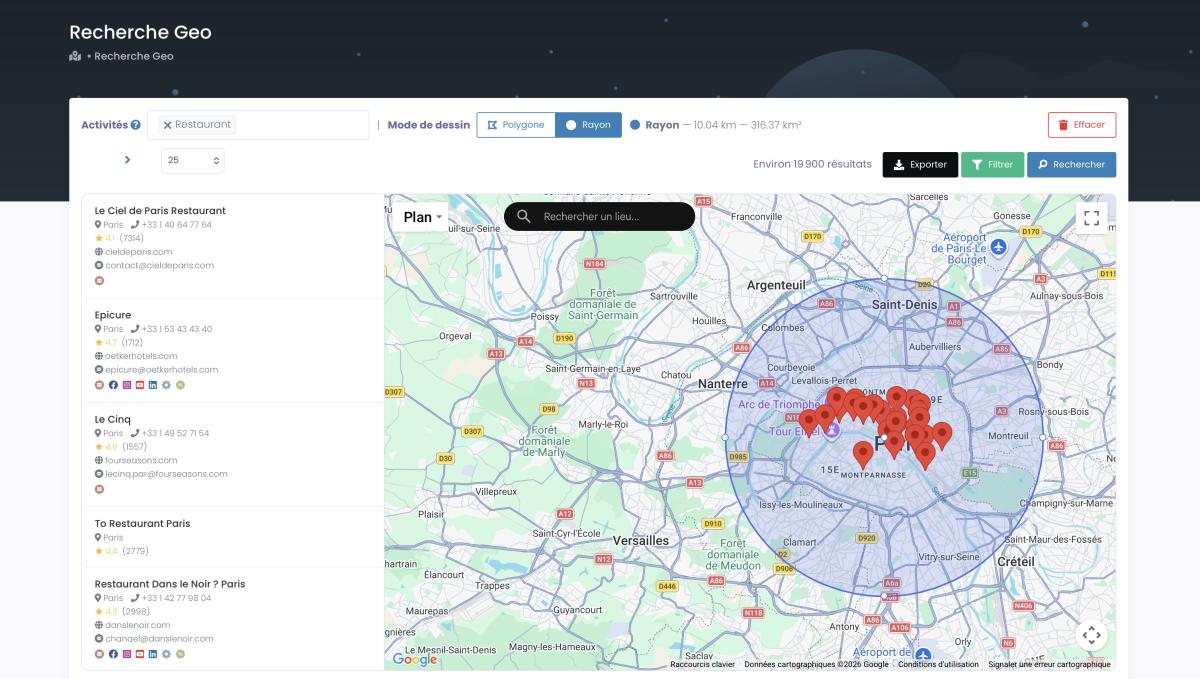
Need to trace a precise territory instead, like a metro area that spills across county lines? Sketch a polygon by hand, straight on the map, and pull only the shops inside your shape.
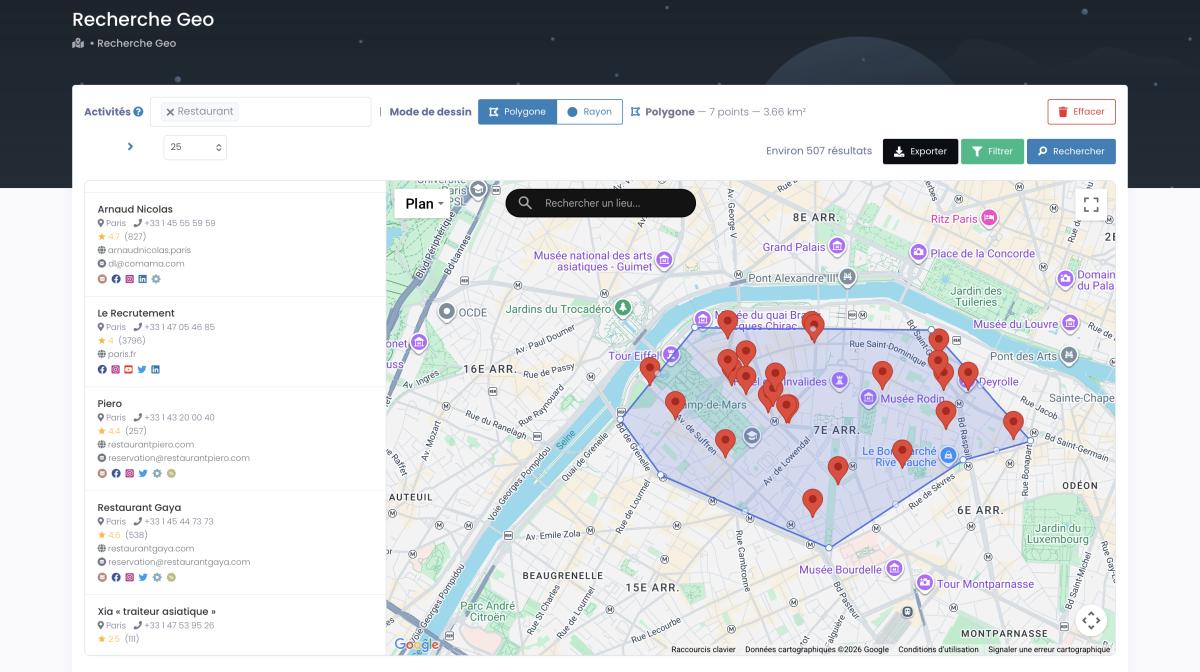
This is also how you handle the niches. "Print shop" is the big bucket, but the trade splits into specialties, and each one is its own little market. Screen printing alone counts 12,037 shops in the US on Scrap.io. Add sign companies, packaging and printing outfits, wide-format specialists, and you can assemble a screen printing shops email list for one campaign and a packaging-and-printing database for another, cleanly separated at export. Building a nationwide USA business email database is just the same move repeated across every state.
And yes, the volume holds up at scale. One Scrap.io client extracted 11,734 businesses in 45 minutes. Country-level pulls aren't a stunt here. They're Tuesday.
Turning the list into replies: cold outreach for print shops
A fresh list is wasted if your emails never land. So let's talk about turning a print shop contact list into actual conversations.
The single most useful stat on cold outreach: lists sent to fewer than 50 recipients average a 5.8% reply rate, versus 2.1% for big blasts (Cleverly, 2026). Smaller and sharper beats bigger and dumber. The B2B average sits around 27.7% open and 3.43% reply, and the top performers clear 10% by being ruthlessly specific.
So don't blast 5,000 generic "Dear printer" emails. Segment. Pull 200 sign shops in one metro, write to them like you actually know what a sign shop's day looks like, reference a real detail, and send. Then do the next segment. This is where the map-based list earns its keep: you can split it by niche, by city, by review count, straight out of the export, which makes the personalization almost automatic. If the writing itself is your weak spot, here's a guide to writing a cold email that gets replies, and the broader cold-list playbook ties the sourcing and sending together.
Does printing respond well to cold email? Honestly, it's a mixed bag, and I'd rather tell you straight than oversell it. A small print shop owner often reads every email themselves, which is great, and a print shop owner email list built this way lands straight on the desk of the person who signs the checks. But many list only a generic info@ box, which lowers your reply odds. That's exactly why the email classification matters: knowing whether you've got the owner's address or a shared inbox tells you how hard to personalize and how much to expect back.
And you're not the only one chasing these shops. The software vendors already winning in this niche prospect print shops relentlessly: shop-management platforms like Printavo (which runs 3,000+ print shops) and web-to-print systems like OnPrintShop both sell straight into this market. A fresher, better-targeted list is how you compete with companies that already live in these inboxes.
One more practical note. Keep it short, one clear ask, and follow up. Most replies come from the follow-up, not the first touch. A fresh, filtered b2b printing leads list gets you into the inbox; the sequence is what gets you the reply.
Staying compliant: CAN-SPAM, GDPR and deliverability
Is this even legal? Short answer: yes, if you follow a few rules that aren't complicated.
In the US, cold B2B email is legal under CAN-SPAM. You need honest headers, a real physical mailing address in every email, and a working unsubscribe that you actually honor. That's the core of it. Print shops are businesses, their listings and addresses are public, and emailing them a relevant offer with an opt-out is squarely within the rules.
If any of your targets sit in Europe, GDPR raises the bar. B2B contact data is generally processable under legitimate interest, but you must keep the outreach relevant, make opt-out easy, and be able to point to where the data came from. That last part is where sourcing matters legally, not just operationally.
Scrap.io pulls only publicly available business data, is GDPR and CCPA compliant, and keeps every record traceable to its source, which makes documenting a legitimate-interest basis far easier. It doesn't excuse you from honoring opt-outs at send time. But it puts you on solid ground instead of guessing where a broker's file came from.
Then there's deliverability, which is really a compliance issue wearing a different hat. Keep your bounce rate under 2% or mailbox providers start routing everything to spam, the good emails included. Authenticate your domain (SPF, DKIM, DMARC) before you send at volume. And re-check anything older than a month, because even a fresh list ages. The upside of building from live data is that your starting point is already clean, which is half the battle when you want to keep bounces low.
FAQ
How can I find a list of company email addresses for printing companies?
Build it from Google Maps instead of buying it. Search "print shop" (or your target niche) by city, state, or the whole US, filter to listings that already have an email, and export. Scrap.io counts 66,886 US print shops, 37,116 of them with an email, and you only pay for the email-present ones.
How do I get clients for my printing business?
Work it like any local B2B channel:
- Identify the buyers near you (agencies, event planners, retailers, local brands) who need print regularly.
- Build a targeted list of those businesses, filtered to ones with a real email.
- Send short, personalized cold emails to fewer than 50 at a time, since small lists reply nearly 3x more.
- Follow up, because most replies come after the first email.
- Keep your Google reviews strong, because buyers check before they answer.
Is it legal to cold-email a printing industry email list?
In the US, yes, under CAN-SPAM: use accurate headers, include your physical address, and offer a working unsubscribe you honor. In the EU, GDPR allows B2B outreach on a legitimate-interest basis if it's relevant, easy to opt out of, and traceable to a public source. Use publicly available business data and respect every opt-out.
Where can I buy a printing industry email list, and should I?
You can buy one from vendors like LakeB2B, ReachStream, Coldlytics, or RevenueBase. Should you? Usually not. Coverage runs thin (RevenueBase shows a verified email on just 12.6% of its printing records), the data is refreshed every 45 days at best, and your competitors bought the same file. Building fresh from Google Maps is cheaper per usable contact and far fresher.
How many printing companies are there in the US?
About 50,404 printing businesses in 2026 (IBISWorld), employing roughly 338,500 people (US BLS). On Google Maps, Scrap.io counts 66,886 US print shops plus 12,037 screen-printing shops, a wider net because it captures small local outfits that government registries miss. More than half of all printing establishments have fewer than five employees.
Is there a 3D printing industry email list too?
Yes, and you build it the same way. 3D printing and prototyping shops have their own Google Maps categories, so you can extract a 3d printing industry email list as its own segment, filtered to email-present businesses, without mixing it into your traditional print shop file. Same workflow, different category toggle.
Bottom line: the printing market is big, fragmented, and overwhelmingly local, which is the best possible setup for a built-from-the-map list. Stop renting a stale file that your competitors also bought. Pick your category, pick your zone, filter to email-present, and export a printing companies mailing list that's fresh the day you send it. The printing industry contacts database you actually want isn't for sale. It's for building.
Build your printing industry email list today. Start your free 7-day Scrap.io trial, 100 leads included, and pull a fresh, filtered list of US print shops straight from Google Maps: 66,886 shops indexed, email-present filtering before you spend a credit, any zone from a single city to all 50 states. Counting is always free, so size your market first.
Generate a list of print shop with Scrap.io