

The average recruiting cold email gets a reply 4.96% of the time. Nineteen out of twenty land in silence. And no, a shinier template alone won't fix that — I'll explain why in a second, but the short version is that the words matter far less than the list you send them to.
Quick disclaimer before anyone rage-clicks away: this is not about sports recruiting. If you're an athlete emailing college coaches, wrong article. This one is for recruiters, agency founders, and staffing teams writing to candidates and to the companies that hire them. Professional recruiting. B2B. The stuff that pays your invoices.
So here's the deal. Below you'll find 12 recruiting email templates you can copy today — for passive candidates, ghosting hiring managers, clients you want to win, the works. Then the part almost nobody else covers: where to actually find the people and companies you're emailing. Because a template is worthless without a fresh list of the right inboxes.
- Why most recruiting emails get ignored in 2026
- What a recruiting email that gets replies looks like (the 5 parts)
- 12 recruiting email templates for every scenario (2026)
- Recruiting email subject lines that actually get opened
- Where to find the companies (and people) to email
- Personalization & follow-up: turn a template into a reply
- Is recruiting cold email legal? (CAN-SPAM & GDPR)
- FAQ
Why most recruiting emails get ignored in 2026
Your template probably isn't the problem.
The list you're sending it to is.
Sit with that for a second, because it's counterintuitive. Everybody obsesses over copy — the hook, the subject line, the perfect sign-off. Meanwhile they're firing all that polished writing at a spreadsheet they bought 18 months ago, half of which has changed jobs, bounced, or moved on. Great email, dead inbox. No reply.
The numbers back it up. Cold recruiting email sits at a 4.96% reply rate across 4,000,000+ messages, while LinkedIn messages pull 17.08% — and pairing the two channels lifts replies by roughly +287% over a single channel (Pin, Recruiting Outreach Benchmarks 2026). On top of that, about 17% of cold emails never even reach the inbox because of authentication and deliverability issues (Gem, 2026; Saleshandy, 2026). Read that again. A sixth of your outreach is dead on arrival before anyone judges your subject line.
And the market is enormous, which cuts both ways — more targets, but also more noise. US staffing revenue is projected around $183.3 billion in 2026, up about 2% year over year (SIA, US Staffing Forecast, March 2026), and the employment & recruiting agencies segment alone runs about $34.0 billion across roughly 22,370 firms (IBISWorld, 2026). Translation: a lot of companies are hiring, and a lot of recruiters are all emailing the same tired lists.
Video: Why Your Google Maps Emails Don't Get Replies?
What a recruiting email that gets replies looks like (the 5 parts)
Every recruiting email that earns a reply has the same five moving parts. Miss one and the whole thing wobbles.
- Subject line — short, specific, human. Five or six words. Peaks at a 5.35% reply rate when kept tight (Pin, 2026).
- Hook (why you) — one line that proves you actually looked at them. A project, a review, a recent hire.
- Pitch (the role) — two sentences, max. The opportunity, and why it's relevant to them, not to you.
- Proof (what's in it for them) — a placement stat, a client name, a concrete outcome. Something to believe.
- Ask (one low-friction CTA) — "Worth a 15-minute chat this week?" beats "book a demo" every single time.
(One note for readers outside the US: "recruitment email templates" is the same animal — British and international teams tend to say recruitment, Americans say recruiting. The five parts don't care what you call them, and the recruitment email examples below translate cleanly across markets.)
That's the skeleton. Keep the body between 150 and 199 words — the exact range that replied best in Pin's 2026 data — and put the candidate's first name in the text, because emails with a first name replied at 5.13% versus 2.61% without it. Nearly double. From one merge field.
Here's the mistake I see constantly. People write a gorgeous 300-word essay about their agency's mission and history. Nobody cares. The 300-word essay was the single most common email in the whole dataset — and it underperformed.
Write less. You'll earn more.
12 recruiting email templates for every scenario (2026)
Passive candidate? Hiring manager who ghosted you? Client you'd kill to win? There's a template below for each. Steal the structure, swap in real details, and — this matters — never send one with a bracket still in it. If you can't fill the bracket, you haven't done enough research to hit send. These are recruiting email examples, not finished emails. Scaffolding, not the house.
Two housekeeping notes. First, these are free — no gated "recruiting email templates pdf," no email wall, no "recruiting email templates free (just give us your address)" nonsense. Copy them straight into your sequencer — consider this your set of the best recruiting email templates for all scenarios, in one place. Second, if you're new to this and genuinely wondering how to write a recruiting email from zero, read the five parts above first, then come back — the structure is what makes these email templates for recruiting actually work.
A quick word on where these come from. Recruiterflow claims its client templates hit 40–50% response rates — take that with a fistful of salt, since it's a vendor stat with no methodology attached. The realistic benchmark is closer to 5% on cold email, higher with personalization and follow-up. Aim high, expect real. And yes, the same recruiter email templates work whether you're writing to a candidate or pitching a company an "email for hiring new employee" support — the levers don't change, only the value prop does.
1. The passive candidate (recruiter email template to candidate)
Subject: Quick question about your work at [Company]
Hi [First name] — I came across [specific project or detail] and thought of a [role] we're filling at [client]. It's [one-line value prop: remote, senior, equity, whatever's true]. You're clearly not job-hunting, which is exactly why I'm reaching out. Worth a quick 15-minute chat this week? If the timing's off, no worries at all.
2. Reconnecting with a candidate who went quiet
Subject: Is now a better time, [First name]?
It's been about six months since I reached out about [role type]. Since then we've placed people at [Company 1] and [Company 2], and a new search came up that fits you better than the last one did. Different company, different comp band. Open to hearing the details? Ten minutes, tops.
3. The referral intro
Subject: [Mutual connection] suggested I reach out
Hi [First name] — [Mutual connection] mentioned you're one of the sharpest [role] people they've worked with. I'm running a search for [client] that lines up with your background in [specialty]. I promised [Mutual connection] I'd keep it short, so: would a brief call this week make sense? If not, I'll leave you be.
4. New business — the hiring manager who's clearly growing (recruiter email template to hiring manager)
Subject: Saw [Company] is hiring [role]
Hi [First name] — noticed [Company] has [role] open in [city]. We place [specialty] talent for firms like [Client 1] and [Client 2], and 96% of the people we place hit their targets in year one. I've got two vetted candidates who'd fit. Want me to send their profiles over, or grab 15 minutes this week?
5. The client you want to win (recruitment email templates to clients)
Subject: [First name] — quick idea for your Q3 hiring
Hi [First name] — [Company]'s growth over the last two quarters has been hard to miss. We specialize in [niche] recruiting and recently placed leaders at [Client 1] and [Client 2], with an average tenure of 4.1 years versus the 2.3-year industry norm. Would it make sense to compare notes on your Q3 roadmap? I've got specific candidates in mind already.
6. The "I already have your candidate" (MPC) email
Subject: A [role] who wants to work at [Company]
Hi [First name] — I'm talking to a [role] who named [Company] as a target. In their current seat they've [specific, quantified win]. If that seat's still open, I'd love 15 minutes to walk you through them. If it's filled, tell me and I'll stop — no hard feelings.
7. The short cold candidate (cold recruiting email template)
Subject: [First name] — got a minute?
You probably get these constantly, so I'll be quick. Your background in [X] caught my eye for a [role] at one of our clients. Are you open to a chat? If not, totally fair — just wanted to put it on your radar.
8. Real estate agent recruiting email (real estate recruiting email templates)
Subject: Your [neighborhood] listings caught my eye
Hi [First name] — I've watched you move [X] listings in [neighborhood] this year. Impressive in this market. I'm helping [brokerage] add agents who already own their local reputation, with [specific perk: better split, marketing support, leads]. No pressure to leave anything good — but if you're curious what a switch would look like, worth a coffee?
9. Outbound to a company that just posted a role (outbound recruiting email template)
Subject: Filling your [role] before it drags on
Hi [First name] — saw [Company] just posted for [role]. These openings sit an average of 36–44 days. We can shorten that: three qualified, pre-screened candidates in your inbox within a week, or you don't pay. Want me to start?
10. The value-first candidate email (best first email to a recruiter, flipped)
Subject: [Role] at [Company] — thought of you
Hi [First name] — your work on [specific thing] tells me you'd thrive on what [client] is building: [one-line description]. It's [comp/remote/scope detail]. I'm not going to pretend it's perfect for everyone, but for someone with your [specific skill], it's a genuinely strong move. 15 minutes to see if it's a fit?
11. The hiring-manager follow-up after a call
Subject: Re: our chat about your [role] search
Great talking earlier about the [role] gap on your team. Here's the case study I mentioned — [Similar company] filled the same seat in [X] days after we took it on. I'll send two profiles by Thursday. Anything change on the must-haves since we spoke?
12. The break-up email
Subject: Should I close your file?
Hi [First name] — I've reached out a couple of times and haven't heard back, which is completely fine. I'll assume the timing's off and stop here. But if [specific pain: a hard-to-fill role, a key departure] ever lands on your desk, just reply to this thread and we'll pick up where we left off. Good luck with [something specific].
Want the sales-side equivalents for pure prospecting? Our cold email templates that generated $20M in sales break down the framework in depth. And if you're recruiting talent from local employers, the candidate sourcing on Google Maps guide pairs perfectly with these templates.
Recruiting email subject lines that actually get opened
Your subject line is the bouncer. Doesn't matter how good the party inside is if nobody gets past the door. And in recruiting, the door is unforgiving — most inboxes are a wall of "exciting opportunity" spam.
Here's what the data actually rewards. Five-to-six-word subjects peaked at a 5.35% reply rate; one-word teasers and 10-word essays both did worse (Pin, 2026). Questions beat statements. Company names beat cleverness. Recruiting email subject line examples that pull their weight:
- "Quick question about [Company]"
- "[First name] — got a minute?"
- "[Mutual connection] suggested I reach out"
- "Saw [Company] is hiring [role]"
- "Is now a better time, [First name]?"
- "Your work on [project] — one question"
- "A [role] who wants to work at [Company]"
- "Should I close your file?"
What kills opens? Anything that smells like a newsletter. "Exciting Career Opportunity." "Let's Connect." "Monthly Update." Straight to trash. Same with ALL CAPS and exclamation marks — you're writing to a busy professional, not selling supplements at 2am. For the full breakdown, here's our guide to email subject lines that get opened.
Where to find the companies (and people) to email
Take Sarah. Great templates. Polished sequences. Follow-up discipline most recruiters would envy. And a prospect list she bought a year and a half ago that's now half-dead — every third send bounces, and the domain reputation is quietly eroding with each one.
Sarah's problem isn't her writing. It's her data. This is the gap every recruiting-email article skips: they hand you templates and wave vaguely at "your list" as if the list appears by magic.
It doesn't.
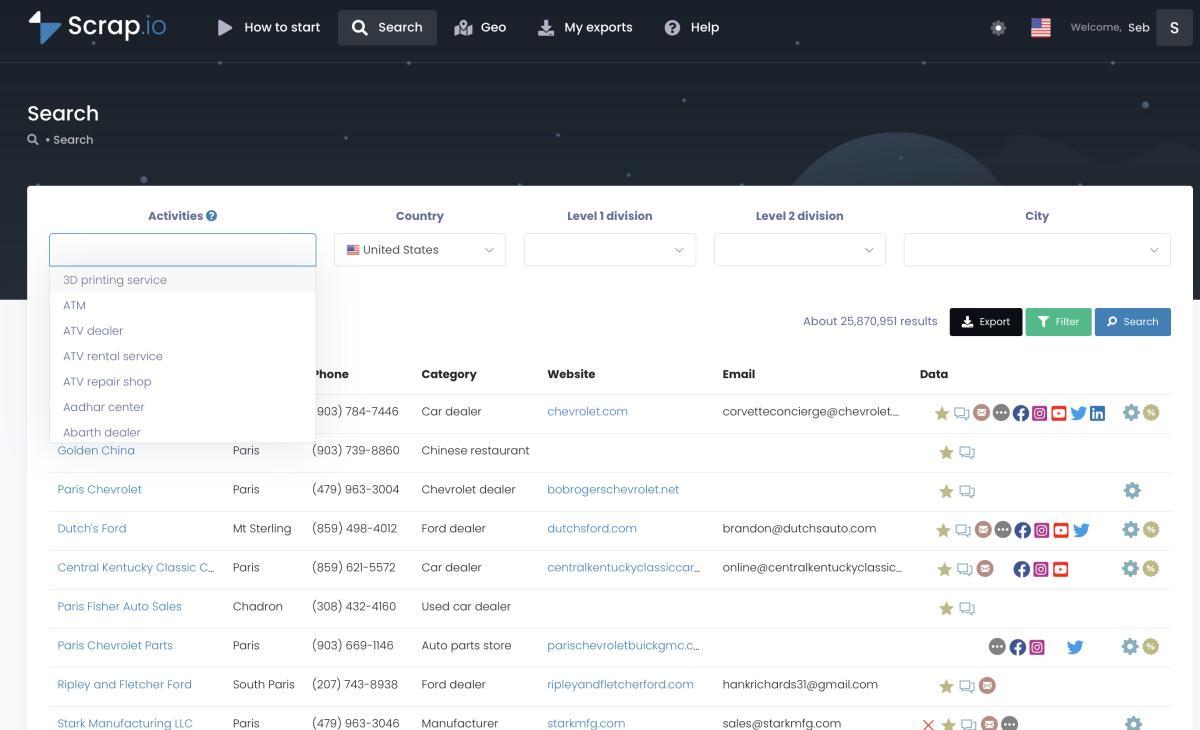
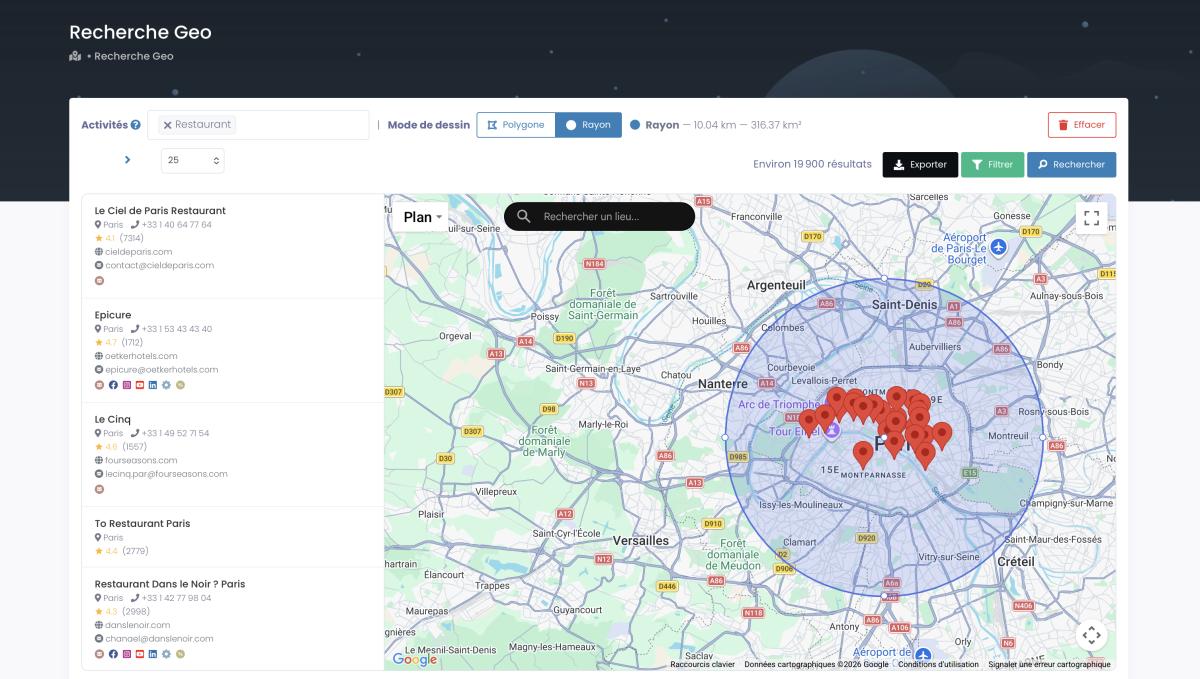
So here's the underused move — build the list from Google Maps. Every company that hires maintains a listing: address, phone, website, public email. That's true whether it's a staffing agency you want as a client, a growing clinic that needs people, or a local employer whose whole team is invisible on LinkedIn. Scrap.io extracts that data in real time across 225,676,406 businesses, 195 countries, and 4,000+ categories — and it validates each record at the moment you export, so you're never firing at a fiche that died last spring.
How concrete does this get? We re-ran the "employment agency" category across the US on August 1, 2026:
| US employment & recruiting agencies (Google Maps) | Count | Share |
|---|---|---|
| Total indexed | 60,206 | 100% |
| With a website | 36,485 | ~61% |
| With a public email | 27,779 | ~46% |
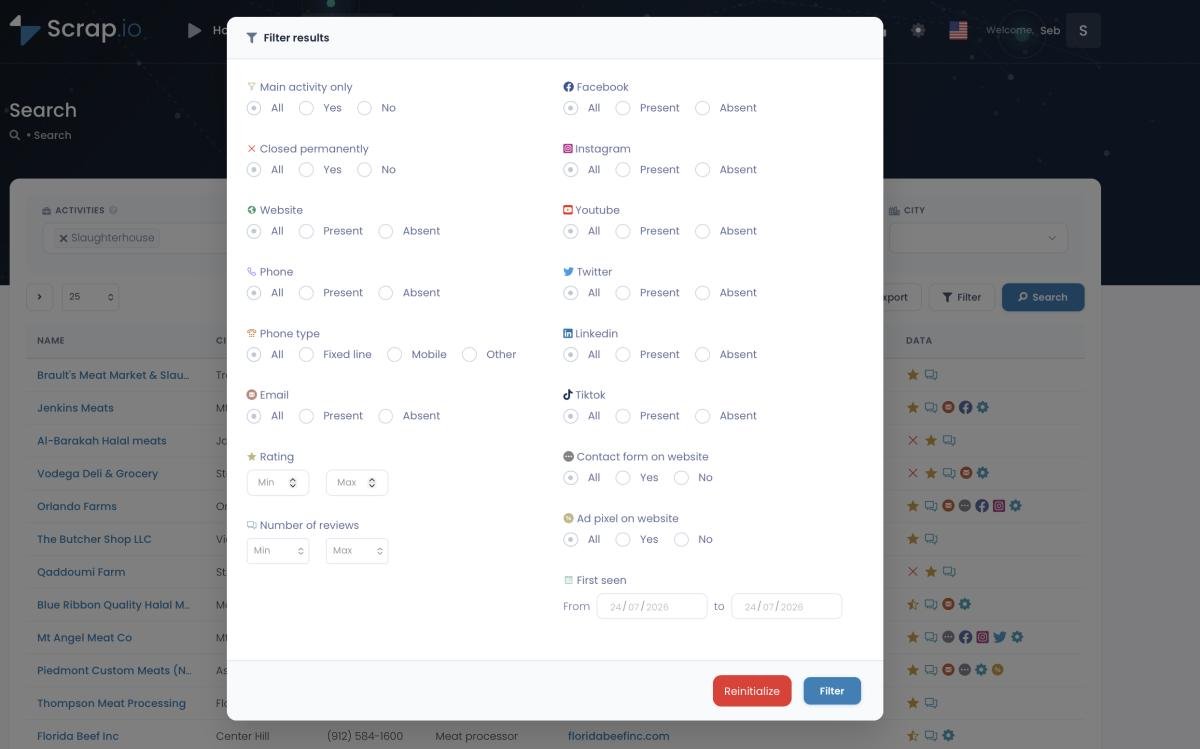
So you've got the template. Here are the 60,206 recipients you didn't. And because you filter to "email present" before extracting, you only spend credits on the 27,779 you can actually reach — not the 32,000 dead ends. That's the whole game: filter first, pay second. It's also how you avoid manually digging through Google Maps one pin at a time.
The workflow is four steps, no code: pick your categories, set your zone (a city, a state, or the entire US), toggle the "has email" filter, export to CSV. Two clicks and you're loading a fresh list into your sequencer the same afternoon.
New to the tool? The two-minute starter walks you through it:
Video: Scrap.io - How to Start?
And if you want to see the whole thing driven by AI — building the list and drafting the outreach — here's the vibe-prospecting walkthrough:
Video: How to Scrape Local Leads with Claude & Vibe Prospecting
If your target is recruiting firms themselves — say you sell software or services to them — start from our ready-made staffing agencies list and filter it down to your city.
Personalization & follow-up: turn a template into a reply
Templates are maybe 20% of the outcome. Data quality and follow-up discipline are the other 80%. I know that's a blunt thing to say in an article full of templates, but it's the honest math.
Start with follow-up, because it's the cheapest win in the whole channel. Three touches capture 93.2% of every reply a sequence will ever earn; a fourth gets you to 97.7% (Pin, 2026). Yet most recruiters send one email and quit. One. Space your touches about two business days apart — Day 0, Day 3, Day 7 — and you'll out-persist nearly everyone competing for the same inbox.
| Channel | Reply rate (2026) |
|---|---|
| Cold email | 4.96% |
| LinkedIn message | 17.08% |
| Email + LinkedIn (multichannel) | +287% vs single channel |
Then personalization. Not "Hi {first_name}" — that's a merge tag, not personalization. Real personalization references their actual work, and it pays: 5.13% vs 2.61% with a first name alone, and more when you go deeper. Even old-school effort still wins — handwritten notes reportedly convert at 12.6% versus 5% for AI-only outreach (Pin, 2026). The lesson isn't "go analog." It's "prove you looked."
Which is exactly why the data source matters here too. Scrap.io pulls the individual email plus the first name for each business, so your merge fields are never empty and your "personalized" send doesn't read like a form letter. For the full sequence playbook — timing, spacing, break-up emails — see our cold email follow-up sequences guide.
Recruiters feel this dependency daily. As one internal recruiter put it on r/recruiting: "I've been an internal recruiter for 4+ years and live and swear by LinkedIn for its sheer volume of candidates…" — which is precisely why email plus a second channel is such an edge. Everyone's crowding the same pond. Bring a different net.
Is recruiting cold email legal? (CAN-SPAM & GDPR)
The slightly-less-fun but non-negotiable part: is any of this legal? Short answer, yes — done right.
In the US, cold email is governed by CAN-SPAM, and it explicitly makes no exception for business-to-business email. The rules aren't complicated: accurate headers, a subject line that matches the content, a valid physical postal address, and a working opt-out you honor within 10 business days. Each violating email can cost up to $53,088, so it's worth the five minutes (FTC, CAN-SPAM Compliance Guide).
| Region | Law | Basis | Must-do |
|---|---|---|---|
| United States | CAN-SPAM | Opt-out | Accurate headers, real address, working unsubscribe |
| EU / UK | GDPR + ePrivacy | Legitimate interest | Relevance, easy opt-out, document your basis |
In the EU and UK, B2B cold email is generally allowed under the "legitimate interest" basis — you have a defensible reason to contact that specific professional — as long as you offer an easy opt-out and can explain why you reached out. One thing makes all of this dramatically simpler: using publicly available business data. When a company published its email on its own Google Maps listing, and every record is traceable to that source, documenting your legitimate interest gets a lot easier. That's a fundamentally cleaner position than a list you bought from a broker in a Telegram group. For the deep dive, read our GDPR cold email compliance guide.
FAQ
How do you write a recruiting email?
Keep it under about 120 words with five parts: a personalized subject line, a one-line "why you" hook, a two-sentence pitch, one proof point, and one low-friction ask. Personalize at least one line — including the candidate's first name nearly doubles reply rate (5.13% vs 2.61%). Then follow up two or three times, because three touches capture roughly 93% of all replies.
What is an example of a recruiting message?
"Hi [First name] — I came across your work on [specific project] and thought of a [role] we're hiring for at [company]. It's [one-line value prop]. Worth a quick 15-minute chat this week? If not, no worries." Short, specific, one ask. That's the whole recipe.
What is the 30/30/50 rule for cold emails?
It's a rough framework for where results come from: about 30% on the target list, about 30% on the subject line and deliverability, and the remaining 50% on the body plus follow-up. The point is blunt — who you send to, and whether it even arrives, matter more than clever copy. Some practitioners flip it to 50/30/20 with list quality weighted highest.
What's the average reply rate for a recruiting email in 2026?
About 4.96% on cold email versus roughly 17% on LinkedIn messages (Pin, 2026). Top-quartile teams clear 5.5%+, and elite personalized campaigns push 10–25%. Pairing email with a second channel lifts replies by around 287% over a single channel.
Is recruiting cold email legal in the US and EU?
Yes, done right. In the US, follow CAN-SPAM: accurate headers, no deceptive subject, a physical address, and a working opt-out — it applies to B2B email too. In the EU and UK, rely on GDPR's legitimate-interest basis with an easy opt-out. Use only publicly available business data, and keep every record traceable to its source.
Great templates deserve a great list
The template was never the hard part. You've got 12 of them now, plus the subject lines, the follow-up cadence, and the compliance basics. What separates the recruiters who book meetings from the ones refreshing an empty inbox is the list — fresh, filtered, and full of real contacts, not a bought file rotting since last year.
So build the list, then send like you mean it.
Generate a list of restaurant with Scrap.io