

There are 20,933 private security companies operating in the United States right now. I know the exact number because I counted them this morning. The problem? Try finding a usable list of security companies you can actually contact — one with emails, phone numbers, the works. Go ahead. I'll wait.
You'll get a Wikipedia page with fifteen giant names and zero contact details. Or a "Top 10" listicle written to sell you a home alarm. None of it helps if your job is to reach these firms, not hire one.
So this guide does the opposite. We'll cover the real market data (the 2026 numbers, sourced), the handful of giants everyone already knows, and then the part nobody explains: how to build your own fresh security company email list — filtered, verified, exportable — in about the time it takes to microwave lunch.
Video: Scrap.io — How to Start
What's in this guide
- How big is the US private security market? (2026 data)
- Top security guard companies in the US (the giants)
- Why a list from Google or Wikipedia is useless for prospecting
- Where security companies actually live: Google Maps
- How to build a fresh list with emails (step by step)
- Filter before you export: only pay for usable leads
- Who buys a security company list? (real B2B use cases)
- Buying vs building: the deliverability trap
- Is it legal? Compliance (GDPR/CCPA)
- FAQ
How big is the US private security market? (2026 data)
The US security services industry is a $49.8 billion machine (IBISWorld, 2025) — and it's more fragmented than almost any other sector you'll prospect into. That last part is the whole opportunity, so hold onto it.
Here's the shape of the market in plain numbers. There are 113,688 security services businesses in the US as of 2026, up 3.5% from 2025 and growing at 5.7% a year over the past five years (IBISWorld, 2026). On the labor side, the country employs 1,272,400 security guards, with roughly 162,300 job openings every year just to cover turnover (U.S. Bureau of Labor Statistics, 2024). Median guard pay sits at $38,370. That churn number matters — a workforce that turns over that fast is a workforce that's constantly buying scheduling tools, training, insurance, and software.
And the growth isn't slowing. The global private security market is projected to add $280.4 billion between 2026 and 2030, an 11.8% CAGR, with manned guarding as the single biggest segment (Technavio, 2026). Manned guarding. Not cameras, not apps — boots on the ground. Which is exactly the kind of local, physical business that lives on a map and not on LinkedIn.
One more thing worth internalizing before you go hunting for names. IBISWorld classifies this market as "low market share concentration" — corporate speak for "thousands of small regional players and no dominant winner." Great for the giants' PR teams. Even better for you, because it means the real list of private security companies is enormous, scattered, and almost nobody has bothered to compile it with contact data. So let's start with the names you already know, and then get to the ones you don't.
Top security guard companies in the US (the giants)
Everyone lists Allied Universal, Securitas and GardaWorld. And for a salesperson, those three are the least useful names on the page. You're not closing a deal with Allied Universal by cold email — they have a procurement department the size of a small town.
Still, context matters, so here are the biggest private security companies in the US, the ones that dominate the national contracts.
| Company | HQ | Scale | Type |
|---|---|---|---|
| Allied Universal | USA | ~800,000 staff, 100+ countries | Manned guarding + tech |
| Securitas USA | Sweden (US arm) | Global top-tier | Guarding + monitoring |
| GardaWorld | Canada | National contracts | Guarding + cash services |
| Inter-Con Security | USA | Government + corporate | High-security |
| Prosegur | Spain (US arm) | Global | Guarding + cash logistics |
If you searched top 10 security guard companies in usa, round that table out with Walden Security, Brosnan Risk Consultants, Constellis, Sunstates Security and Inter-Con — the usual suspects by revenue. The biggest security company overall is Allied Universal: north of $21 billion in revenue, roughly 800,000 employees, operations in 100+ countries (Allied Universal, 2025). Genuinely enormous.
But here's the thing nobody says loudly enough. Those ten names are a rounding error. They're maybe 0.05% of the 20,933 security companies in the US. The other 20,900-plus — the regional patrol firm in Tampa, the event security outfit in Nashville, the two-county guarding company outside Phoenix — those are the ones who open cold emails, switch suppliers, and actually reply. That's where the money is. So why does every "list of security companies in usa" stop at the giants?
Why a list from Google or Wikipedia is useless for prospecting
Ever tried to actually contact the companies on a Wikipedia "list of private security companies"? Good luck finding an email. You get a name, maybe a country of origin, and a hyperlink to a corporate homepage where the "Contact Us" form disappears into a void.
The other sources aren't better. A Yelp "Top 10 in LA" gives you one city and no exportable data. A NASCO directory PDF from 2022 lists giants without a single phone number. And the "8 best security companies" listicles? Written to rank for ads, aimed at homeowners, useless for B2B.
Quick clarification while we're here, because the search results are a mess: this article is about security guard and manned-guarding services — patrol, event security, executive protection. It is not about the folks who bolt cameras to your wall. If that's what you're after, we've got a separate security system installer email list guide. Different industry, different buyers, don't mix them up.
Every one of those static sources shares the same three fatal flaws. Not exportable. No contact data. And frozen the moment they were published. A directory is a photograph. Prospecting needs a live feed. So where do you get one?
Where security companies actually live: Google Maps
The best directory of security companies isn't a directory.
It's Google Maps.
Think about it. A regional guarding company wants to be found by local property managers, so it puts itself on the map — with a website, a phone number, reviews, hours. Multiply that by every patrol firm, event security outfit and protective-services provider in the country, and you've got the most complete, most current list of security companies anywhere. It's just not shaped like a list. Yet.
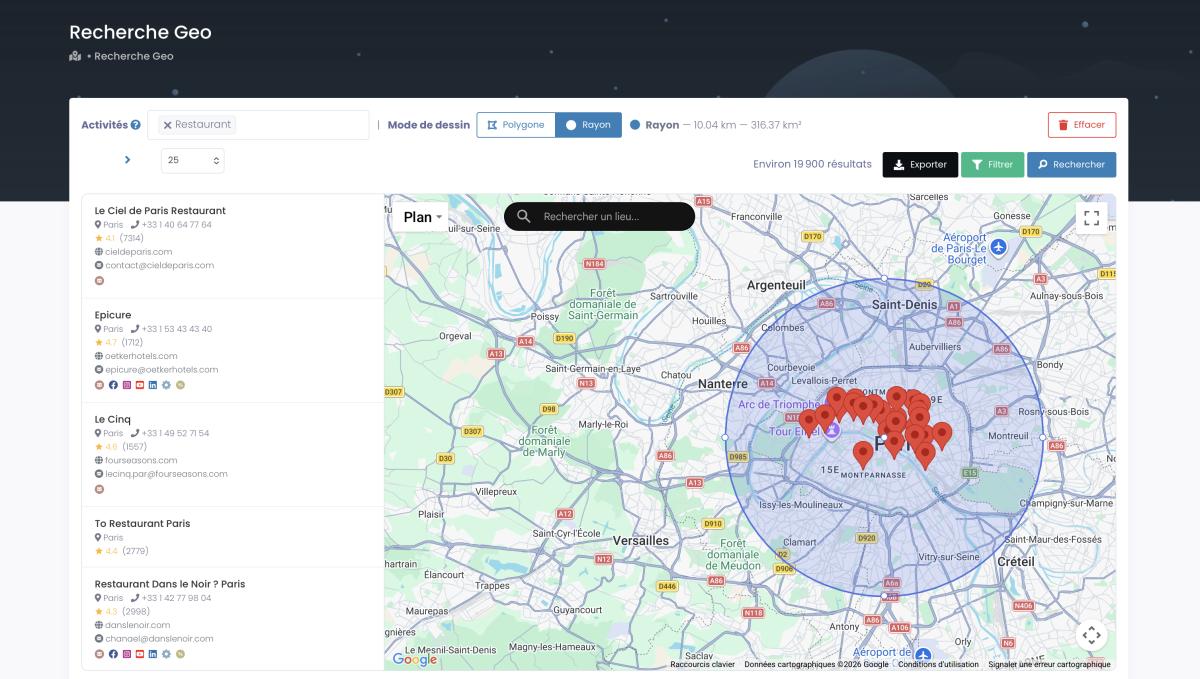
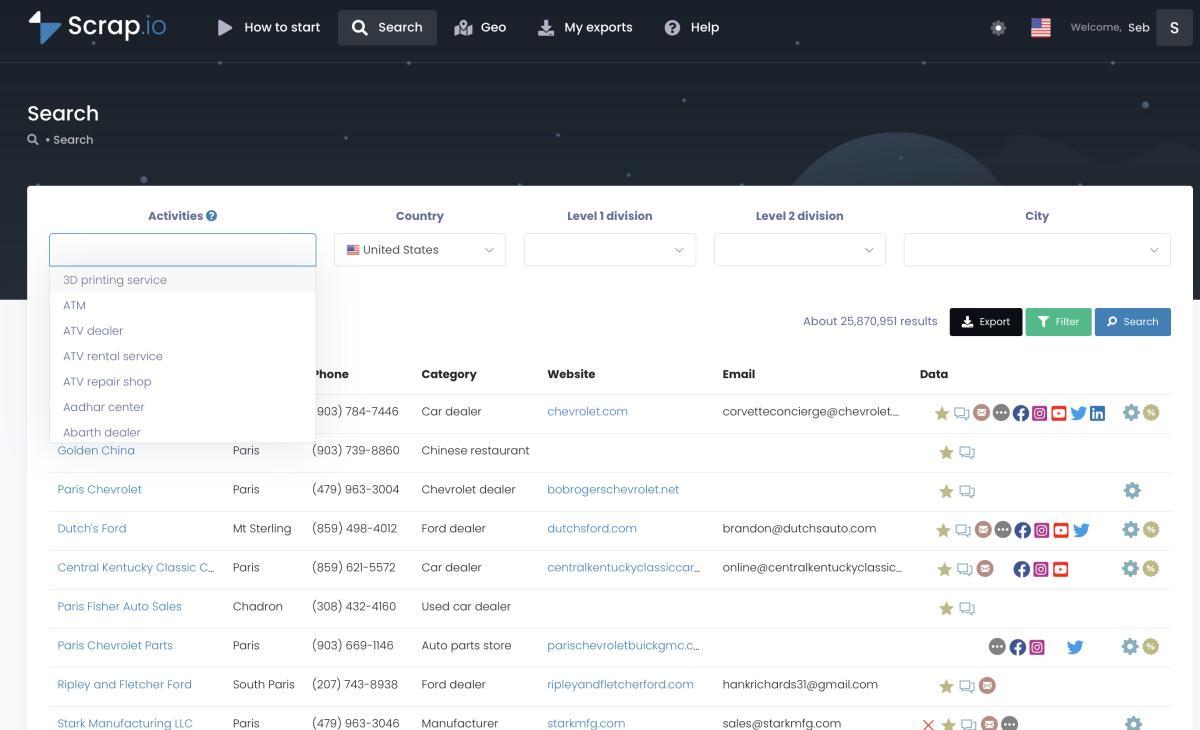
This is where a tool like Scrap.io earns its keep. It reads the Google Maps categories Security guard service and Security service, crawls the website behind each listing, and turns the whole thing into a spreadsheet. The numbers, pulled live the day I wrote this:
| US security companies indexed | With a public email | With a website | With a phone number |
|---|---|---|---|
| 20,933 | 10,609 | 15,232 | 19,975 |
Read those numbers again. Over half the firms have a public email. Nearly three-quarters have a website. And 95% have a phone. No Wikipedia page comes remotely close — and unlike a frozen directory, you can slice this by city, county, state or the whole country. Need security guard companies near me, or every firm in Texas, or the full national set? Same tool, different zone. Want to learn the mechanics of pulling contacts off the map, there's a dedicated how to find emails on Google Maps walkthrough.
See how many security companies Scrap.io finds in your state — counting is free. No credit spent, no export needed. Type a category, pick a zone, and get the exact count of firms (and how many have emails) before you commit to anything. Check your market →
How to build a fresh list with emails (step by step)
Meet Dave. He sells scheduling software to guard firms. Last month he built a list of 6,000 of them before lunch. No data broker, no VA in a spreadsheet, no three-week wait. Here's exactly what he did — and yes, it really is this short.
- Pick the category and zone. Choose Security guard service (and Security service if you want the full net), then set your area — a single city, a county, a whole state, or the entire US. The tool shows how many results match before you spend a cent.
- Filter to "email present" — before extracting. Toggle the email filter so only firms with a real address get counted. This is the step that saves your budget. More on that in a second.
- Count for free. Hit the count button. It tells you exactly how many private security contracting companies match your filters — across a whole country if you want — and it costs zero credits.
- Preview, then export. Glance at the data (names, phone types, email classifications), then export to CSV or Excel. One credit per business. Re-export the same firm within 30 days and it's free.
- Drop it into your sequencer. Load the file into your cold email tool and you're sending the same afternoon.
Two clicks and no code. That's the actual workflow. Dave pulled his 6,000 in one sitting, and because the count step is free, he sized the whole national market before spending a single credit. If you want to nerd out on the sourcing side, our guide on how to build a cold email list goes deeper, and the lead scraper breakdown compares the tools honestly (including where Scrap.io isn't the right pick).
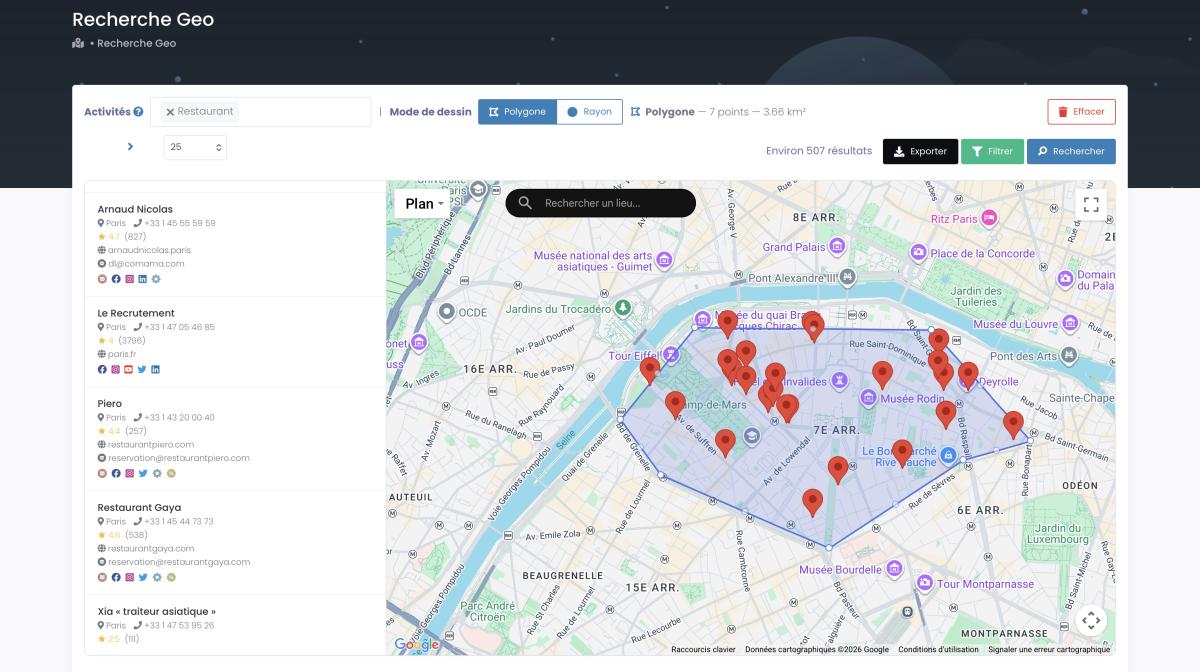
Scaling this to a whole country is where it gets fun. Google Maps caps visible results at about 120 per search, so a DIY scraper has to loop through every city one at a time — slow, expensive, and it still misses listings. A purpose-built index skips that ceiling entirely: pick the category, pick "United States," hit export.
Video: How to Scrape Local Leads at the Country Level
Build your own list of security companies now — start a free 7-day trial (100 export credits included). Any category, any zone from a single city to all 50 states, filtered to email-present firms before you spend a credit. Start free →
Filter before you export: only pay for usable leads
Nothing burns a prospecting budget faster than paying for 10,000 leads and finding half have no email. You've bought a spreadsheet of dead ends, and now you're deleting rows in Excel to clean up a mess you paid for. Sound familiar?
The fix is embarrassingly simple: filter before extraction, not after. Scrap.io applies every filter before a single credit is consumed. So instead of exporting all 20,933 firms and hoping, you filter for "email present" and go straight to the 10,609 that actually have one. Zero waste. You pay for contactable leads, full stop.
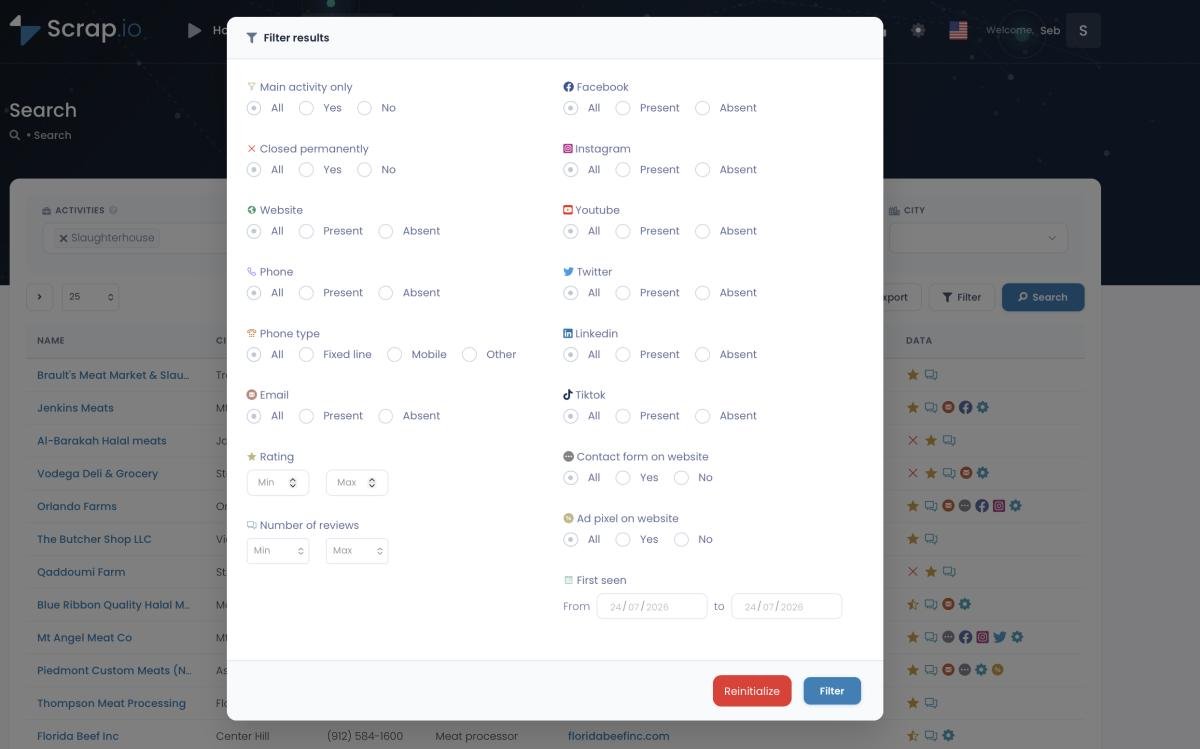
And email presence is just the start. Want firms with a website but no ad pixel (they need marketing help)? Filter it. Highly-rated companies only? Set a minimum star count. Recently-detected listings — brand-new firms that just opened? There's a filter for that too. One caveat, stated plainly: phone-type detection (mobile vs landline) isn't available for US and Canada numbers, so if you were planning an SMS-only campaign filtered by mobile, that specific toggle won't help you stateside. Good to know before you sign up.
Video: Finding Clients Through Google Maps Filters
Who buys a security company list? (real B2B use cases)
Who actually needs a list of security companies? More people than you'd think. And the proof is that entire software companies exist to sell to this exact industry — which means someone, somewhere, is very interested in reaching all 20,933 of them.
Look at the players. TrackTik and Belfry Software both build workforce-management platforms aimed squarely at guarding firms. Trackforce (Valiant) runs its software across 300,000+ security professionals on 30,000+ sites in 45 countries — a whole business built on the back of this market. Thinkcurity is literally a prospecting hub for the security industry. And here's my favorite bit of proof: Silvertrac Software publishes cold email templates for selling to security companies. They wouldn't write those if the use case weren't real.
So who's buying these lists? Software vendors (scheduling, incident reporting, RMR billing). Marketing and web agencies chasing local service businesses. Uniform and equipment suppliers. Insurance brokers with bundled deals. Recruiters filling those 162,300 annual openings. Even other private armed security firms scouting subcontractors and partners. If you sell anything a guarding company needs, this list is your total addressable market. Learn to write the outreach itself with our guide on how to write a cold email, and if you sell across verticals, an email list by industry approach lets you repeat the exact same play for locksmiths, contractors, and everyone else on the map.
Buying vs building: the deliverability trap
Roughly 28% of B2B email addresses go stale every year (Prospeo, 2025). Read that as: the list you buy today is already rotting. By summer, a chunk of it is dead — people quit, firms fold, mailboxes get shut off.
That's the trap with a bought list of security companies. It's static the moment it's compiled, and you're never the only buyer. That same "exclusive" file got sold to a dozen other senders who already carpet-bombed those inboxes. A purchased, unverified list routinely bounces 20%+, versus under 2% for a clean one. And a bounce rate north of 2% doesn't just lose you those addresses — it tanks your whole domain's sender reputation and sends even your good emails to spam. One bad list. Months of cleanup.
Building fresh sidesteps all of it. Because the data is extracted live at the moment you export — from both the map listing and the company website — it's as current as the source. No warehouse, no six-month-old snapshot. If you want to be thorough, still run the file through a checker; here's how to verify your email list before the first send. And if you're weighing the purchase route anyway, our honest take on why buying email lists usually backfires is worth five minutes.
The contract security industry has always been like this, by the way. A Congressional Research Service report put it well two decades ago: "The contract guard industry is somewhat fragmented, however, with several large national companies and thousands of smaller regional and local companies" (Congressional Research Service, 2004). Thousands of small firms, constantly changing. You can't capture that in a static file. You have to pull it live.
50,000+ professionals build fresh lists with Scrap.io instead of buying stale data. Real-time extraction from 225 million+ businesses across 195 countries, rated 4.8 on Capterra and 4.9 on G2. Try it free →
Is it legal? Compliance (GDPR/CCPA)
Now for the less fun but essential part: yes, prospecting businesses is legal — under conditions.
Publicly listed business contact data — the email a security firm published on its own website, the phone number on its Google listing — is fair game for B2B outreach. In the US, CAN-SPAM sets the rules: accurate sender info, a real physical address, honest subject lines, and a working opt-out you honor within ten business days. That's the whole bar, and it's not high. Under GDPR, if you ever email EU-based firms, "legitimate interest" (Article 6) covers B2B prospecting as long as your targeting is relevant and you offer an easy opt-out. California's CCPA carves out publicly available business information entirely.
The part that actually protects you is traceability. When a regulator asks where you got a contact, "we bought a list" is a red flag; "this firm published its business email on its public Google Maps listing, and we targeted it because it matches our industry and location" is an audit-proof answer. Scrap.io only pulls publicly available business data, is GDPR and CCPA compliant, and keeps every record traceable to its source. For the full breakdown, here's our guide to GDPR cold email B2B and where to source data for the USA business email database the right way.
FAQ
What are the top 10 security companies in the US?
Allied Universal, Securitas USA, GardaWorld, Inter-Con Security, Prosegur, Walden Security, Brosnan Risk Consultants, Constellis, Sunstates Security and Guardsmark rank among the largest by revenue. But those ten are a tiny fraction of the 20,933 security companies operating in the US — and for B2B outreach, the thousands of regional firms are far more reachable.
How many security companies are there in the US?
As of July 2026, Scrap.io indexes 20,933 private security and security guard service companies on Google Maps, of which 10,609 have a public email and 15,232 have a website. IBISWorld counts 113,688 businesses in the broader security services industry (2026).
Who is the biggest security company?
Allied Universal — over $21 billion in revenue, roughly 800,000 employees, and operations in more than 100 countries (2025). It's consistently the largest private security firm in the US and one of the largest security companies in the world.
Where can I get a list of security companies with emails?
Directories list a handful of names without contact data. To get a usable list, extract the Security guard service and Security service categories from Google Maps with a tool like Scrap.io, then filter for companies that have an email — that narrows the field straight to the 10,609 contactable firms. Export to CSV and you're done.
Is it legal to send cold emails to security companies?
Yes. B2B prospecting on publicly available business data is legal in the US under CAN-SPAM (accurate headers, real address, working opt-out) and in the EU under GDPR's legitimate-interest basis. Keep your data traceable to its source, and honor every unsubscribe.
Get your list before your competitors do
The giants aren't your market. The other 20,900 firms are — the regional patrol companies, the event-security outfits, the two-county guarding firms in Phoenix and Tampa and Nashville who read their own inbox and actually reply. No Wikipedia page hands you those with an email attached. You build that list, fresh, from the map.
Your competitors are already emailing these companies. So the only real question is whether you pull your list before or after they do.
Your competitors are already emailing these 20,933 companies. Get your list today — 7 days free, 100 leads on us. Pick your category, pick your zone, filter to email-present firms, and export a fresh, verified list of security companies in minutes. Build your list now →
Generate a list of security guard service with Scrap.io