

Here's a number that should stop you before you spend a dime. Roughly 22.5% of a B2B database goes bad every single year — people quit, companies fold, inboxes die (HubSpot). Some studies put email decay north of 70% (Landbase, 2026). So the shiny "verified" list you buy this morning? It's already rotting by lunch.
That's the uncomfortable truth nobody selling you a list wants to lead with.
And yet the market for it is enormous — data brokers pull somewhere between $363 billion and $464 billion in 2026, heading toward $519–656 billion by the early 2030s (Mordor Intelligence, Grand View Research). A lot of that money buys files that were stale before the invoice cleared. This guide ranks the real mailing list companies — the ones that actually sell you contacts, not the ones that just send emails — with 2026 pricing, honest notes on data quality, and the compliance stuff everyone skips. Then it shows you the option almost none of them will mention: building your own list from Google Maps, in real time. If you're weighing outsourced data providers more broadly, our roundup of the best lead generation companies pairs well with this one.
What's in this guide
- What mailing list companies actually sell (and the confusion)
- The 8 best mailing list companies in 2026 (compared)
- How much does it cost to buy a mailing list in 2026?
- Is buying a mailing list a good idea? The data-decay problem
- How to choose a mailing list provider (7-point checklist)
- Is it legal to buy mailing lists? GDPR, CCPA & CAN-SPAM
- The smarter alternative: build your list from Google Maps in real time
- Mailing list companies vs Scrap.io: side-by-side
- FAQ
What mailing list companies actually sell (and the confusion)
Type "best mailing list companies" into Google and you'll get two completely different answers. Half the results sell you a tool to send emails — MailerLite, Brevo, Kit, that whole crowd. The other half sell you the emails themselves. You want the second kind. Google's AI Overview mixes them up constantly, so let's kill that confusion in the first hundred words.
A mailing list company — sometimes called a list broker, a list vendor, or a data provider — sells you contact records. Names, postal addresses, phone numbers, and often business emails. You buy or license the file, then you do the outreach yourself. That's the model behind the direct mailing list providers and email list companies we're ranking here.
An email marketing platform is the opposite animal. It sends messages to a list you already own. Confuse the two and you'll either buy software when you needed data, or buy data when you needed software. Neither is cheap. Neither is refundable once you've clicked send.
So which do you actually want? If your sentence is "I need to reach a bunch of businesses I don't have yet," you want a data provider. If it's "I need to email people who already signed up," you want a platform. This article is about the first group — the business mailing lists, the consumer and residential files, the B2B contact databases. The ones you buy.
The 8 best mailing list companies in 2026 (compared)
There's no single "best" mailing list company. There's only the best for your budget, your target, and how fast your data needs to be true. A residential direct-mail campaign has almost nothing in common with a B2B cold email push, and the vendor that nails one will flop at the other.
Here are the eight names that keep surfacing when people search for reputable mailing list companies and top mailing list companies in the USA. Honestly, we did the annoying part for you — read the mailing list companies reviews, dug through the best mailing list companies reddit threads, clicked past the sales pages — so this shortlist of direct mailing list companies and best mailing list providers is the signal, not the noise. Prices are 2026 figures; treat every vendor accuracy stat as a claim, not gospel — because it is one.
| Company | Type | 2026 pricing | Data quality (their claim) | Best for |
|---|---|---|---|---|
| BookYourData | B2B email, pay-as-you-go | From $99 / 250 credits (~$0.40/contact), down to ~$0.10 at 10k | 500M+ profiles, 97% deliverability guarantee | B2B email, no subscription |
| LeadsPlease | US list broker (mail + email) | $0.60 → $0.24/record (50k); business email from $299.75 / 500 | 98%+ accuracy, USPS-verified | Transparent per-record buying |
| Melissa | Enterprise data | ~$12,300/yr for 1M records | Large legacy dataset | High-volume enterprise buyers |
| Salesgenie | Subscription platform (Data Axle) | Subscription required — no one-shot buy | Big compiled B2B/B2C database | Teams wanting an ongoing tool |
| Data Axle (InfoUSA) | Enterprise data licensing / API | Quote-based | Legacy compiled data (parent of Salesgenie) | Enterprise / agency licensing |
| DirectMail.com | Consumer/residential list platform | Quote-based, demographic targeting | Consumer direct-mail data | Residential lists by demographics/zip |
| PostcardMania | Full-service direct mail | Done-for-you; "1,000 free records" offer | Bundled list + print + mail | Hands-off postcard campaigns |
| TheEmailListCompany | Email list vendor | Not public — request a quote | Unclear / undisclosed | Buyers who found it in the SERP (vet first) |
BookYourData is the cleanest of the pure B2B email plays. Pay-as-you-go, credits that don't expire, real-time verification at export, and a 97% deliverability guarantee they'll refund against. It's rated 4.9/5 on G2. Is the "500 million profiles" figure a vendor claim? Of course it is. But the pay-per-lead model means you're not locked into a subscription you'll forget to cancel.
LeadsPlease is the transparency pick. It's an actual US list broker — 170M+ consumer records, 14M+ business contacts, USPS-verified, updated monthly — and, refreshingly, it puts prices on the page instead of hiding them behind a sales call. Business email lists start at $299.75 for 500. Business mailing lists from $124.95 for 500. You can buy a targeted mailing list or a mailing list by zip code without ever talking to a rep.
Melissa plays at the enterprise end. Deep data, but the pricing is opaque and lands around $12,300 a year for a million records. For a static file, that's a rough deal.
Salesgenie (and its parent, Data Axle / InfoUSA) is the old guard of compiled data. Powerful, huge coverage — and locked behind a mandatory subscription. There's no "buy 5,000 records and leave." You're signing up. DirectMail.com and PostcardMania live in the direct-mail world: great if you're stuffing physical mailboxes, useless if you wanted email and mobile. DirectMail.com is where you'd grab residential mailing lists by zip code or run a purchase mailing list by demographics — age, income, household type. These are marketing mailing list companies in the postal sense, not email tools. And TheEmailListCompany? It ranks for this search, but the pricing isn't public and the data source is fuzzy. Vet it hard before you hand over a card. (Those free mailing lists from mailing list companies you see advertised? Usually recycled junk — every spam trap in existence is already on them.)
Prefer to build a list instead of renting one? See how Scrap.io pulls live business data from Google Maps — 225M+ businesses across 195 countries, filtered before you spend a single credit. Same targeting power, none of the decay.
How much does it cost to buy a mailing list in 2026?
People ask how much is a 1000 email list worth like it's a fixed number.
Short version: a thousand B2B records runs roughly $100 to $400. But the sticker price isn't the real question. The real question is how many of those records are still true when you hit send.
Let's break the models down, because "how much to buy a mailing list" has three different answers depending on who you ask.
| Pricing model | Typical cost | Example vendor | Watch out for |
|---|---|---|---|
| Per record (no subscription) | $0.24 – $0.60 / record | LeadsPlease | You pay for dead rows too |
| Credit / pay-as-you-go | $0.10 – $0.40 / contact | BookYourData | Volume discounts hide the base rate |
| Enterprise annual license | ~$12,300 / yr (1M records) | Melissa | Static file, priced like fresh data |
| Real-time extraction | From $35/mo (build your own) | Scrap.io | You do the extracting (it's two clicks) |
Notice the trap in that first row. You can buy a mailing list by zip code in minutes, sure. But every purchase mailing list order still bundles the rot: at $0.30 a record, you're paying full price for the ~22.5% that are already dead. Nobody discounts the corpses. You buy 10,000 records, and you've quietly paid for roughly 2,250 that will bounce, retire, or vanish.
That's the part the price tag hides. And it's exactly why a real-time USA business email database — where you only pay for records that have an actual email attached — tends to beat a bulk purchase on cost-per-usable-contact, even when the headline price looks similar.
Video: Stop Paying $20,000 a Year for ZoomInfo — This Does More for $49 a Month
Is buying a mailing list a good idea? The data-decay problem
Works for direct mail. Risky for cold email. That's the honest two-line answer, and here's why.
B2B data decays at about 22.5% per year — call it 2.1% a month (HubSpot). Roughly 23% of email addresses go invalid annually, and in some fast-moving segments email decay climbs past 70% a year (Landbase, 2026). Bad data isn't a rounding error, either: poor data quality costs US businesses an estimated $3.1 trillion a year. The list you buy today is, quite literally, decomposing.
Physical addresses hold up better than emails, which is why direct mail still works off a purchased file. And direct mail isn't dead — it pulls a 4.4% response rate versus email's 0.12%, roughly 36 times higher (MPA, 2026), with ROI often cited around 290% (treat that range loosely). So if you're mailing postcards, a good residential file earns its keep.
Cold email is where bought lists go to die. Send to a stale, resold file and your bounce rate spikes, your domain reputation tanks, and mailbox providers start dumping you in spam — permanently. This is why Mailchimp flatly tells people to never buy email lists, and why every serious ESP echoes it. The community says the same thing, bluntly. Threads like "Good source of a mailing list?" on r/msp and "Best Way to Buy a Targeted Mailing List?" on r/marketing circle the same conclusion: buy for postal, be very careful with email. Over on Quora, the recurring advice for "best website to buy an email list" is basically don't — build and verify instead.
Renting a list is renting a problem. The smarter move for cold outreach is to pull from a source you control, then verify before you send. Our full breakdown of buying email lists — what works and what doesn't goes deeper, and the email validator guide covers the verification pass that keeps your bounce rate under 2%.
Fresh data, guaranteed. Scrap.io refreshes every record in real time at the moment of extraction — no frozen file, no 22.5% rot. That's 225,676,406 businesses across 195 countries and 4,000+ categories, validated when you export, not last quarter.
How to choose a mailing list provider (7-point checklist)
How do you tell a reputable mailing list company from a data landfill with a checkout button? Seven questions. Ask every one before you pay.
- Where does the data come from? "Public business listings and websites" is a good answer. "Our proprietary partnerships" with no detail usually means resold or scraped-from-somewhere data.
- When was it last verified? "Real-time" or "monthly" is fine. "Regularly" is a dodge. Push until you get a number.
- Is there a subscription trap? Some vendors (looking at you, Salesgenie) won't sell a one-off file. Know before you commit.
- Can you see the price without a sales call? If basic pricing requires a demo, they either charge too much or charge different people differently. Both are red flags.
- What's the bounce/refund policy? "All sales final" means they already know the data has problems.
- Can you filter to what you actually need? Industry, location, email present, rating — the tighter the targeting, the fewer dead rows you buy. This is where an email list by industry beats a generic dump.
- Is it compliant, and can they prove it? CAN-SPAM, CCPA, GDPR. If they wave you off with "you'll be fine," walk.
Look, run any of the best mailing list companies through those seven and the pretenders fall out fast. Most fail on numbers three and four alone.
Is it legal to buy mailing lists? GDPR, CCPA & CAN-SPAM
Bought a list, hit send, got flagged for spam and maybe a compliance complaint. This is the part every listicle conveniently skips. So let's not.
Yes — buying mailing lists is legal, when the data is publicly sourced and you follow the rules where your recipients live. In the US, CAN-SPAM permits unsolicited commercial email as long as you use accurate headers, a real physical address, and a working one-click unsubscribe. California's CCPA carves out publicly available business data almost entirely. In the EU, GDPR allows B2B outreach under "legitimate interest," provided you document your reasoning and offer an easy opt-out.
Buying is legal. How you contact people is what's regulated. And the catch nobody mentions: a purchased list is a compliance headache precisely because you can't always prove where the data came from. When a regulator asks "where did you get this person's info?", "we bought a file" is a weak answer. "This business publicly lists its contact details, and we targeted it by industry and location" is an audit-proof one. Our GDPR cold email guide for B2B walks through the documentation that keeps you out of trouble.
Traceability is the whole game. Data you can point back to a public source beats data you rented from a broker who won't name their sources — legally and operationally.
The smarter alternative: build your list from Google Maps in real time
Take Marcus, a web-agency owner in the US. He spent two years renting lists — pay, receive a static file, watch half of it bounce, repeat. Then he flipped the model. Now he pulls his own: every restaurant without a website in his county, extracted and verified this morning, filtered down to the ones that actually have an email. No broker. No decay. No file someone recycled five times.
That's the pitch for building instead of buying. Every mailing list company on this page is fishing from roughly the same aging pond — LinkedIn, corporate sites, resold databases. Meanwhile Google Maps indexes real businesses with owner-maintained contact info, and it's constantly updated. Scrap.io works from 225,676,406 business listings across 195 countries and 4,000+ categories, pulled live at the moment you extract.
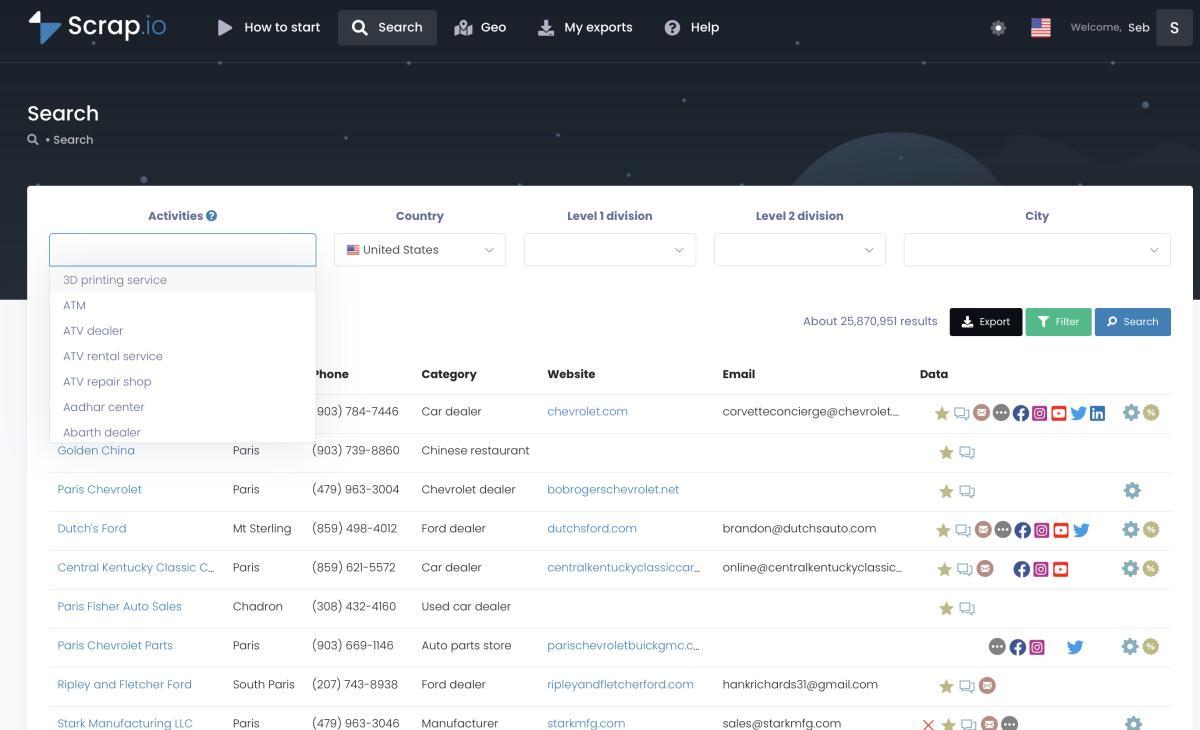
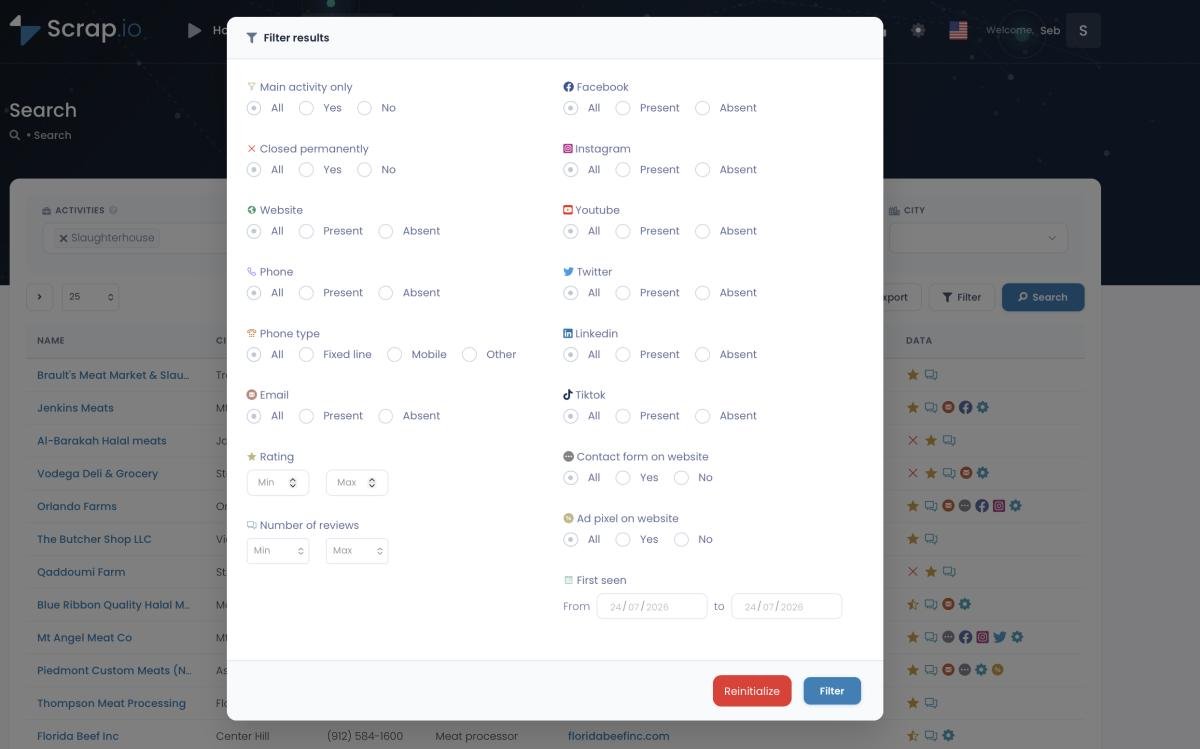
Here's the part that saves your budget: you filter before you extract, and before you spend a single credit. Only want businesses that have an email listed? Toggle it. Only mobile numbers for an SMS campaign? Done. A minimum rating, a review count, a website but no ad pixel? Stack the filters. You pay one credit per usable business — not for the dead weight a broker bundles in.
And it's fast. One Scrap.io user pulled 11,734 businesses in 45 minutes. Try building that manually. I'll wait. Once you've got the list, it exports to CSV or Excel — clean columns, up to five classified emails per business (individual, contact, sales, marketing, admin), ready to drop into your cold email tool or CRM. Want the full workflow? Here's how to build a cold email list and how to find emails on Google Maps, step by step.
Video: Scrap.io — How to Start
Try Scrap.io free for 7 days — up to 50 searches and 100 export credits (100 leads on us). Pick a category, pick a zone from a single city to a whole country, filter to email-present contacts, and export a fresh list before your coffee's cold. Start your free trial →
Mailing list companies vs Scrap.io: side-by-side
One model sells you a snapshot of the past. The other lets you take the photo yourself, right now. Here's the honest comparison.
| Factor | Traditional mailing list companies | Scrap.io |
|---|---|---|
| Data freshness | Static file; decays ~22.5%/yr | Real-time at extraction |
| You pay for dead rows | Yes — bundled in | No — filter before you spend a credit |
| Coverage | Mostly US-centric | 225M+ businesses, 195 countries |
| Targeting | Demographics / firmographics | Category + zone + 4,000 filters, GeoSearch radius & polygon |
| Commitment | Per-file or forced subscription | From $35/mo, cancel anytime |
| Compliance | Varies; source often opaque | Public business data, GDPR & CCPA compliant, traceable |
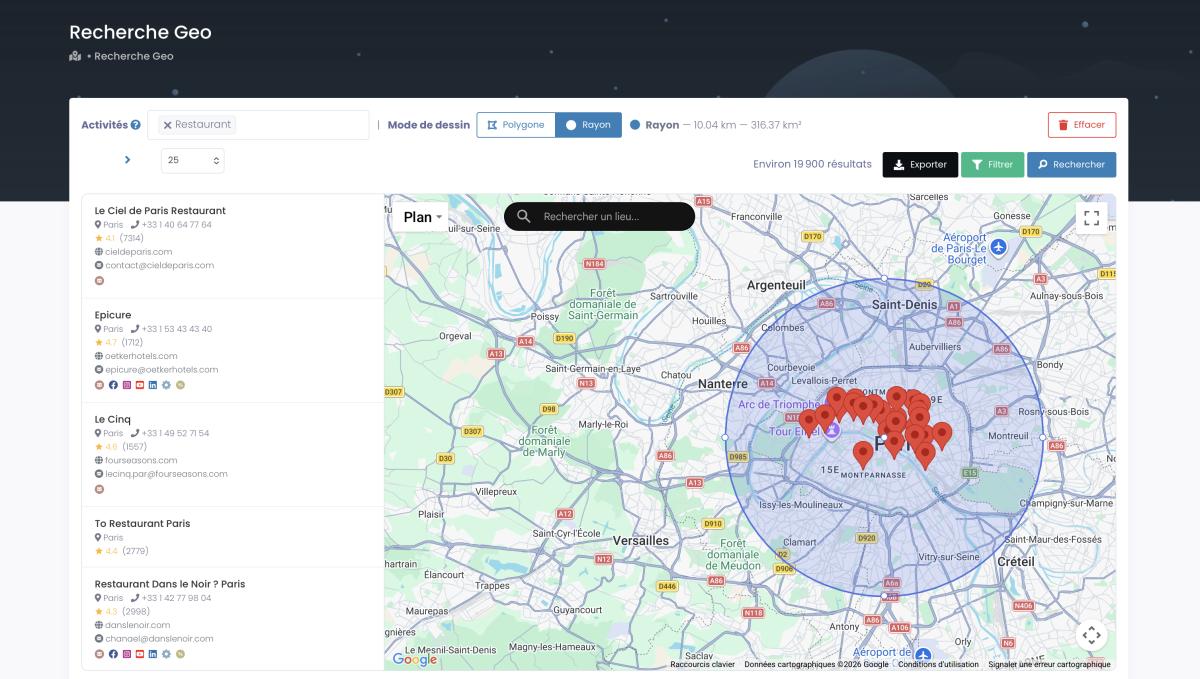
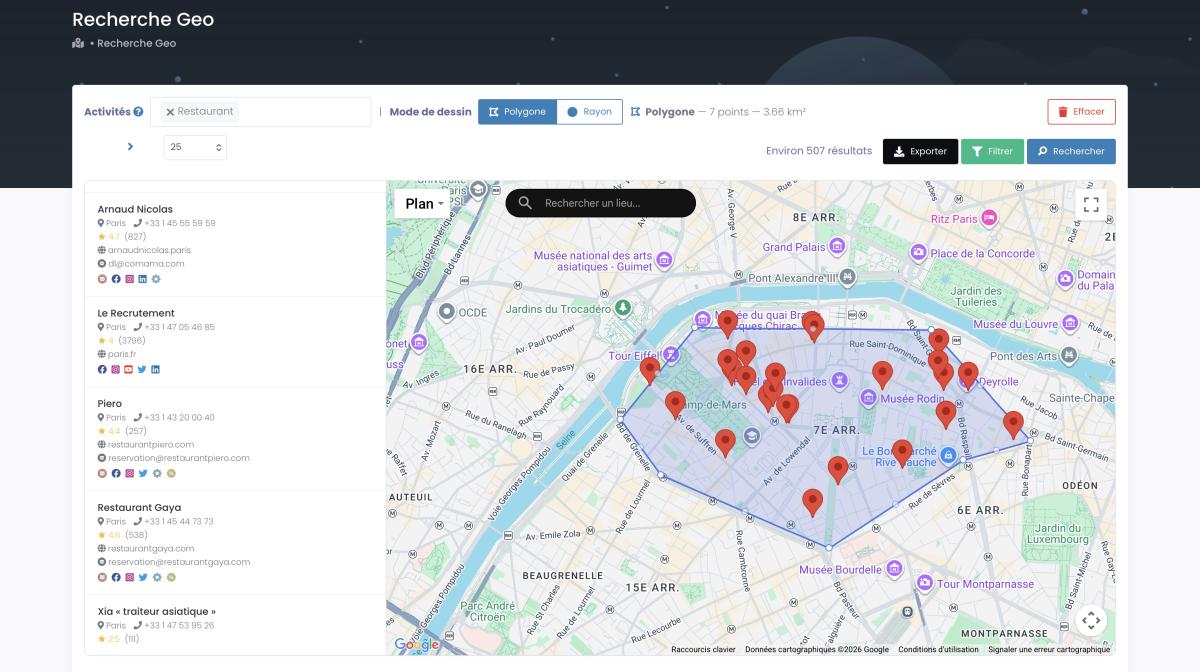
Anyway, here's the thing the best mailing list companies genuinely can't do: draw your own zone. Set a radius around a point, or sketch a polygon by hand over an exact neighborhood or catchment area, and pull every matching business inside it — with all the same filters applied. Try that with a static file.
None of this means brokers are useless. If you're running a physical direct-mail campaign to residential addresses by zip code, a good postal file still does the job. But if you want fresh email and mobile data, filtered to only what's usable, across more than the US? That's a different tool. If you're rethinking your whole data stack, our ZoomInfo alternatives comparison covers where each option fits.
Video: Scrap.io vs Apollo — Which Tool for Which Type of Prospecting
FAQ
Is buying a mailing list a good idea?
It works for direct mail, and it's risky for cold email. Purchased email lists decay about 22.5% per year and can wreck your deliverability — Mailchimp and most ESPs advise against them. The safer play is to build from a real-time source you control, then verify before you send.
How much does a 1,000-contact list cost in 2026?
Roughly $100–$400 per 1,000 business records. Per-record pricing runs about $0.24–$0.60 (LeadsPlease) or $0.10–$0.40 (BookYourData), while enterprise vendors like Melissa price in the thousands per year. Remember you're also paying for the ~22.5% that are already dead.
What's the difference between a mailing list company and an email marketing platform?
A mailing list company sells you the contacts. An email marketing platform (MailerLite, Brevo, Mailchimp) sends emails to contacts you already have. If you need people to reach, you want the first. If you need to message a list you own, you want the second.
Are mailing list companies legal to use?
Yes — when the data is publicly sourced and you follow CAN-SPAM in the US, CCPA in California, and GDPR in the EU. Buying a list is legal; how you contact the people on it is what's regulated. Always include a working opt-out.
What's the most reputable way to get a mailing list?
Either buy from a transparent, no-subscription broker with a fresh-data guarantee, or build your own from a real-time source like Google Maps via Scrap.io. Both beat a cheap, recycled file — and building gives you traceability that a purchased list can't.
The bottom line
The best mailing list companies aren't a scam. LeadsPlease sells clean, USPS-verified postal data. BookYourData does honest pay-as-you-go B2B email. If you're mailing postcards, buy the file and go.
But for cold email — for anyone whose data needs to be true today — renting a snapshot of last quarter is a slow way to burn your domain. The market that sold you that snapshot is worth half a trillion dollars, and a big chunk of it is decay you paid for. So pick your target, filter before you spend, and pull data you can actually stand behind.
Stop renting yesterday's data. Start your free 7-day Scrap.io trial — 100 leads on us — and build a list that's fresh today: any category, any zone from a city to a whole country, filtered to email-present contacts before you spend a credit. Start your free trial →
Generate a list of restaurant with Scrap.io