

Every single day, thousands of brand-new businesses open their doors across the US. In September 2026 alone, more than 578,000 business applications were filed (US Census Bureau). Most of those new owners don't have a supplier yet. No accountant. No website guy. No insurance agent.
Guess who gets the deal?
The first person who shows up. Not the slickest pitch, not the lowest price. The first relevant one through the door.
So here's the real question this guide answers: how do you find newly opened businesses the week they launch, with a phone number and an email you can actually use, before every other vendor in town piles in? That's what we're fixing.
Video: Find Businesses That JUST Opened (Before Your Competitors Do)
- What counts as a "newly opened business" (and why it's the hottest lead)
- Why new businesses are the best leads nobody is calling yet
- How to find newly opened businesses: 5 methods compared
- New businesses near me: how to track openings in your area
- How to build a live list of newly opened businesses with Scrap.io
- Reaching new owners: outreach scripts that convert
- Automate it: a daily feed of new businesses
- Is this legal? Compliance for prospecting new businesses
- Conclusion
- FAQ
What counts as a "newly opened business" (and why it's the hottest lead)
Let's define the thing before we chase it. A newly opened business is a company that has physically started operating: a storefront with hours, a service with a phone that rings, a listing that just showed up on the map. It's open. You can call it today.
That last part matters more than it sounds.
Why is a week-old business the hottest lead you'll find? Because it's a stack of unmade decisions. Who prints the menus. Who does the books. Who builds the website. Who insures the place. Every one of those is up for grabs, and nobody has claimed it yet.
Compare that to an established business. They already have a provider for everything you sell. To win them you have to beat an incumbent, survive a contract renewal date, and out-argue plain inertia. (Good luck with that.) With a new owner, there's no incumbent to beat. There's just a decision waiting to be made.
Here's the thing most people miss: "new" has a shelf life. A business is a virgin lead for maybe a few weeks. After that the supplier slots fill up one by one, and by the time you reach the hundredth batch of newly opened businesses in the USA you're fighting incumbents again like everyone else. So the whole game is speed, and speed starts with knowing where new companies actually surface first.
Newly opened vs newly registered: the gap that matters
This trips up almost everyone, so let's kill the confusion fast.
Newly registered means a company exists on paper. Someone filed with the state, pulled an EIN, maybe reserved a name. That's it. It might open next month. It might never open at all. The US Census counts these as "business applications," and a real chunk of them go nowhere.
Newly opened means the doors are actually open. There's a location, hours, a phone, usually a Google Maps listing. It's a real, reachable business.
See the gap? A list of newly registered businesses is half ghosts: filings that never became anything you can visit. The "appeared on Google Maps" signal is tighter, because a map listing means the place is physically operating and findable by customers. For prospecting, that's the signal you want.
| Aspect | Newly registered | Newly opened |
|---|---|---|
| What it means | Exists on paper (state filing, EIN) | Physically operating |
| Where it shows up | Secretary of State, Census BFS | Google Maps, the storefront |
| Reachable today? | 🔴 Often not | 🟢 Yes, phone and email |
| Best for prospecting | 🟡 Early but noisy | 🟢 Hot and actionable |
Why new businesses are the best leads nobody is calling yet
Take Sarah, a freelance web designer in Austin. She used to cold-email 500 random companies a month and book maybe two calls. Brutal. Then she changed one thing: she stopped emailing everyone and started emailing only the businesses that opened near her that month. Twelve of them. Not five hundred.
Her reply rate went up. A lot. Why? Because a brand-new coffee shop with no website actually needs a website, and Sarah was the first person to even mention it.
That's the whole thesis of signal-based selling: stop spraying, start reacting to buying signals. And a business opening its doors is about the loudest buying signal there is. New owner, open wallet, empty supplier list. (The signal runs in reverse too: tracking businesses that just closed surfaces their customers, who suddenly need a new supplier.)
There's one verbatim I keep coming back to. On Reddit's r/AskSF, a graphic designer asked, "Are there any online spaces where one can find a list of NEW businesses opening in SF or the Bay Area? ... I am a graphic designer" (source). Read that again. A professional, with a service to sell, basically begging for a list of newly opened businesses so she can reach them first. The demand is real. The tooling, for most people, is not.
And the volume is absurd in the best way. The US has averaged 442,461 business applications a month since May 2020, nearly double the pre-2020 pace of 232,475 (Census BFS). That's a firehose of fresh owners, month after month. The only hard part is turning that firehose into a clean list with contact info, which is exactly where the free tools fall apart.
How to find newly opened businesses: 5 methods compared
So where do these businesses actually show up first? Spoiler: not where most people look. There are five realistic ways to find them, and they are very much not equal. Here's the honest scorecard before we break each one down.
| Method | Coverage | Contact data | Real-time |
|---|---|---|---|
| Government registers | 🟢 High | 🔴 None | 🟡 Lagging |
| Local directories & city listings | 🔴 One city | 🔴 Rare | 🟡 Varies |
| Free aggregators (NewBizRadar) | 🟡 US only | 🔴 None | 🟡 Weekly |
| Google Maps "first seen" (Scrap.io) | 🟢 195 countries | 🟢 Phone + email | 🟢 Yes |
| Social & review signals | 🟡 Patchy | 🟡 Manual | 🟢 Yes |
Method 1: Government registers (Secretary of State, Census BFS)
Every US state runs a business registry through its Secretary of State business search, and the Census Bureau publishes Business Formation Statistics every month. Authoritative? Totally. These are the official record.
But here's the catch. Registers tell you a company was registered, not that it opened. No phone. No email. No website. And a filing can sit there for months before anything real happens, if it ever does. Great for research, rough for outreach.
Method 2: Local directories & city listings
Plenty of cities publish their own "new business" lists. The City of Chicago's New Business dataset is a solid example, Grapevine, Texas keeps a public new-business listing, and Yelp has a "new" filter in some markets.
The problem shows up the second you try to scale. Each source covers exactly one city, the formats never match, and contact data is thin to nonexistent. Tracking 30 metros this way means babysitting 30 different pages in 30 different layouts. No thanks.
Method 3: Free aggregators (e.g. NewBizRadar)
NewBizRadar is the best-known of these. It aggregates US registration data, claims around 130,490 new registrations a week, and emails you a weekly digest. Free, simple, decent coverage of filings.
The ceiling, though, is real. It's registrations, not openings (remember the gap we just drew). It's US only. And it hands you zero phone numbers, zero emails, zero websites. You learn that a business exists somewhere, which is a start, and then you're on your own to actually find it and contact it.
Method 4: Google Maps "first seen" signal (recommended)
Here's the method I'd actually build a prospecting routine on. When a business opens, it shows up on Google Maps. That first appearance is a timestamp, and it's a far better "it's open" signal than any paper filing.
A tool like Scrap.io, which extracts every business in an area straight off the map, lets you filter by the date a listing was first detected. So you get the opening signal and the phone, email, and website in one shot. Open, located, reachable. That's the trifecta nothing else gives you.
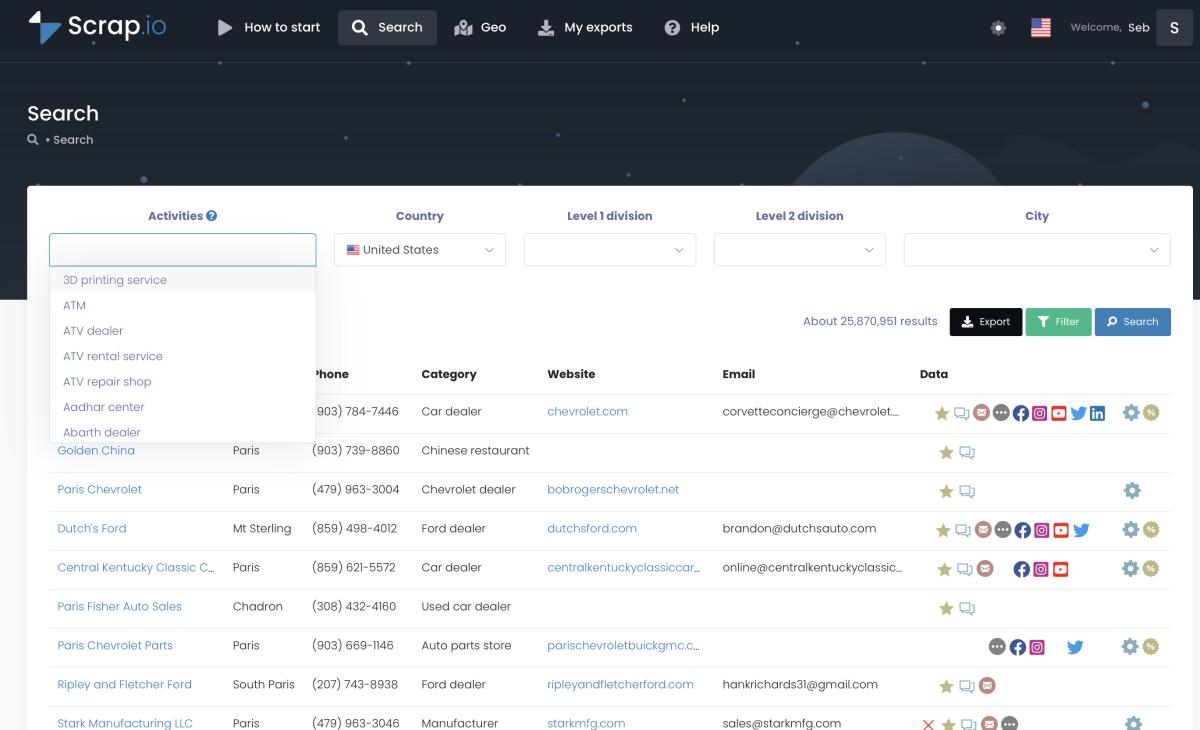
Searching Google Maps data in Scrap.io to surface newly opened businesses.
Method 5: Social & review signals
The last one is more hands-on. A sudden flood of brand-new five-star reviews, a "grand opening" post on Instagram, a first-ever Facebook check-in. These are genuine signals that a place just opened, and they're truly real-time.
The downside? It doesn't scale and it's a pain to systematize. You'll catch the openings you happen to follow and miss the thousands you don't. Fine as a supplement. Hopeless as your main engine.
New businesses near me: how to track openings in your area
Want to know what just opened within five miles of your office? This is the new businesses near me use case, and it's where most local service businesses live. You don't care about the whole country. You care about your city, your radius, your patch.
There are two clean ways to draw that patch on the map. A radius search drops a pin and pulls every business inside a circle you size yourself, perfect for "within 10 miles of my shop." A polygon search lets you draw the exact shape by hand, so you can trace a single neighborhood, a business district, or the oddly shaped territory your reps actually cover.
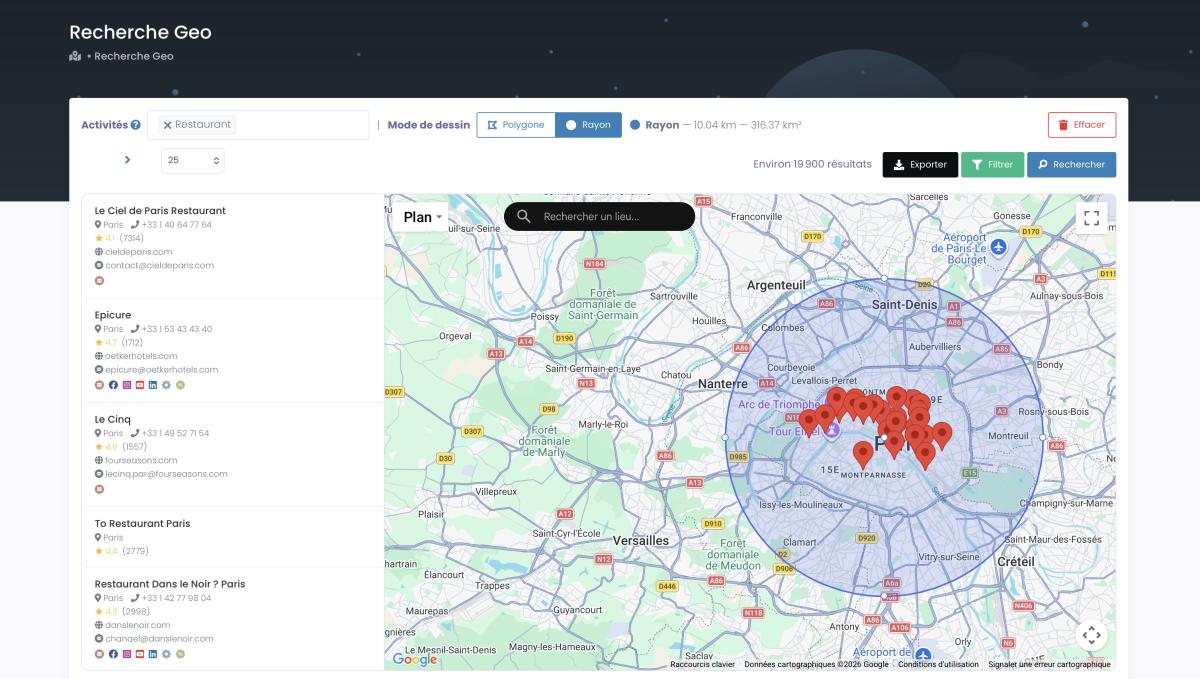
Radius search: catch newly opened businesses near me inside a set distance.
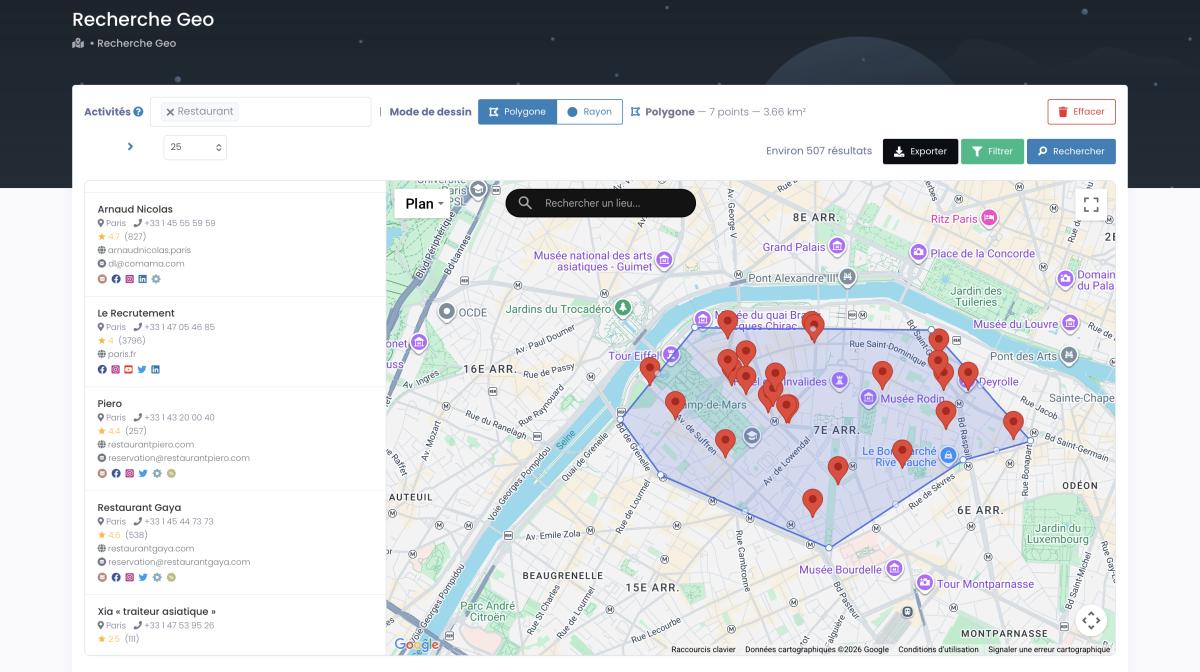
Polygon search: draw any custom area and stack the "date first seen" filter.
Both let you add the "date first seen" filter on top, which turns a plain area search into a live newly opened businesses near me feed. That's really the answer to "how to find out what new businesses are opening near me": pick the area, filter by recent, done. People type all sorts of versions of this, from "list of newly opened businesses near me" to "best newly opened businesses near me" to "newly registered businesses near me." Same need underneath.
And the queries get hyper-local fast. Someone in Los Angeles is really searching "new businesses opening near me 2026 california," someone in Miami wants "newly opened businesses in california" swapped for Florida, and plenty add "open now" or "hiring" on the end. The map handles all of them, because it's filtering live listings, not a frozen directory.
| Source | What you get | Contacts you can use? |
|---|---|---|
| City / registry lists | Names, filing dates | 🔴 No |
| Directories (Yelp, etc.) | Names, some hours | 🟡 Rarely |
| Google Maps + Scrap.io | Open businesses, geofiltered | 🟢 Phone, email, website |
For a true near-me feed with contacts attached, the map wins. Every time.
How to build a live list of newly opened businesses with Scrap.io
Registers tell you a company exists on paper. Google Maps tells you it's actually open, with a phone number you can call today. So let's build an actual list of new businesses, step by step, the way I'd do it on a Monday morning.
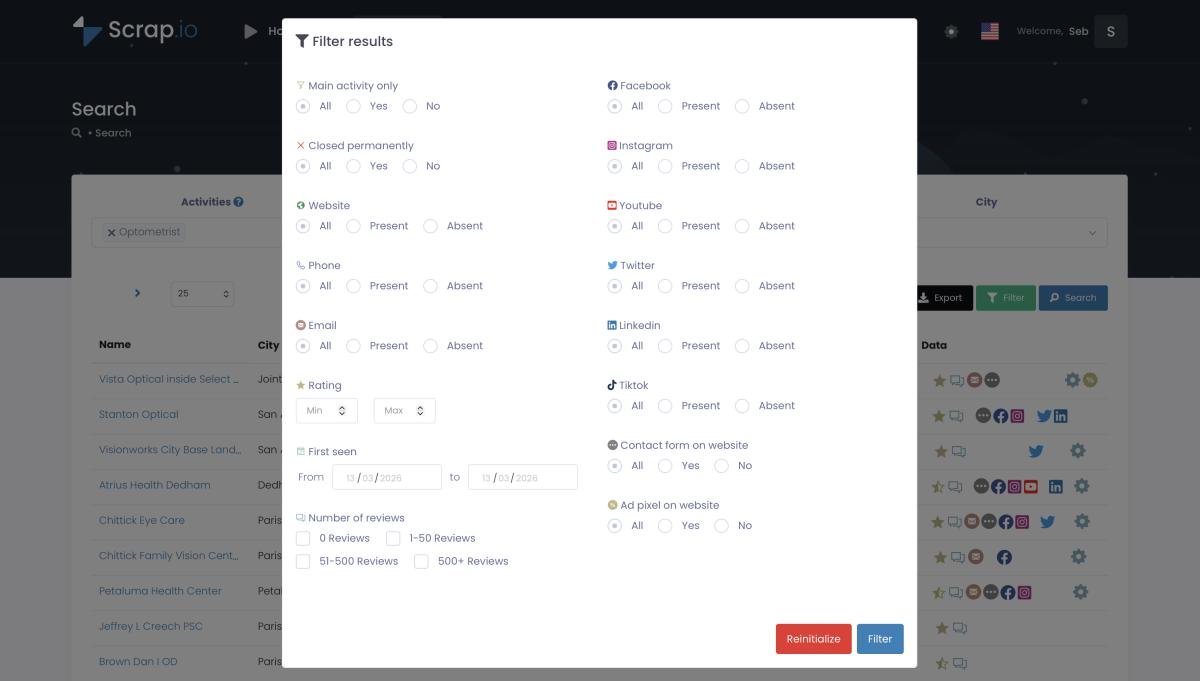
Scrap.io filters: the "date first detected" filter is the new-opening signal.
Filter by "date first seen" (the new-opening signal)
Pick your area (a city, a county, a whole state, or a GeoSearch radius or polygon) and your category, say "restaurants" or "dentists" (not sure which? Take a minute to define your ICP with Google Maps data first). Then set the date first seen filter to the last 30 or 90 days. That's the opening signal doing the heavy lifting: you're now looking only at listings Scrap.io watched appear recently.
Quick reality check on how big this gets. In a single category, restaurants, Scrap.io detected 11,149 new restaurant listings in the US over the last 90 days, out of 672,781 total. One category, one quarter, eleven thousand fresh openings. Multiply that across 4,000+ categories and you start to see the scale of what's out there.
Add contact filters before you spend a credit (email/phone/no website)
This is the step that saves you money, so don't skip it. Scrap.io applies filters before extraction, which means you only spend a credit on a listing that matches what you asked for. Only want businesses with an email on file? Filter for it. Only the ones without a website because websites are what you sell? Filter for that too. Only the ones with a contact form, or an ad pixel, or a minimum review count? Set it, all before you pay a single credit.
That's the difference between a targeted list and a bag of garbage you paid for.
Export & enrich (phone, email, website, socials)
Hit export and you get a CSV or Excel file with the stuff you can act on: phone (tagged fixed or mobile), classified emails (contact, sales, marketing, plus a named person's email with first and last name when it's on the site), website, and social links. Drop it into your cold outreach tool or CRM and you're ready to go the same day. What you've really built is your own u.s. new businesses database: a living list of new businesses opening in the USA that refreshes every time you run it.
Reaching new owners: outreach scripts that convert
The worst thing you can send a brand-new owner is a generic pitch. The best? A message that proves you noticed they just opened. That's the entire gap between "delete" and "tell me more."
Here's a cold email that works, precisely because it's short and it's obviously not a blast:
"Hi Maria, saw that Oak & Ash opened on Burnet Road last week, congrats on the launch. I build websites for new Austin restaurants and noticed you don't have one up yet. Want me to send over two quick mockups, no strings attached? David"
Notice what it's doing. It names the business and the street (proof you're a real person, not a script). It references the opening itself (the signal). It offers something concrete and free. And it's four sentences, not a wall of text. My advice? Lead with the observation, never the pitch.
Phone works the same way. "Hi, is this the owner? Saw you just opened on Main Street, congrats. Quick question for you..." beats "Hello, am I speaking with the business owner today?" every single time, because the first one proves you're not reading down a list of 500 names. (You are. But they don't need to know that.)
One honest caveat: don't fake it. If you say you noticed they opened, actually have noticed. New owners talk to each other, and a lazy mail-merge that calls their taco shop a "salon" travels fast. Personalize the first line, keep it true, and the opening signal does the rest of the work.
Automate it: a daily feed of new businesses
What if a fresh list of businesses that opened yesterday landed in your inbox every morning, on autopilot? Not a someday fantasy. People run this today.
Video: Daily Leads on Autopilot
The manual version takes two minutes: save your search (area + category + "date first seen = last 7 days") and rerun it every Monday. The automated version is where it gets fun. Wire up the Scrap.io MCP so you can pull leads just by chatting with Claude, or connect the REST API to Make.com, Zapier, or n8n. A scheduled job then runs the search, grabs the new openings, and drops them straight into your CRM or a Google Sheet. You can even pull new business listings by month to watch the trend. You wake up, the list is already there.
This is the part that turns a clever trick into an actual channel. Anyone can do a one-off search. The people who win set it to track new business openings while they sleep and show up first, every single day, without thinking about it.
Is this legal? Compliance for prospecting new businesses
Let's be honest about the part everyone skips: is any of this even allowed? Short answer, yes, when you do it right.
You're working with publicly available business data, and B2B prospecting on public data is legal. Scrap.io only extracts public listing data, it's GDPR- and CCPA-compliant, and every single data point is traceable back to its source. That's a clean foundation to build on.
The rules you still have to respect are about how you reach out, not about your right to hold the list in the first place. Follow CAN-SPAM for email in the US (a real sender name, an honest subject line, a working unsubscribe). Mind GDPR if you're contacting businesses in the EU. Don't keep texting people who opted out. Basic stuff, and yet people skip it constantly and get burned.
Do that, and prospecting newly opened businesses is just... good sales. Fast, legal, and respectful of the person on the other end of the line.
Conclusion
The owners who opened this week are deciding right now who they'll buy from for the next few years. You can be in that conversation, or you can turn up in month six and fight whoever got there first. I know which one I'd pick.
The move itself is simple. Pick your area, filter Google Maps by "date first seen," add a contact filter, and send a message that proves you actually noticed. Then set it to run every morning so you never miss the window again.
Be the first through the door.
FAQ: Finding Newly Opened Businesses
How do I find newly opened businesses near me?
Four quick ways: (1) your city's official "new business" listing or data portal, (2) local directories and Yelp's "new" filter, (3) a free registration aggregator like NewBizRadar, or (4) filter Google Maps by "date first seen" with a tool like Scrap.io to get openings with phone and email already attached. Only the last one hands you contacts you can act on today.
What's the difference between newly registered and newly opened businesses?
Registered means the company exists on paper (a state or Census filing). Newly opened means it's physically operating, with a storefront, hours, and usually a Google Maps listing. Registration can come before an opening, or never lead to one, so the "appeared on the map" signal is more reliable for prospecting.
Is it legal to collect data on new businesses for prospecting?
Yes, using publicly available business data for B2B outreach is legal. Scrap.io only extracts public listing data and is GDPR- and CCPA-compliant, with every data point traceable to its source. Just follow local anti-spam rules like CAN-SPAM and GDPR when you actually reach out.
How many new businesses open in the US each month?
The US Census Bureau recorded 578,926 business applications in September 2026, and about 5.62 million across 2025. Roughly 10% of applications become employer businesses within a year, which is exactly why filtering your list matters.
Can I get a daily or weekly list of new businesses automatically?
Yes. Rerun a saved Google Maps search filtered by "date first seen," or automate it with the Scrap.io API or MCP (or a tool like Make.com) so a fresh list of new local businesses lands in your inbox or CRM on a schedule.
Generate a list of restaurant with Scrap.io