

By The Scrap.io Team | Last updated: August 2026
Table of Contents
- Why Brewery & Distillery Email Lists Matter for B2B Success
- How to Build a Quality Brewery & Distillery Contact Database
- What to Look for in a Brewery Email List
- B2B Use Cases: Who's Reaching Out to Breweries?
- Compliance & Legal Considerations
- How Scrap.io Gives You an Edge
- FAQ, Brewery & Distillery Email Lists
- Start Building Your Brewery Contact List Today
A buddy of mine sells hop pellets to small craft breweries across the Pacific Northwest. Last year he spent three weeks manually Googling breweries, clicking through Yelp pages, and copy-pasting emails into a spreadsheet. Three weeks. He ended up with 87 contacts.
Half of them bounced.
That's the reality for most B2B companies trying to reach the craft beverage industry right now. There are 15,474 breweries and 3,353 distilleries sitting on Google Maps in the US alone, yet finding a reliable brewery email list feels like hunting for a clean pint glass at a frat house.
This guide breaks down how to actually build a brewery email list that works: the methods, the data quality, real B2B examples, compliance, and the tools that make it happen without losing your mind. And because the same data sources cover both, we'll treat the distillery email list side with equal weight. You can pull verified brewery emails from Google Maps and start free with 100 leads if you want to skip ahead.
Why Brewery & Distillery Email Lists Matter for B2B Success
The Booming US Craft Beverage Market
Numbers first. The US brewery industry hit $35.6 billion in market size in 2026, growing 5.2% year over year (IBISWorld). On the distillery side? A $21.7 billion market, up 5.5% YoY (IBISWorld, 2026). Two industries that are shrinking headcount in some corners and exploding in others, and both are packed with small operators who read their own inbox.
Here's where it gets confusing, and where most "how many breweries" answers fall apart. IBISWorld counts roughly 9,945 breweries as licensed operators. Google Maps shows 15,474. Which one is right? Both, actually. The license count tracks legal permit-holders. Google Maps counts storefronts: taprooms, brewpubs, second locations, satellite tasting rooms, the outfit that bonds under one name but trades under three. It's the same gap the winery world has between the TTB bonded list and the map. For prospecting, the storefront number wins every time, because you're selling to a place a human actually walks into.
And the craft segment is massive: roughly 9,500 craft breweries according to the Brewers Association. California leads, then New York, Pennsylvania, Colorado, and Michigan. Cities like Portland, Denver, San Diego, and Asheville have more breweries per capita than most states have total.
What matters for B2B: these are overwhelmingly small, independently owned businesses. The owner is often the head brewer, the marketing director, AND the person answering emails. You can actually reach the decision-maker. (Try doing that with Anheuser-Busch. I'll wait.)
Who Needs a Brewery Email Database?
Pretty much anyone selling to the food and beverage industry. Equipment manufacturers, ingredient suppliers, SaaS companies building brewery management tools, marketing agencies chasing craft brands, packaging companies, distributors, insurance providers. The list goes on.
If your ideal customer profile includes "small business owner in the beverage industry," a brewery email list is your prospecting shortcut. Need to find brewery owner contacts for a cold email campaign? Building a distillery owner mailing list for an equipment launch? The starting point is the same. And it's not just breweries. The same data sources cover distilleries, cideries, wineries, and brewpubs. Related industries work the same way: check out our guides on bar email lists, restaurant email lists, the winery database, and the cafe email list for adjacent markets.
How to Build a Quality Brewery & Distillery Contact Database
There are basically three ways to get a brewery email list in 2026. Each has tradeoffs: speed versus cost versus data freshness. Here's the breakdown, ranked.
Method 1: Google Maps Scraping (Scrap.io)
This is the approach that actually scales. Google Maps has the most comprehensive, up-to-date listing of breweries in the US. Every brewery that wants customers to find them is on there, with their address, phone number, website, hours, and (often) an email.
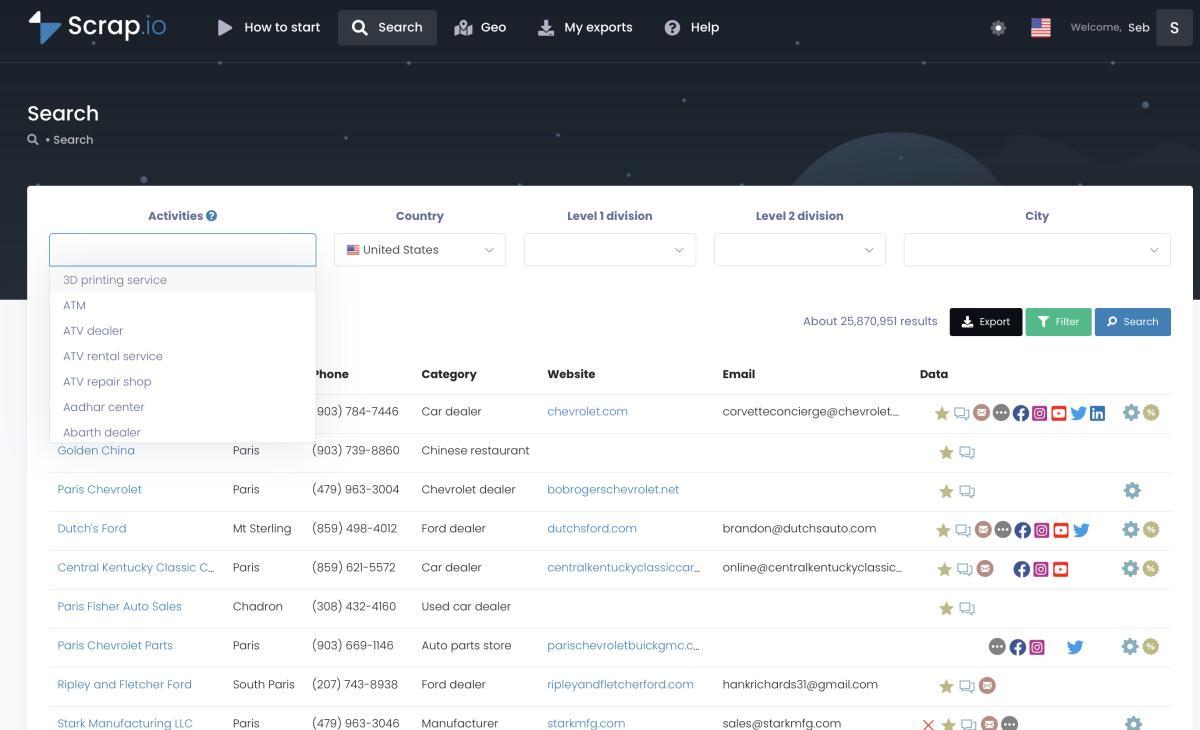
Tools like Scrap.io extract this data automatically. Want to find distillery emails from Google Maps? Search "distillery" in Kentucky. Need a craft brewery contact database for the entire USA? Search "craft brewery" nationwide. Apply your filters (rating, review count, website technology), and export everything to CSV. You get up to 5 emails per business, plus phone numbers, social profiles, and Google Maps ratings.
The key difference? This data is scraped in real time. Not six months ago. Not "updated quarterly." Right now, at the moment you export.
Video: Scrap.io - How to Start?
See it before you spend a credit. Search "brewery" in your state, count the results for free, then filter down to the ones with an email present before you pay. That's the whole trick. Start free on Scrap.io with 100 brewery leads and watch the count update as you stack filters.
Method 2: Industry Directories & Associations
The Brewers Association maintains a brewery directory. So do state-level craft brewers guilds. These are useful for context and market sizing. For outreach? They're terrible. Why? Most directories don't list emails. They link to websites, and you still have to hunt for contact info by hand.
Associations like the American Craft Spirits Association and state-level brewery guilds offer member directories too. Same problem. No direct emails, inconsistent data formatting, zero segmentation. A brewery directory is a starting map, not a mailing list.
Method 3: Manual Research & LinkedIn
You could do what my hop-selling friend did: Google each brewery, visit the website, find the "Contact" page, copy the email, check LinkedIn for the owner's name, and repeat 15,000 times. Building a craft brewery contact list this way is technically free. It just costs you your sanity.
Honestly, this works if you're targeting 20 or 30 specific breweries. For anything beyond that? You'll burn out before you hit Send on your first campaign. That's not grit. That's masochism.
Why Real-Time Data Beats Static Lists
B2B contact data decays at roughly 30% per year. A brewery email list you bought in January? By summer, a third of those emails bounce, the phone numbers are disconnected, and some of those businesses have closed for good.
Craft breweries are especially volatile. New ones open every week. Others close. Owners change. Websites get rebuilt. Static lists can't keep up, and the vendor selling you one rarely tells you when it was last checked.
Real-time scraping solves this because you're pulling from the source, Google Maps, every single time. No stale databases. No "last verified: 2024" disclaimers. So when people ask where to buy brewery email addresses, the honest answer is: don't buy static ones at all. Build them fresh.
What to Look for in a Brewery Email List
Key Data Points for Effective Outreach
A bare-bones brewery email list with just names and emails won't cut it. For brewery outreach that converts, you need verified brewery contacts with rich data points, not a glorified spreadsheet from 2023.
| Data Point | Why It Matters |
|---|---|
| Business name | Basic personalization |
| Owner/manager name | Decision-maker targeting |
| Verified email(s) | Deliverability (up to 5 per business) |
| Phone number | Multi-channel follow-up |
| Physical address | Geographic segmentation |
| Google Maps rating | Quality/reputation filtering |
| Website URL | Research and tech stack analysis |
| Social media profiles | Warm-up via LinkedIn/Instagram |
| Business category | Brewery vs. brewpub vs. distillery vs. cidery |
Filter Before You Pay: What 15,474 Breweries Actually Looks Like
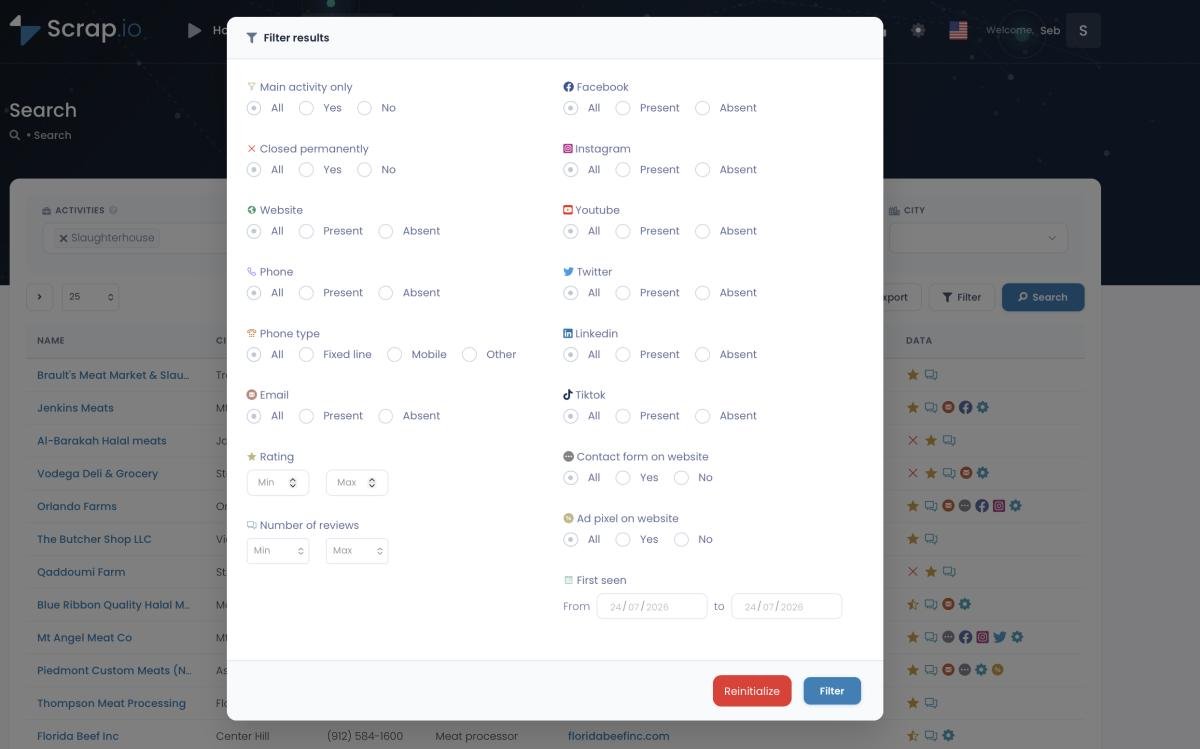
Here's the part no broker puts on the sales page. Of those 15,474 US breweries on Google Maps, only a fraction publish an email you can actually use. So why pay for the rest?
| Filter (US) | Breweries | Distilleries |
|---|---|---|
| All | 15,474 | 3,353 |
| With email | 9,764 | 2,302 |
| With website | 12,741 | n/a |
| With phone | 13,394 | n/a |
Source: Scrap.io, real-time, August 2026.
Read that top to bottom. If your campaign is cold email, you care about 9,764 breweries, not 15,474. Paying for the other 5,710 (the ones with no reachable email) is pure waste. Scrap.io applies the email filter before a single credit is spent, so you only ever pay for breweries you can contact.
The inverse is a goldmine too. Only 12,741 of 15,474 breweries have a website, which means roughly 2,700 breweries with no website at all. If you're a web agency or a digital-marketing shop, that's your entire prospect list on a plate: established businesses with a location, reviews, and foot traffic that visibly need what you sell. Filter for "no website," and there it is.
Email Verification & Deliverability
Sending 2,000 cold emails to unverified addresses is a fast track to getting your domain blacklisted.
Period.
The food and drink industry sees an average 14.9% conversion rate on email campaigns (Omnisend, 2025). But that's only achievable with clean data. Personalized emails are 10x more likely to be opened than generic blasts (LeadsAtScale, 2025). You can't personalize if you don't even know whether the email belongs to the owner or an info@ inbox nobody checks.
Look for brewery email list providers that offer real-time verification or, better yet, pull data directly from active business listings where the brewery itself published the email. The best brewery email list in 2026 isn't the one with the biggest database. It's the one with the freshest data.
Segmentation: Brewery Size, Location, Type
Not all breweries are the same customer. A 3-barrel nanobrewery in Vermont has very different needs than a 50,000-barrel regional producer in Texas.
Segment by location (California alone has more craft breweries than most countries), by type (microbrewery, brewpub, taproom, production brewery, contract brewer), by size (Google review count is a decent proxy), and by tech stack if you're selling software. A targeted brewery marketing list built around these filters will always outperform a generic craft beer email database. The more granular your targeting, the higher your response rate. Always.
List of Breweries by State
Want a list of breweries by state instead of the whole country? Easy. Drop from the national view to a single state and the platform tags each brewery by its administrative zone. Here's the current top five, pulled live from Google Maps while writing this.
| State | Breweries (Google Maps, Aug 2026) |
|---|---|
| California | 1,812 |
| New York | 890 |
| Pennsylvania | 863 |
| Colorado | 663 |
| Michigan | 529 |
Source: Scrap.io, real-time, August 2026.
California has more breweries than the next two states combined.
So if you're building a list of craft beer brands to pitch, or you just want brewery names for one region, start where the density is. And remember: counting is free on Scrap.io, so you can check the exact number for any state before you export a single row.
B2B Use Cases: Who's Reaching Out to Breweries?
Equipment & Ingredient Suppliers
Hop suppliers, malt distributors, yeast labs, keg manufacturers, canning lines, glycol chillers. The craft beverage industry contacts list is enormous. Brewery leads for equipment suppliers alone could fill a whole CRM. Every one of these companies needs a way to reach brewery owners and head brewers.
A 12-person brewing equipment company in Nashville went from 3 callbacks a week to 11 after switching from a purchased list to real-time scraped data. The difference? Fresh emails that actually belonged to decision-makers, not generic addresses nobody reads.
SaaS & Brewery Management Software (Ekos, Crafted ERP, Breww)
Companies like Ekos, Crafted ERP, and Breww build software specifically for breweries: production tracking, inventory management, taproom POS, compliance reporting. Their entire addressable market IS the brewery email list.
Ekos, for one, has built a large user base by reaching brewery owners directly. When your total market is ~15,000 businesses in the US, you can't afford to waste leads on bad data. Every bounce is a prospect you paid for and can't reach.
Marketing Agencies & Consultants
Craft breweries need marketing help. Most are run by brewers, not marketers. Agencies that specialize in food and beverage, or even hyperlocal marketing, use brewery contact databases to build their client pipelines.
WebFX offers lead generation services built specifically for breweries. That tells you something about the demand.
Real Campaign Results: Brewery & Distillery Lead Generation in Action
Bare Brews LLC partnered with Tri-Media to launch an email marketing campaign targeting brewery owners, production managers, and craft beer entrepreneurs across the US in 2025. Their service (mobile alcohol separation and pasteurization) was niche enough that a targeted brewery email list was the only viable channel. The campaign combined branding, education, and lead nurturing across a multi-step email sequence.
On the brewery side, Wellington Brewery uses email marketing through Constant Contact to keep customers engaged and drive repeat purchases. Understanding how breweries USE email helps you write better outreach TO them.
Is there a verifiable, brewery-specific verbatim to quote here? I looked, and I couldn't find one I'd stake my name on. So instead of inventing a fake quote, here's the closest real one: over on r/coldemail, someone documented pulling 10,000+ validated business emails from Google Maps in a single campaign, filtered by review count and rating, no developer involved. Different vertical, identical playbook. The thread blew up precisely because it's the workflow this whole article describes. For a broader look at building email databases across industries, check our email database hub.
Compliance & Legal Considerations
CAN-SPAM Act Requirements
Cold emailing breweries in the US? Totally legal under CAN-SPAM. But you have to follow the rules:
- Clear sender identification (your real name and company)
- Accurate subject lines (no bait-and-switch)
- A physical mailing address in every email
- A working opt-out mechanism, honored within 10 business days
Penalties for non-compliance? Up to $53,088 per email (FTC, 2026 inflation-adjusted). Not per campaign. Per email. So yeah, take this seriously.
GDPR (If Targeting EU Breweries)
Reaching out to breweries in Germany, Belgium, the UK, or anywhere in the EU? Different ballgame. GDPR requires legitimate interest or explicit consent. B2B prospecting can qualify under legitimate interest, but you need to document your reasoning, offer an easy opt-out, and never buy sketchy third-party lists with no provenance.
Opt-Out Management & Best Practices
Beyond the legal minimum, just be a decent human. If someone unsubscribes, remove them immediately. If an email bounces hard, delete it. Keep your list clean. A pristine brewery mailing list of 500 verified contacts will outperform a messy list of 5,000 every single time.
How Scrap.io Gives You an Edge
Real-Time Data from 15,474 US Breweries
Scrap.io indexes data from Google Maps across 195 countries and 4,000+ business categories, with 225M+ businesses in total. For US breweries specifically, that's 15,474 establishments, of which 9,764 publish an email, all scraped fresh at export with phone numbers, addresses, ratings, and website data attached.
Unlike brokers such as Coldlytics, which use human researchers to build lists on demand (slower, pricier), or Exact Data, which sells you a static file frozen the day it ships, Scrap.io gives you the data in minutes and it's current the moment you pull it. The brewery niche is small enough that data freshness matters more here than almost anywhere. For a broader look, our guide on the USA business email database shows how the same method scales to 25M+ contacts.
Video: How to Scrape Local Leads at the Country Level
Advanced Filters: Location, Size, Reviews, Website Tech
Search "brewery" in Colorado and get every single one. Filter by Google rating (4+ stars only), by review count (a proxy for size), by whether they have a website, by the tech stack their site runs on. Want only breweries using Shopify? You can do that. Only ones with fewer than 50 reviews (likely smaller operations)? Done.
And when your target doesn't fit neat state or county lines (a specific metro, a cluster of taprooms along one highway), GeoSearch handles it. Draw a radius around a point, up to 500 km, or sketch a custom polygon on the map by hand. Every filter still applies inside that shape.
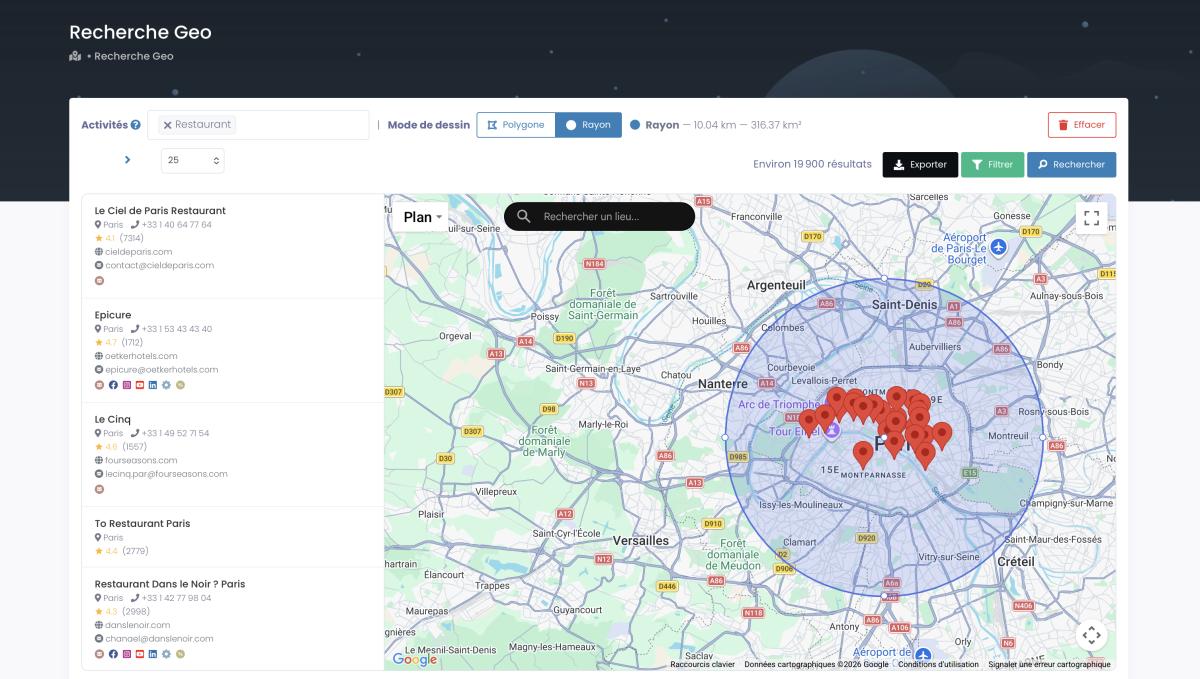
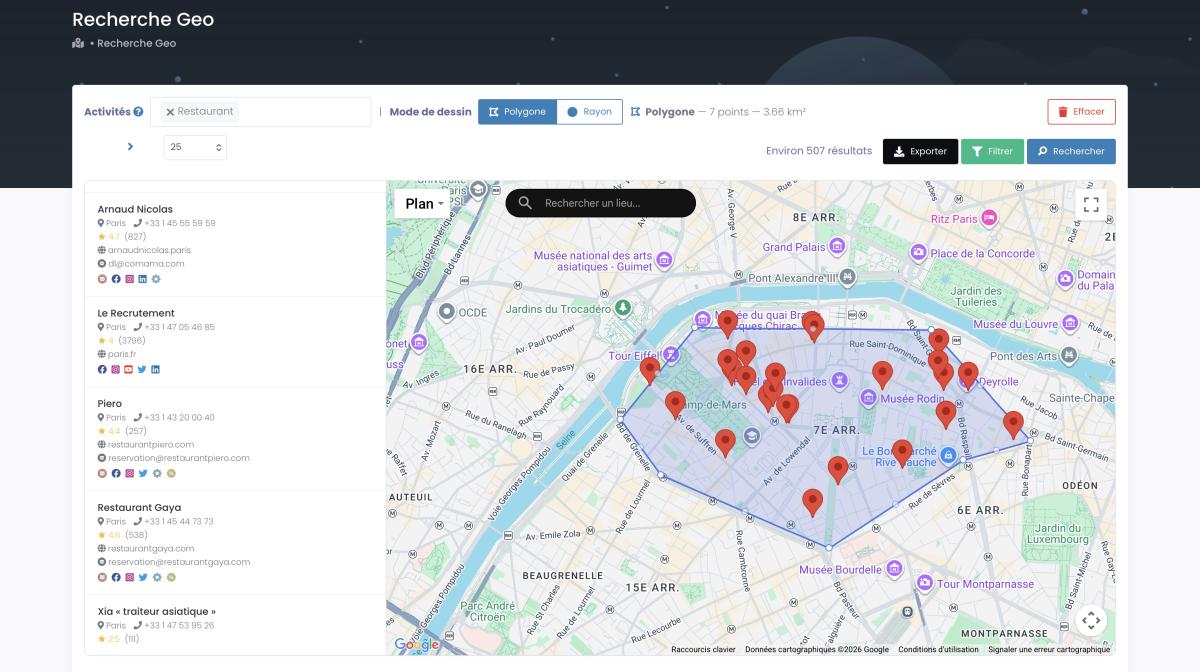
From Google Maps to your CRM in minutes. Pick "brewery," pick a state or the whole country, filter to email-present, and export. 50,000+ professionals already run this exact play. Try it on 100 breweries free and see the data quality before you spend a cent.
From Google Maps to Your CRM in Minutes
Export to CSV or Excel. Import into your CRM. Or connect directly through the API. The whole point is speed: identify your targets, pull the data, and start your outreach sequence before your competitors finish building their spreadsheets by hand. One credit equals one business, and re-exporting the same record within 30 days is free.
One more thing worth saying out loud, because it's where most Google Maps campaigns quietly die. Fresh data gets the email delivered. It doesn't write the email for you. Watch this before you hit send.
Video: Why Your Google Maps Emails Don't Get Replies?
FAQ, Brewery & Distillery Email Lists
How many breweries are there in the United States in 2026?
There are 15,474 breweries on Google Maps in the US as of August 2026, of which 9,764 publish an email address. IBISWorld counts around 9,945 as licensed operators; the higher Google Maps figure also captures taprooms, brewpubs, and satellite locations. The market is worth $35.6 billion and growing 5.2% year over year (IBISWorld, 2026).
How do I get a list of breweries by state?
Pick "brewery," then choose a state instead of the whole country, and export. On Google Maps the current leaders are California (1,812), New York (890), Pennsylvania (863), Colorado (663), and Michigan (529). Counting is free on Scrap.io, so you can check the exact number for any state before spending a credit, then filter to email-present and pull only the contacts you can reach.
Where can I find a verified brewery email list?
You can build one using Google Maps scraping tools like Scrap.io, which provides real-time data from 15,474 US breweries, including up to 5 brewery email addresses per business for cold email campaigns, plus phone numbers and social profiles. If you're wondering how to reach craft breweries for B2B, this is the fastest path, and you only pay for the 9,764 that actually have an email.
Is it legal to send cold emails to brewery owners?
Yes, under the CAN-SPAM Act in the US. You must include clear sender identification, a physical mailing address, and a working opt-out mechanism, honored within 10 business days. Penalties for non-compliance reach $53,088 per email. Data pulled from public Google Maps listings is fair game for B2B prospecting.
What data points should a brewery email list include?
A quality list should include business name, owner or manager name, verified email(s), phone number, physical address, Google Maps rating, website URL, social media profiles, and business category (brewery, microbrewery, brewpub, distillery). The email classification (individual, contact, sales, marketing) matters as much as the address itself.
How often should brewery contact data be updated?
B2B contact data decays at roughly 30% per year. Static purchased lists become unreliable within months. Real-time scraping tools pull always-fresh data directly from Google Maps at the moment of export, so there's no expiration date to worry about.
Start Building Your Brewery Contact List Today
The US craft beverage market isn't slowing down. 15,474 breweries, 3,353 distilleries, and each one a potential customer for the right B2B company. The difference between the companies that close deals and the ones that struggle? Data quality. Fresh emails, accurate contact info, the ability to segment and personalize at scale.
Stop paying for stale brewery databases that were "verified" sometime last year. Stop copy-pasting brewery email addresses from Yelp pages. Build a brewery prospecting list with real-time data and reach the people who actually make buying decisions.
Try Scrap.io free for 7 days. 100 verified brewery and distillery leads included, filtered to email-present before you spend a single credit, pulled fresh from Google Maps. 50 searches and 100 export credits, no annual lock-in. Build your brewery list now and see the data quality for yourself.
Générer un fichier de brasserie avec Scrap.io