

Austin M. manages outreach for a marketing agency with around 150 people. Last quarter, he was about to wire $0.30 per lead to a virtual assistant for 400 Georgia companies. Names, emails, phones — the usual grind. Twenty-four-hour turnaround, best case.
Then he tried Scrap.io instead. Scraped 11,734 Georgia companies in under 45 minutes. Not 400. Nearly twelve thousand. His exact word for it, left in a public Capterra review: "blown away."
That's the gap. The gap between how most people build a Georgia business directory and what's actually possible right now. Georgia has 802,754 businesses live on Scrap.io this morning — pulled straight from Google Maps listings that companies update themselves. The state ranks 7th in CNBC's Top States for Business 2026. And it keeps opening companies faster than any static file can track.
Here's the number nobody puts on a landing page. In a single year, 41,761 businesses opened in Georgia and 37,392 closed. That's about 113 new companies a day. Your Q1 list? It's already missing twenty thousand of them.
This guide breaks down how to access, filter, and actually use Georgia business data — without paying for a stale list that bounces.
Video: How Scrap.io extracts thousands of Georgia business contacts in two clicks — no category selection needed.
- Georgia's Business Landscape — 802,754 Companies and Counting
- Georgia Business Search: Secretary of State vs. Real Contact Data
- Why Georgia Business Data Matters for B2B Prospecting
- What's Included in Georgia Business Directory Data
- How to Extract Georgia Business Data at Scale
- Top Industries to Target in Georgia
- Georgia Business Data: Industry Breakdown by the Numbers
- Use Cases for Georgia Business Directory
- How Real Businesses Use Georgia B2B Data
- Frequently Asked Questions
- Compliance & Legal Framework
- Build Your Georgia B2B Pipeline
Georgia's Business Landscape — 802,754 Companies and Counting
802,754. That's how many Georgia businesses were live on Google Maps the morning we wrote this. By the time you read it, the number has already moved.
Industry Breakdown & Growth Statistics
Quick clarification, because this trips people up. Google Maps has over 1.3 million total listings for Georgia — churches, ATMs, park benches with a pin, the works. The 802,754 figure on Scrap.io represents actual, filterable businesses with extractable contact data. Big difference.
Zoom out and the small-business picture is enormous. Georgia is home to roughly 1.4 million small businesses — 99.7% of all companies in the state, employing about 1.8 million people, or 42.5% of the private workforce, according to the UGA SBDC and SBA state data. These are not side gigs. They are the economy.
Professional services lead the pack with an estimated 184,000 businesses — lawyers, accountants, marketing shops, IT consultants. All B2B buyers. Retail follows with around 35,500 establishments. Then healthcare, construction, hospitality, and food services. That last bucket alone employs a big chunk of the state's small-business workforce.
And here's the problem with most Georgia business database providers. They update quarterly. Maybe. By the time you download their file, hundreds of new businesses have opened, dozens have closed, and half the phone numbers route to voicemail boxes nobody checks.
| Industry | Est. Businesses | Notes |
|---|---|---|
| Professional & Technical Services | ~184,000 | Lawyers, accountants, IT, marketing |
| Retail Trade | ~35,500 | Every store needs tech, marketing, logistics |
| Healthcare & Social Assistance | High growth | Aging population + new facilities |
| Construction | Growing fast | EV factories, data centers, infrastructure |
| Accommodation & Food Services | Large SMB employer | Highest SMB employment sector in GA |
| Logistics & Warehousing | Expanding | Savannah port + new inland port |
| Film & Entertainment | Project-based | "Hollywood of the South" |
Want the same picture for the whole country? The USA business email database guide zooms out to all 50 states — Georgia is one slice of a much bigger map.
Geographic Distribution Across 159 Counties
Everyone defaults to Atlanta. Fair enough — the metro houses 33 Fortune 1000 companies and dominates the state's business density. But Georgia has 159 counties, and limiting yourself to the ATL metro means fighting every other sales team doing exactly the same thing.
Speaking of the big names — here's the answer to a question people search constantly: which Fortune 500 companies are actually based in Georgia?
| Rank | Company | Sector | HQ |
|---|---|---|---|
| #24 | The Home Depot | Retail | Atlanta |
| #47 | UPS | Logistics | Atlanta |
| #70 | Delta Air Lines | Airlines | Atlanta |
| #97 | The Coca-Cola Company | Beverages | Atlanta |
| #161 | Southern Company | Utilities | Atlanta |
| #187 | Genuine Parts Company | Auto Parts Distribution | Atlanta |
Source: Select Georgia — Fortune 500 companies headquartered in Georgia.
Those six anchor whole supply chains. But the money for most B2B sellers is in the long tail. Columbus has become a manufacturing corridor. Augusta? A national cybersecurity hub, thanks to Fort Eisenhower. Savannah runs one of the busiest ports on the East Coast. And the Georgia Ports Authority just added an inland port near Gainesville — which spun up a whole cluster of logistics and freight companies that didn't exist two years ago.
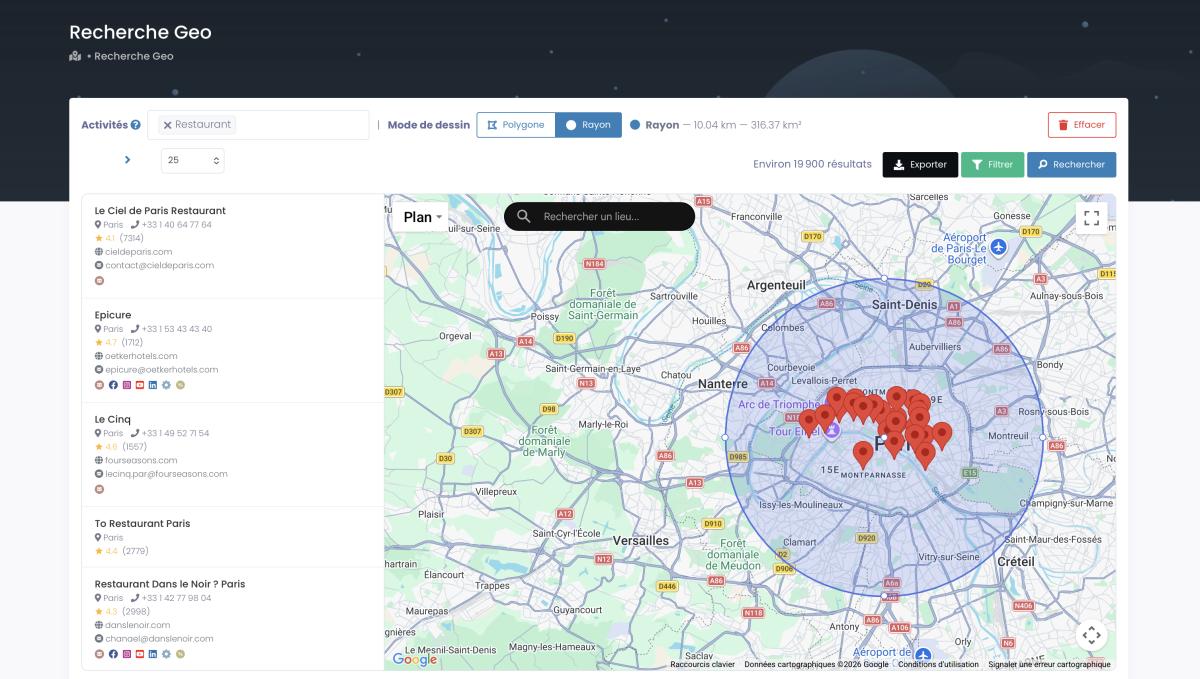
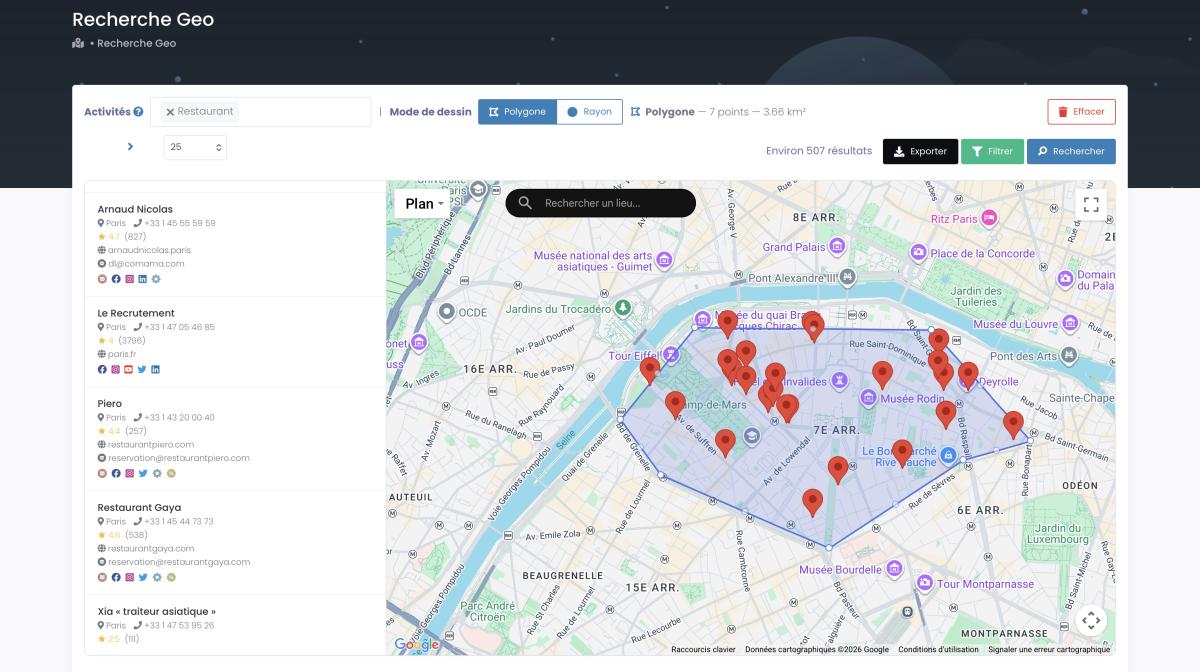
With Scrap.io, you don't have to pick one city. The GeoSearch tool lets you draw a radius around any point or trace a custom polygon on the map — grab every business within 20 miles of Macon, or just the strip along I-75 between Atlanta and Valdosta.
Georgia Business Search: Secretary of State vs. Real Contact Data
You typed "Georgia business search" into Google, landed on ecorp.sos.ga.gov, found the company… and then what?
That "and then what" is the whole problem. A business lookup Georgia on the state registry tells you a company exists and whether its paperwork is current. It will not tell you how to reach a human there. No phone. No email. No website. No way to filter 40,000 results down to the 200 you actually want. So let's walk through what each source really gives you.
How to look up a business in Georgia (the official way)
Use the Georgia Secretary of State's business search at ecorp.sos.ga.gov to confirm a company's legal name, registration status, and filing history. It's free, it's exhaustive, and it's the right tool for verifying that a business is real and in good standing. That's where its usefulness ends. For a georgia business entity search by name, it's perfect. For prospecting, it's a dead end.
What the Georgia Secretary of State business search does NOT give you
Here's the honest side-by-side. Three ways to find a business in Georgia, and what each one actually hands you.
| What you're looking for | GA SoS (ecorp.sos.ga.gov) | Chambers of Commerce | Scrap.io (Google Maps live) |
|---|---|---|---|
| Legal name / registration status | ✅ | ❌ | 🟡 (trade name) |
| Address | ✅ (registered) | ✅ | ✅ (operating) |
| Phone | ❌ | 🟡 | ✅ (+ fixed/mobile) |
| ❌ | 🟡 | ✅ (up to 7 categories) | |
| Website | ❌ | 🟡 | ✅ |
| Social profiles | ❌ | ❌ | ✅ |
| Google rating & reviews | ❌ | ❌ | ✅ |
| Filter by industry / size / digital presence | ❌ | ❌ | ✅ |
| Bulk CSV / Excel export | 🟡 (limited) | ❌ | ✅ |
| Freshness | Annual filing | Members only | Real-time |
And the chamber route? Georgia has 179 separate chambers of commerce. A hundred and seventy-nine. Each one lists its own dues-paying members and nobody else. So a statewide georgia business registry built from chambers doesn't exist — it's 179 tiny silos that don't talk to each other.
How to find a business in Georgia with contact data
If the goal is to actually reach the company, you skip the registry and pull its live Google Maps listing. That's where the business publishes the stuff it wants customers to use: phone, website, hours, the email on its contact page. Scrap.io reads that listing plus the site behind it, and — this is the part that has no equivalent anywhere else — it can pull every business in a zone with no category at all. That's literally the directory of Georgia. No category filter needed. Full guide here: extract every business from Google Maps. Prefer a broader comparison of B2B data sources first? The ZoomInfo alternatives breakdown covers where Google Maps data fits.
Curious what the Secretary of State can't show you? Run a free count on any Georgia category — counts don't cost a credit, on any plan. See the real number before you spend anything. Try Scrap.io free →
Why Georgia Business Data Matters for B2B Prospecting
The data you bought in January is already eight months dead.
Fastest Growing Industries (E-mobility, Tech, Healthcare, Data Centers)
Since 2018, Georgia has pulled in tens of billions of dollars in EV and battery investment, with more than 26,400 e-mobility jobs announced, according to the Georgia Department of Economic Development. Hyundai, Kia, Rivian — they aren't just building assembly lines. Each factory spawns an ecosystem: parts suppliers, contractors, temp agencies, logistics firms, cafeterias, security companies. The ripple effect is enormous.
Data centers are booming too. Each facility needs HVAC contractors, electricians, security, fiber installers, cleaning services. One data center creates downstream work for dozens of local businesses. None of which existed as a lead last year.
Healthcare keeps expanding as Georgia's population ages and grows. New urgent care clinics, medical spas, rehab facilities, home health agencies — they pop up every month, each one needing equipment, software, compliance help, and marketing.
And then there's film. Georgia's tax incentives turned the state into "Hollywood of the South." Productions need catering, equipment rental, transportation, lodging, set construction. These businesses appear for a project, update their Google Maps presence, and vanish when production wraps. Old directories miss them entirely. A real-time Georgia business directory catches them.
New Infrastructure Is Creating Whole Clusters of Companies
Want proof the ground moves faster than a database? The Gainesville Inland Port. It opened on May 4, 2026 — a $134 million rail terminal served by Norfolk Southern, running to Savannah five days a week, built to move up to 200,000 containers a year and cut roughly 26,000 truck trips off the highways in its first year alone.
Read that as a prospecting signal, not a press release. Dozens of logistics, freight, and warehousing companies have set up around Gainesville since May. Not one of them is in a list you bought last year. They're on Google Maps, though — because that's where their customers find them.
Film, EV manufacturing, data centers, healthcare, logistics. Georgia's economy isn't standing still. The businesses opening today won't show up in a database compiled last year. They will show up on Google Maps.
What's Included in Georgia Business Directory Data
"Business data" usually means a name and a phone number that rings a fax machine. Here's what a record actually contains.
Contact Information & Verification
When we say complete list of businesses in Georgia by industry, here's what each record carries:
| Data Point | Description |
|---|---|
| Business Name | As listed on Google Maps |
| Phone Number(s) | Classified as fixed, mobile, or special |
| Email Address(es) | Auto-sorted: Main, Individual (+ first/last name), Contact, Sales, Marketing, Finance, Administration |
| Website URL | Live link to the business site |
| Physical Address | Full street address with city, state, zip, GPS |
| Social Profiles | Facebook, Instagram, LinkedIn, TikTok, YouTube, X |
| Google Reviews | Rating score + number of reviews |
| Business Hours | Current operating schedule |
| Website Tech | CMS, detected technologies, advertising pixels |
| Category / Industry | Google Maps classification |
The email part is worth a beat. Scrap.io doesn't just grab the generic info@ address, though it gets that too. It crawls the business's website and sorts what it finds into categories — so you can email the Sales inbox for a pitch, or the named Individual contact when you've got a first and last name to personalize with. Better coverage, and you're not guessing which address a human actually reads. Want to validate those addresses before a campaign? The email validator guide walks through it.
Real-Time Updates from Google Maps
This is what separates live extraction from stale lists. Traditional Georgia business directory with email addresses providers take a snapshot, package it, and sell the same file to hundreds of buyers for months. By the time you open it, the data has already started decaying.
Real-time extraction flips that. New restaurant opens in Decatur? It's there. Contractor in Marietta changes their number? Updated. Dry cleaner in Savannah closes for good? Gone from results. You're not buying a list — you're tapping a feed that businesses themselves keep current.
Industry Classifications & Business Details
Google Maps categories are surprisingly granular — way more useful than old SIC codes. Want all healthcare providers in Georgia? Sure. But you can narrow it to pediatric dentists, or medical spas that opened in the last year, or home health agencies with a website but no Instagram. Same with the construction companies in the Georgia database: filter commercial vs. residential, high review counts vs. low. The construction company email list guide goes deep on that one.
How to Extract Georgia Business Data at Scale
Austin's plan was to wire a VA $120 for 400 leads. He got 11,734 in 45 minutes instead. Here's how that works.
Video: Scrap.io — How to Start?
State-Wide Extraction in Two Clicks
Not exaggerating. Pick a category (or leave it blank for everything), select Georgia as your location, and hit start. Scrap.io handles the rest.
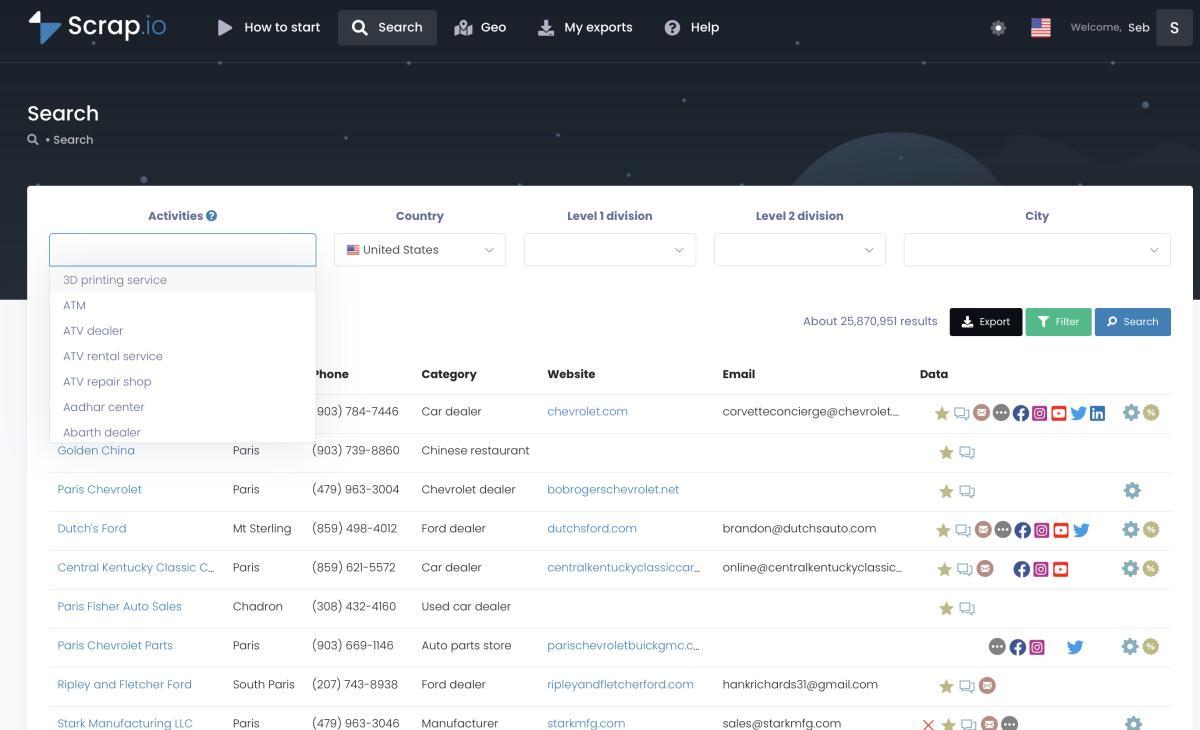
No code. No API keys. No hiring a VA to copy-paste from web pages for a week. The platform has indexed 225,676,406 establishments across 195 countries and 4,000+ categories, and it runs at 10,000 requests per minute. Georgia's 802,754? That's a Tuesday morning.
One honest caveat, because the style here is no-bullshit: pulling an entire state in a single search needs the Agency plan or higher. City-level searches work on every plan. If you specifically want all of Georgia in one shot, that's the tier to look at. The video below shows exactly this — extracting an entire territory at once.
Video: How to Scrape Local Leads at the Country Level — the same method that pulls a full state like Georgia.
Advanced Filtering Options
Here's where the real value kicks in. You probably don't want all 802,754 businesses. You want the ones that match your ideal customer.
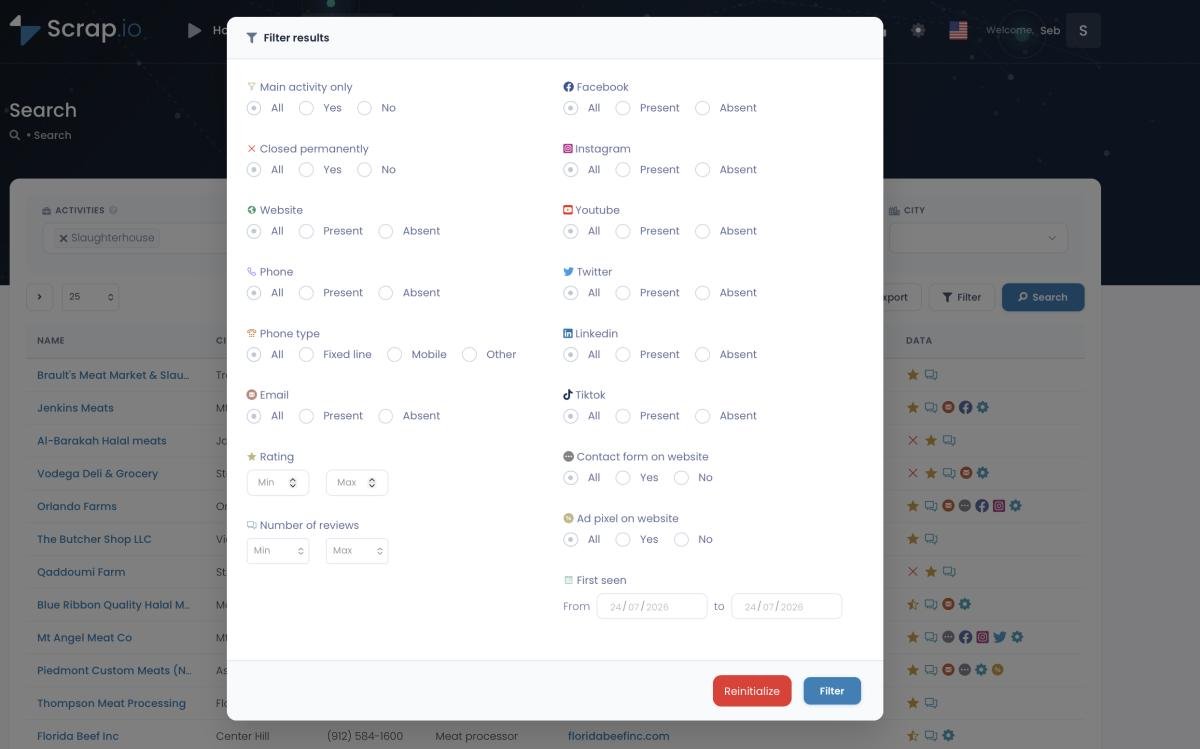
Say you run a web design agency. Filter for Georgia businesses with no website — that's your entire prospect list, pre-qualified. Or businesses with emails but no social presence (they need a digital marketing agency). Or 4+ star ratings and 50+ reviews (established, probably have budget). Or listings claimed recently (just getting serious about online presence).
And the filters run before credits are spent. You only pay for contacts that match your criteria. No more buying 10,000 records and throwing out 9,000. Doing quick research instead of a full pull? Google Maps scraper Chrome extensions are a lighter option, and the full Google Maps scraping guide covers larger extractions step by step.
Data Export Formats
Once you've filtered your Georgia companies list, export to CSV or Excel. Every field included. Ready to drop straight into HubSpot, Salesforce, Pipedrive, whatever you use. Some users wire the export into Make.com for a hands-off pipeline: extract Georgia leads, enrich, sequence, follow up.
Pick your category, select Georgia, hit start. Free trial: 7 days, 50 searches, 100 export credits, no code. Start your free trial →
Top Industries to Target in Georgia
Professional services alone: 184,000 businesses. That's more prospects than most SDRs will touch in a career.
Professional Services (~184,000 businesses). Accountants, lawyers, consultants, marketing agencies, IT firms — B2B buyers who respond to well-targeted outreach. Lawyers especially; the law firm email list guide has specific plays. Marketing agencies? The marketing agency email list guide covers that angle.
Retail Trade (~35,500 stores). Every retailer needs POS systems, inventory software, delivery logistics, security, marketing. Time your outreach to their buying cycle — inventory tools before the holiday rush, accounting software at fiscal year-end.
Healthcare & Social Assistance. Exploding sector. Doctors, urgent care, medical spas, rehab centers, home health. Most are terrible at online marketing — too busy with patients. If you sell websites, SEO, or compliance software, it's wide open. See the healthcare email list guide.
Construction. EV factories, data centers, infrastructure, residential development. Georgia's construction sector is humming. For electricians specifically, the electrician email lists guide; general contractors, the construction company email list.
Logistics & Warehousing. Savannah port plus the new Gainesville inland port equals a logistics boom. Freight companies, customs brokers, warehousing — many brand new, and only a current Georgia business directory has them.
Film & Entertainment. Seasonal but lucrative. Catering, equipment, transportation, set construction. They update Google Maps fast, because productions move fast.
Georgia Business Data: Industry Breakdown by the Numbers
The industries with the WORST email coverage are often the ones worth targeting. Counter-intuitive, but stay with me.
First, the headline numbers — counted on Scrap.io on August 7, 2026, for the state of Georgia. Of the 802,754 establishments: 458,602 have a website (57.1%), 344,152 have none (42.9%), and 270,099 have at least one email pulled from their site (33.6%). Re-run the count yourself, it's free, and it'll have moved by the time you do.
| Industry Category | Approx. Count | % with Email | % with Website |
|---|---|---|---|
| Professional & Technical Services | ~184,000 | ~45% | ~70% |
| Accommodation & Food Services | ~40,000+ | ~25% | ~45% |
| Retail Trade | ~35,500 | ~35% | ~55% |
| Healthcare & Social Assistance | ~28,000+ | ~50% | ~65% |
| Construction & Trades | ~25,000+ | ~30% | ~50% |
| Real Estate | ~18,000+ | ~50% | ~60% |
| Automotive Services | ~15,000+ | ~30% | ~40% |
| Beauty & Personal Care | ~12,000+ | ~35% | ~40% |
| Logistics & Transportation | ~8,000+ | ~40% | ~55% |
| Legal Services | ~7,000+ | ~55% | ~75% |
| Financial Services | ~5,000+ | ~45% | ~70% |
| Data Centers & IT Infrastructure | Growing | ~60% | ~80% |
These figures are approximate snapshots — actual numbers shift as businesses open, close, or update. The "% with email" column matters most for outreach. Low email availability often means high opportunity: if only 25% of restaurants have an accessible email, the ones that do are far more reachable than their competitors.
These 802,754 records aren't a claim — pull the count yourself, for free. Austin M. turned the same dataset into 11,734 contacts in 45 minutes. Run your Georgia count →
Use Cases for Georgia Business Directory
344,152 Georgia businesses have a Google Maps listing and no website. In 2026. Let that sink in, then look at who can use it.
Web agencies are the obvious one. Yussef C. — a managing director at a marketing agency — uses Scrap.io specifically to filter for businesses without websites, export the list, and pitch web design. That 344,152 figure is his prospect list, pre-qualified. The contact form lead generation strategy pairs perfectly with it.
Software companies get surgical. Restaurant management software? Target Atlanta restaurants with 50+ reviews. Scheduling tools? Filter for service businesses with multiple locations. CRM vendors? Go after professional services firms with emails but no social presence — they're collecting leads and not managing them.
Marketing companies look for signals. Lots of reviews but a low average rating? Reputation management. Website but zero social media? Digital strategy. Recently claimed listing? Actively investing in their online presence for the first time.
Banks and lenders track growth signals: more reviews over time, new locations, extended hours. Expansion means they might need financing.
Suppliers use geographic clustering. If you supply restaurant equipment, map every restaurant along the Atlanta BeltLine or in Buckhead. Proximity matters when you're delivering fridges and grills. For real-estate-adjacent leads, the real estate agent email list guide is worth a look.
Directory builders. John V. — an internet company owner with a small team — used Scrap.io to build and deploy two complete online industry directories. Extracted the data, structured it, launched the sites. Two directories from one extraction.
How Real Businesses Use Georgia B2B Data
Three users. Three completely different ways to use the same 802,754 records.
Austin M. — CX Director, Marketing & Advertising (51-200 employees). Was about to pay a VA $0.30/lead for 400 companies. Found Scrap.io and scraped 11,734 companies in under 45 minutes. Weeks of manual research, compressed into a coffee break. Verified on Capterra under his real name.
Yussef C. — Managing Director, Marketing Agency (self-employed). Runs a one-person shop selling websites to local businesses. His whole workflow: filter Georgia businesses with no website, export, pitch. Simple. Repeatable. And the list refreshes every time he runs it, so he never emails the same stale lead twice. Also on Capterra.
John V. — Owner, Internet Company (1-10 employees). Used Scrap.io to deploy two complete online industry directories — not lead lists, actual directory websites populated with structured business data. For a team under ten people, that's normally months of manual collection.
One honest note, because we'd rather you hear it from us. Some users say Scrap.io's pricing runs a touch high and occasionally flag duplicate website entries. Fair. The duplicate-exclusion filter handles the second part — it drops contacts you've already exported so a campaign spread over weeks stays clean. On price: you filter before paying, so you're not burning credits on junk. Different math than a flat per-record list.
Frequently Asked Questions
How do I look up a business in Georgia?
Use the Georgia Secretary of State's business search at ecorp.sos.ga.gov to confirm a company's legal name, registration status, and filing history — it's free. But it stops there: no phone, no email, no website, no way to filter by industry. For contact data you can actually prospect with, extract the business's live Google Maps listing instead.
How do I get a list of small businesses in an area?
Three options, from worst to best:
- Chamber of commerce directories — free, but members only, and Georgia has 179 separate chambers.
- State registry (ecorp.sos.ga.gov) — free and exhaustive, but no contact data.
- Real-time Google Maps extraction — filter by area, industry, email presence, or review count, then export. Georgia currently returns 802,754 businesses.
How many businesses are registered in Georgia?
Georgia has approximately 802,754 businesses with extractable data on Scrap.io, sourced from Google Maps. The broader count — all entity types registered with the state — exceeds 1.3 million, and the SBA counts about 1.4 million small businesses statewide. The Georgia Secretary of State's business search covers registration records, but that's names and filing status only. No emails, no phones, no industry filtering.
What industries have the most businesses in Georgia?
Professional and technical services lead with an estimated 184,000 businesses — roughly 16-17% of the total. Retail follows (~35,500), then healthcare, construction, and accommodation/food services. Fastest-growing right now: EV manufacturing, data centers, healthcare, and logistics around the expanding port system.
How can I get a complete Georgia business email list?
Real-time extraction from Google Maps through Scrap.io. Pick the location (Georgia or specific cities/counties), apply filters (industry, has email, has website, review count), and export. You get emails, phones, websites, social profiles — the full contact stack, and a georgia b2b email list with phone numbers in one file. Beats buying a stale Georgia business list compiled months ago.
Is there a free Georgia business directory?
The state's official search at ecorp.sos.ga.gov is free but limited to name and registration status. Google Maps is free to browse manually, but extracting at scale needs a tool. Scrap.io offers a free 7-day trial with 100 export credits — enough to test data quality on a specific Georgia segment. People also search for a georgia business directory pdf or a georgia business license search; the registry covers licensing lookups, while contact data comes from the live listing.
What's the best source for Georgia B2B leads?
The best source combines freshness, completeness, and filtering. Real-time Google Maps extraction wins on all three — businesses update their own listings constantly, so the data stays current. Static list brokers can't match that. Compare approaches here.
Can I scrape Google Maps for Georgia businesses legally?
Extracting publicly available business information from Google Maps is legal. Businesses publish this data specifically so people can find and contact them. Scrap.io collects only public data. For the full legal picture on cold outreach, read the cold email compliance guide and the CAN-SPAM compliance overview.
Compliance & Legal Framework
Alright — the less fun but absolutely essential part. If you're using a Georgia business contacts database for outreach, keep these in mind.
CAN-SPAM Act. The U.S. federal standard for commercial email. You need accurate sender identification, a working unsubscribe mechanism, and your physical business address in every message. Fines run up to $53,088 per violation — per email. Not optional.
TCPA. If your data includes phone numbers and you plan to call or text, the Telephone Consumer Protection Act applies. Auto-dialers and pre-recorded messages require prior consent. Manual dialing has more flexibility, but tread carefully.
Public data legality. The business info on Google Maps — names, addresses, phones, emails listed on websites — is publicly available data that companies chose to display. Extracting it for a Georgia business directory isn't "hacking" or scraping private data. It's collecting what businesses published for the express purpose of being contacted.
GDPR. Only relevant if you're targeting EU-based businesses or your company operates under EU jurisdiction. For Georgia-focused B2B outreach within the U.S., CAN-SPAM is your primary framework. For deeper guidance: cold email compliance covers the specifics, and anti-spam compliance tips walks through implementation.
Build Your Georgia B2B Pipeline
Georgia's economy isn't slowing down. Ranked 7th for business by CNBC in 2026, 1.4 million small businesses, and a tissue of new companies forming faster than any static file can log them.
But opportunity without contact data is just a headline. The businesses you want to reach are already on Google Maps — updating their listings, publishing their emails, maintaining their profiles. The data is right there.
Maybe you're after the 184,000+ professional services firms. Maybe the construction boom fueled by billions in EV investment. Maybe the logistics cluster forming around the Gainesville inland port. Either way, you need data that moves at the speed of the market.
41,761 Georgia businesses opened last year. Start your free 7-day trial and get your first 100 verified Georgia leads today — emails, phones, and social profiles included. Start your free trial →
Explore more directories: California · Texas · Florida · New York · NYC · Houston · USA Business Email Database
By François | Scrap.io Team · Last updated: August 2026
Generate a list of restaurant with Scrap.io