

Let's get the conflict of interest out of the way first: we build Scrap.io. LocalProspects.ai competes with us. Read everything below with that in mind.
Now the part that's harder to wave away. There are 74,862 plumbers on Google Maps in the United States (Scrap.io data, extracted July 19, 2026). A city-level search for plumbers in Austin, Texas returns 173. Same job title, two wildly different definitions of the word "market."
That gap is basically this whole review.
We wrote it because nobody else has. Search LocalProspects.ai today and page one is the product site, the founder's YouTube channel, his Facebook posts, and an automated MRR directory. Go hunting for a LocalProspects.ai review on Reddit and you'll find a launch thread on r/SideProject — enthusiastic, useful, and not a structured evaluation of anything. Zero independent assessments. So here's one — written by a direct competitor, concessions included, with the numbers dated and sourced. You can decide how much weight that deserves.
Table of contents
- What LocalProspects.ai actually is
- What LocalProspects.ai does genuinely well
- LocalProspects.ai pricing in 2026
- Where LocalProspects.ai stops: the geographic ceiling
- Freshness: live extraction vs stored records
- Filtering before you spend credits
- Both tools speak AI agent. Here's the difference
- LocalProspects.ai alternatives: how to choose
- Legal and compliance: what neither tool exempts you from
- The verdict
- FAQ
What LocalProspects.ai actually is
LocalProspects.ai is a Google Maps lead extraction and enrichment tool launched in 2026 by Bennett Black, a solo founder who built it while running an agency. It sells one thing: enriched local business leads, on demand, with the full enrichment pipeline included on every plan.
The origin story explains almost everything about the product. Black was an agency operator who needed contactable leads, not raw map rows — so the tool is built backwards from outreach. Owner name, phone line type, website copy. Everything a cold caller wants at 9am on a Tuesday.
Four months in, he reported over 15,000 searches run through the platform (Bennett Black, Facebook, 2026). That's real traction for a product that young. And the pain point it targets is unambiguous — one of their published customers puts it in a single line:
"Local Prospects has made it extremely easy to find high-quality leads without manually scraping Google or hiring VAs." — Aaron Marquez, AMARQUEZ (vendor-published testimonial)
Manually scraping Google, or paying someone to. That's the baseline this entire category is competing against, and it's a low bar cleared easily.
And yes, it is young. Roughly four months old at the time of writing. That's not a knock — it's a planning input. A four-month-old SaaS has a shorter track record on uptime, data consistency, and support response than one that's been shipping since 2021. Factor it into how much you commit up front, not into whether you try it.
What LocalProspects.ai does genuinely well
Three things. They do them, we don't, and pretending otherwise would waste your time and torch our credibility in the same sentence.
Owner and decision-maker names
LocalProspects.ai returns an owner or decision-maker name on its leads when one is findable. Scrap.io does not — we extract Individual Email with First Name and Last Name when a named person's address appears on the business website, but we don't attempt to identify the owner as such.
One caveat on the number you may have seen quoted. A ~70% match rate has circulated in the tool's own comparison content, but as of July 19, 2026 no match-rate figure is published on localprospects.ai — the site says "owner name when available." Treat any percentage as a vendor claim, not a measurement. Match rates on this kind of data swing hard by niche: dentists and law firms publish names, HVAC contractors mostly don't.
Phone line type and carrier, including in the US
Here's the concession that matters most, and we're going to write it in plain text rather than bury it.
Scrap.io's phone type filter — landline, mobile, special — is unavailable in the United States and Canada. LocalProspects.ai classifies line type (landline, mobile, VoIP, toll-free) plus carrier, and it does it on the US market. If you're running SMS campaigns or cold calls to American small businesses and you need to know which numbers can receive a text, that's a real advantage for them. Not a marketing edge. An actual capability gap on our side.
One of their published customer testimonials puts it better than we would:
"I'm going to say that I am pleasantly surprised at the value that you get when you use this amazing service called localprospects.ai. […] every phone number that it scrapes it actually identifies if it's a mobile number if it's a landline and that way it makes it easy for your Outreach to know if you can text or not." — Jaime Ojeda, Business eBoost
Worth flagging: that quote, and the two others we cite in this article, are testimonials selected and published by the vendor on its own homepage. They're real people saying real things. They're also, by definition, the happy ones.
If you're shopping specifically for the best google maps scraper for cold calling, or a google maps scraper with mobile phone numbers attached, this is the section that should decide it. On the US market, line-type detection is theirs. Ours covers everywhere else.
Raw website text from up to five pages
Their enrichment crawls up to five pages of a business's website and hands back the full text, plus tech stack, logo and social profiles. Scrap.io returns title, meta description, keywords, detected technologies, CMS, ad pixels and contact-form presence — structured signals, not prose.
Different philosophies. If you're feeding an LLM to write personalised first lines, raw page text is more useful than a tech-stack flag. If you're segmenting 40,000 businesses by "runs a Meta pixel and has no contact form," structured signals win. Neither is objectively better. It depends what's downstream.
A word on the question everyone eventually asks: how accurate are scraped business emails? Both tools find emails the same way — by crawling the business website linked from the Maps listing, because Maps listings don't display emails at all. So accuracy is bounded by what the business actually publishes. LocalProspects flags each address with a verification status and a role-based indicator; Scrap.io classifies them by function (individual with first and last name, contact, sales, marketing, finance, admin). Neither of us invents an address that isn't on the site. Anyone promising 95% deliverability on scraped B2B emails is selling you something. We laid out the method in full in our guide on how to find emails on Google Maps.
LocalProspects.ai pricing in 2026
$29/month for 10,000 leads with full enrichment included is aggressive pricing. Genuinely. We're not going to squint at it.
Here's the grid, verified on localprospects.ai on July 19, 2026:
| Plan | Monthly | Annual (per month) | Leads / month |
|---|---|---|---|
| Free | $0 | — | 100 |
| Starter | $39 | $29 | 10,000 |
| Agency | $97 | $79 | 50,000 |
| Scale | $297 | $229 | 200,000 |
One credit equals one enriched business. Failed enrichments get refunded automatically. Every plan includes the same pipeline, the same API, the same CSV export — no add-on tiers, which is a cleaner model than most of the market. Their first search is free and doesn't require a card.
Scrap.io Basic, for comparison: $35/month annual, $49/month with no commitment, for 10,000 credits. So on paper they're $6/month cheaper at the entry tier. Bref, on a single-city workflow they win the price line.
The rollover trap: what unused leads really cost you
Neither tool rolls over unused credits. Theirs reset monthly, including on annual subscriptions. Ours reset too. Fine — that's the industry norm, and we're not going to pretend it's a scandal when we do exactly the same thing.
But run their own "cost per usable lead" logic on their own Starter plan and it gets interesting. At $29/month annual for 10,000 leads, you're at $0.0029 per lead — if you use all 10,000. Burn 3,000 in a typical month and your real cost is $0.0097 per lead. Still cheap. Just not the number on the pricing page.
Which is why the "cheapest google maps scraper 2026" question is close to meaningless without a volume assumption attached. My advice? Pull one month of actual usage before you commit to twelve.
Is there a free google maps scraper alternative?
Sort of. Their Free plan gives 100 leads. Outscraper gives 500 records. Open-source options on GitHub are free if your time is free. And Scrap.io's Chrome extension is free and unlimited — it shows emails and social profiles directly on the Google Maps interface, though it doesn't do bulk export. Every genuinely free path caps out somewhere. That's not cynicism, that's just how the unit economics of website crawling work.
Where LocalProspects.ai stops: the geographic ceiling
LocalProspects.ai searches run city by city. There is no state-level or country-level search. That's the ceiling, and it's the single most important line in this review.
You can queue multiple cities in one job — their location endpoint does fuzzy matching on cities and regions, and a satisfied customer describes exactly this workflow:
"I usually targets small businesses in the usa and need to have mobile numbers to get in touch with owners directly.. which local prospects is really good at. Moreover, you can also add multiple cities to get leads in one go which saves a lot of time." — Dhaval Karena (vendor-published testimonial)
Read that second sentence again. It's a compliment, and it's also a precise description of the architecture: the unit of search is the city. Stack enough of them and you approximate a region. You never actually get one.
To their credit, their own comparison page concedes the point rather than dodging it — they credit Scrap.io with "geographic searches from city to country scale" and list "Large geographic extraction options" under our strengths. That page is localprospects.ai/compare/scrap-io, and it's worth reading. It's more fair-minded than most vendor comparison pages, ours included.
City-by-city vs country-level: a real math problem
Numbers, extracted from Scrap.io on July 19, 2026:
| Search scope | Plumbers on Google Maps | Reachable in one query? |
|---|---|---|
| Austin, TX (city) | 173 | Both tools |
| State of Texas | 5,682 | Scrap.io (Agency plan) |
| United States | 74,862 | Scrap.io (Company plan) |
Source: Scrap.io, Google Maps data extracted July 19, 2026.
So: how many plumbers are there in the United States, at least as Google Maps sees them? 74,862. Austin is 0.2% of that.
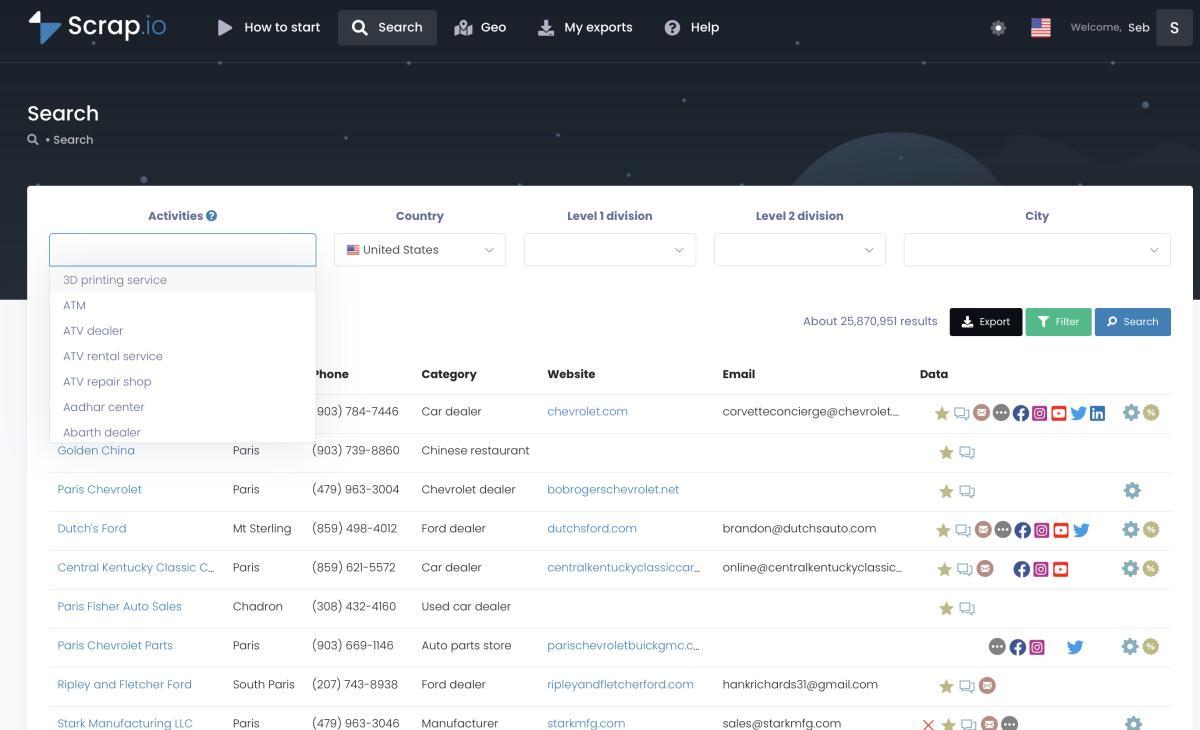
Now do the operational math. Covering Texas city by city means identifying every city with plumbers in it, queueing them, deduplicating across overlapping metro boundaries, and hoping you didn't miss the small ones. Try that manually. I'll wait. On Scrap.io it's a dropdown — city, county, state, or country, across 195 countries and 4,000+ categories. Two clicks, no code, no coordinate grid.
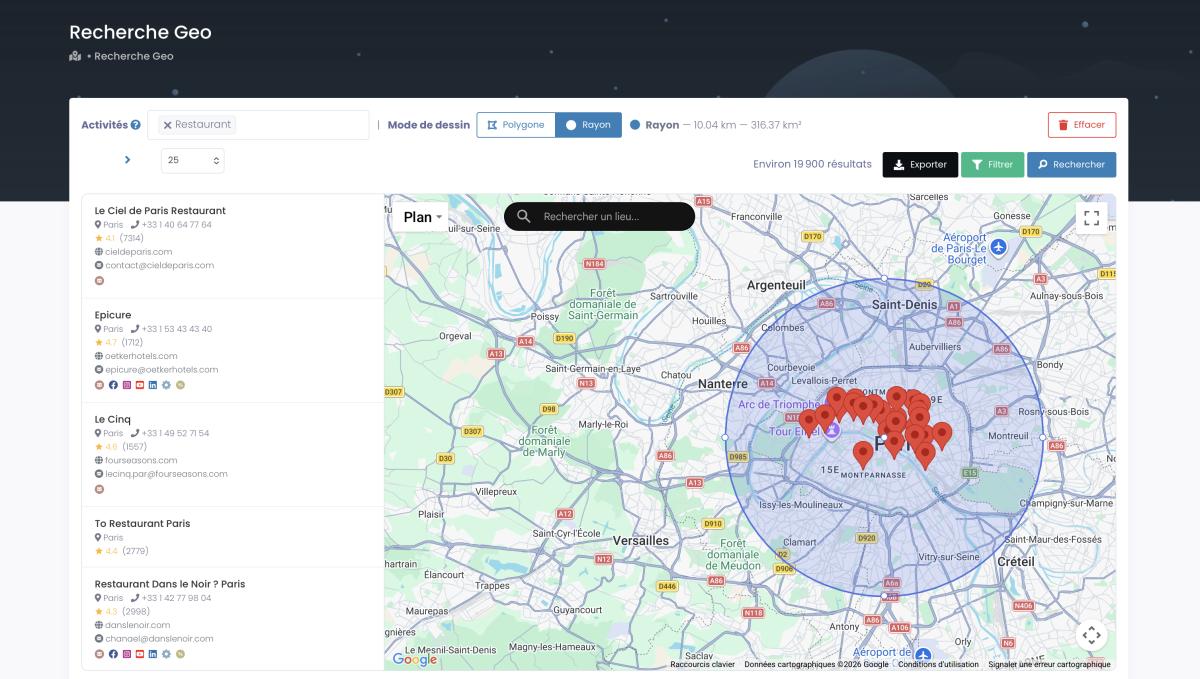
There's also GeoSearch, which handles the shapes that administrative boundaries don't: a radius up to 500 km around a point, or a hand-drawn polygon up to 1,000,000 km². Useful when your territory is "everything within 40 minutes of this warehouse" rather than a county line. We documented the full approach in our guide on how to extract every business in a country.
Video: How to Scrape Local Leads at the Country Level
Curious how many businesses actually exist in your target market? Scrap.io counts are free — in the app, through the API, and through the MCP server. No credits, no commitment. Find out whether your market is 173 businesses or 74,862 before you buy anything from anyone.
Freshness: live extraction vs stored records
When a tool says the data is "live" — live at what moment, exactly? When they scraped it, or when you exported it?
Those are not the same thing, and the difference shows up in your bounce rate.
Scrap.io extracts in real time at every export. No frozen database sitting between you and the map listing. Every field is pulled at the moment you export it and is traceable back to its source. That's the mechanism, not a slogan — we broke down how Scrap.io extracts data in real time separately.
LocalProspects.ai runs an enrichment job that takes 30 to 90 seconds per batch, which means their data is fetched on demand too. Their own writing on the subject concedes that neither model is universally better, and honestly, that's a fair position at the abstract level.
At the concrete level, though, local business data rots fast. Restaurants close. Contractors move. A dental practice gets acquired and the phone number redirects. Every month between "scraped" and "exported" is a month of decay you inherit. In theory both models work. In practice, the only version of "fresh" that survives contact with a cold-calling list is the one where extraction and export happen in the same breath.
Filtering before you spend credits
The most expensive lead is the one you paid for and can't use.
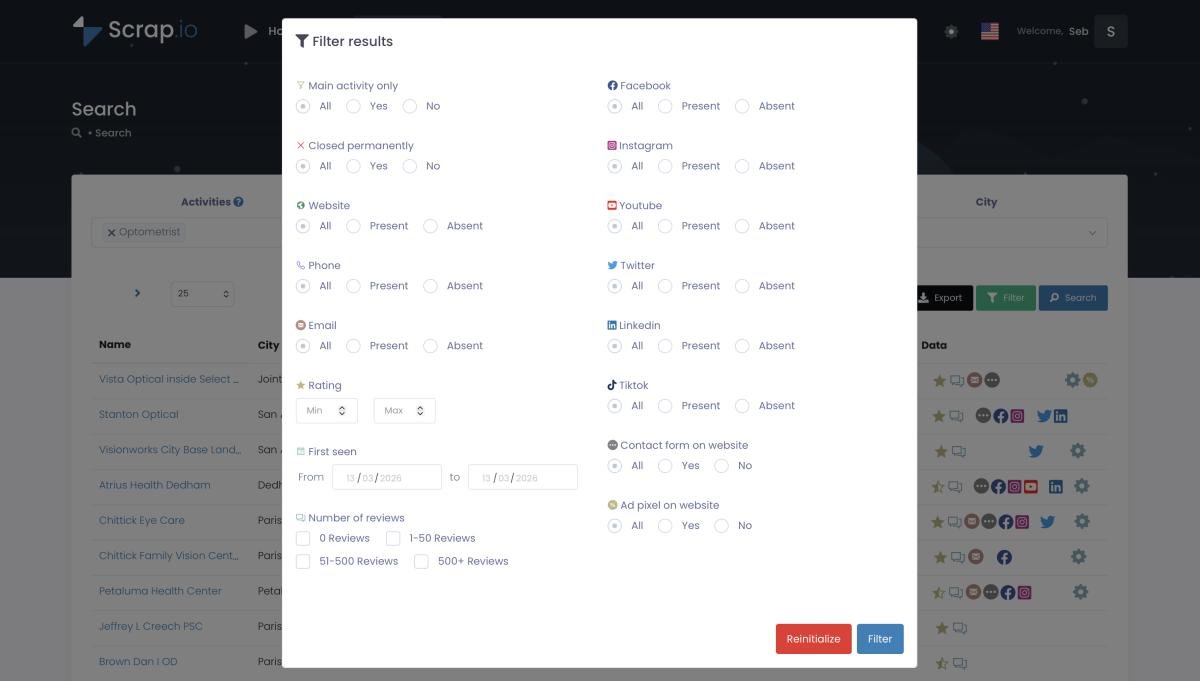
This is the argument we'd make even if we sold nothing. On Scrap.io, filters apply before credits are consumed. Has an email. No website. Mobile number only. Minimum rating, minimum review count, runs an ad pixel, has a contact form, listing claimed or unclaimed, first detected after a given date. You narrow first, you pay second.
Back to the plumbers, same July 19, 2026 extraction:
| Segment (US plumbers) | Count | Share | Credits with pre-export filtering |
|---|---|---|---|
| All plumbers | 74,862 | 100% | 74,862 |
| With an email on the website | 27,363 | 36.6% | 27,363 |
| With no website at all | 31,264 | 41.8% | 31,264 |
Source: Scrap.io, Google Maps data extracted July 19, 2026.
That third row is quiet gold for a web agency. 31,264 American plumbers with no website — a list of businesses that literally need the thing you sell. Without a dedicated filter, that segment is invisible; you'd extract all 74,862 and sort them out afterwards.
Which is where the money goes. Filter first: 31,264 credits. Filter afterwards: 74,862 credits for the same usable output. At $0.0029 per lead on a Starter-tier annual price, that's roughly $126 spent on rows you were always going to delete. Not catastrophic on one campaign. Multiply it across a year of monthly pulls and it stops being rounding error.
There's one more capability worth naming, because LocalProspects.ai doesn't have it at all: catchment-area search with no category. Every business in a zone, regardless of activity type. Their search requires a niche keyword. Ours doesn't — you can pull an economic map of a territory rather than a vertical slice of it. The full mechanics are in our filtering guide for accurate extraction.
Video: Scrap.io - How to Start?
31,264 US plumbers without a website. That's the list an agency actually wants — and with pre-export filters you pay for those 31,264, not for all 74,862. Run the count yourself on Scrap.io: 225,676,406 businesses indexed across 195 countries, and counting is free.
Both tools speak AI agent. Here's the difference
They ship a markdown skill file. We ship an MCP server. Both work with Claude — but not in the same way, and the difference is more than plumbing.
LocalProspects.ai's approach: a markdown skill file you copy into Claude Code, Cursor, Codex or any agent that reads skill files, backed by a REST API with an lp_ key passed as x-api-key. Your agent reads the instructions, hits the endpoint, fires a search job, then polls for 30 to 90 seconds until results are ready. It works. It's also three moving parts and a wait loop.
Scrap.io's approach: an official MCP server at scrap.io/mcp, compatible with Claude, ChatGPT, Gemini and any MCP client. The agent talks to the server directly — no skill file to keep in sync, no polling loop to write. GeoSearch works in natural language, so "find every restaurant in the 11th arrondissement of Paris" becomes a polygon without you drawing one. Results come back to the agent directly, ready to map, report or export.
Free counts: the underrated feature
Here's the bit nobody talks about loudly enough. Counting is free on Scrap.io — in the interface, through the API, and through the MCP server. Zero credits.
Which changes how an agent can behave. It can probe a market before spending anything: how many HVAC contractors in Ohio, how many of those have no website, how many have a mobile number. Three counts, three zeros on the invoice, then one informed export. On a metered API where every call costs, that exploratory loop is a budget leak, so nobody builds it.
Google maps scraper API access, and what you can wire it into
Both tools ship one, so this is a fair fight. Their REST API uses an lp_ key and a job-then-poll pattern. Ours sits at 300 requests per minute, included on every plan, with an official Make.com module and Zapier or n8n through the same endpoints. If you want a google maps scraper with api access that a non-developer can still trigger from an automation canvas, the Make module is the shortcut. If you want a lead scraper MCP for AI agents, that's the scrap.io/mcp route above.
Plus a free unlimited Chrome extension if you want emails and socials surfaced right on the Google Maps interface — a different job entirely, but people ask.
Does the volume actually hold up under that kind of automation? One documented Scrap.io case: 11,734 businesses extracted in 45 minutes for a single campaign. That's the ceiling most google maps lead scraper for agencies shortlists are really trying to establish, and it's easier to test than to argue about.
LocalProspects.ai alternatives: how to choose
There is no best google maps scraper. There's the one that matches the shape of your campaign — and the shape of your campaign is mostly a question of geography and what you do with the leads afterwards.
| If you need… | Best fit | Entry price |
|---|---|---|
| One city, owner names, US mobile/landline detection | LocalProspects.ai | $29/mo annual |
| A whole state or country, real-time data, pre-export filters | Scrap.io | $35/mo annual |
| Occasional pay-as-you-go exports and review scraping | Outscraper | $3 / 1,000 records |
| Custom developer pipelines | Apify | from $2.10 / 1,000 places |
| A cheap credit-based Chrome-adjacent option | Lobstr.io | $20 / 10,000 credits |
A few honest notes on that table. Outscraper bills enrichments separately — contacts at +$3 per 1,000 domains, phone lookup at $5 per 1,000 — so the $3 headline isn't the landed cost. Apify is excellent and genuinely cheap per place, but you're also paying for compute time, and you need someone who's comfortable in JSON. Lobstr.io's credits get consumed twice on the same business if you want the Maps row and the email.
And then there's the "official" route everyone considers and then abandons: the Google Places API Text Search, which caps at 60 results total across all pages, returns no emails and no owner names, and comes with export restrictions in the Google Maps Platform terms. Sixty. For a country with 74,862 plumbers in it. It's the right tool for a consumer app doing single lookups and the wrong tool for literally everything discussed in this article.
If you want the wider field rather than a head-to-head, we ranked the 10 best Google Maps scrapers in 2026. And since LocalProspects.ai positions itself first and foremost as an Outscraper alternative, that comparison is probably the other one you're weighing.
Video: Scrap.io vs Apollo — Which Tool for Which Type of Prospecting
Here's the full head-to-head, re-verified on both sites on July 19, 2026:
| Criterion | LocalProspects.ai | Scrap.io |
|---|---|---|
| Entry price (annual) | $29/mo — 10,000 leads | $35/mo — 10,000 credits |
| Entry price (no commitment) | $39/mo | $49/mo |
| City search | ✅ | ✅ |
| County / state search | ❌ | ✅ (Pro / Agency) |
| Whole-country search | ❌ | ✅ (Company — 195 countries) |
| GeoSearch radius / polygon | ❌ | ✅ up to 500 km / 1,000,000 km² |
| Catchment area with no category | ❌ | ✅ |
| Owner / decision-maker name | ✅ | ❌ |
| Phone line type — US | ✅ | ❌ (unavailable US & Canada) |
| Phone line type — rest of world | ❌ | ✅ |
| Emails classified by role | ✅ | ✅ (contact / sales / marketing / finance / admin) |
| Raw website text (up to 5 pages) | ✅ | 🟡 title, meta, tech stack, pixels, CMS |
| Filters applied BEFORE extraction | ❌ | ✅ |
| Free counts | ❌ | ✅ (app, API and MCP) |
| Official MCP server | ❌ (markdown skill file) | ✅ scrap.io/mcp |
| Official Make.com module | ❌ | ✅ |
| Chrome extension | ❌ | ✅ (free, unlimited) |
| Free trial | 100 leads, no card | 7 days — 50 searches + 100 credits |
| Unused credits roll over | ❌ | ❌ |
If country-level reach is what you're missing, the Scrap.io 7-day trial includes 50 searches and 100 export credits — enough to test data quality on your own niche. Rated 4.8 on Capterra, 4.9 on G2 and 4.5 on Trustpilot by 50,000+ professionals.
Legal and compliance: what neither tool exempts you from
A clean lead list will not save you from a CAN-SPAM complaint.
This section is missing entirely from their comparison page, and it shouldn't be, because it's the part that actually generates lawyers' letters. Collecting public business data is broadly lawful in the US. What you do with it afterwards is governed separately, by rules that don't care which vendor's CSV you're reading from.
- CAN-SPAM (US) — accurate headers, no deceptive subject lines, a visible physical address, and a working opt-out honoured within 10 business days. The FTC compliance guide is short and worth 15 minutes.
- GDPR (EU) — company phone numbers and generic addresses generally aren't personal data; a named person's professional email is. B2B outreach usually leans on legitimate interest, and legitimate interest still requires an opt-out.
- CCPA (California) — carves out publicly available information, but honour deletion requests when they come.
Scrap.io extracts only publicly available business data, is GDPR and CCPA compliant, and every data point is traceable back to its source. That's a statement about our collection practices, not about your campaign. Nobody's tooling makes your outreach compliant. That part's on you. (Factual information, not legal advice — if real money is on the line, talk to an actual lawyer.)
The verdict
If your entire pipeline is five cities and a phone, LocalProspects.ai is a good buy. If your market is a state, a country, or 195 of them — you'll hit a wall, and you'll hit it fast.
LocalProspects.ai is a strong fit for city-level outreach in the US, and a poor fit for state- or country-level extraction. The owner names are real, the US line-type detection is a genuine advantage we don't match, the pricing is fair, and the free tier lets you check all of it yourself before paying. For a solo agency owner cold-calling contractors in three metros, it's well-built for exactly that job.
Where it stops is scale and the credit economics of scale. City-by-city search, no pre-export filtering, no free counting, no country query. If any of those three appear in your workflow, the $6/month price difference stops being the decisive number.
Buy on the shape of your territory, not on the pricing page. That's the whole thing.
Try Scrap.io free for 7 days — 50 searches and 100 leads on us, across 225,676,406 businesses in 195 countries and 4,000+ categories. Real-time extraction, filters before credits, free counts. Cancel anytime.
FAQ
Is LocalProspects.ai legit?
Yes. LocalProspects.ai is a real, operating product launched in 2026 by Bennett Black, with published pricing, documented API endpoints, and named customer testimonials on its site. It's a young tool — roughly four months old as of July 2026 — so test it on your own niche with the free 100-lead tier before committing to an annual plan.
How much does LocalProspects.ai cost in 2026?
Three paid plans plus a free tier: Starter at $39/month ($29 annually) for 10,000 leads, Agency at $97/month ($79 annually) for 50,000 leads, and Scale at $297/month ($229 annually) for 200,000 leads. Every plan includes the full enrichment pipeline, API access and CSV export. Unused leads do not roll over, including on annual subscriptions. Verified on localprospects.ai, July 19, 2026.
Does LocalProspects.ai give you business owner names?
Yes. LocalProspects.ai returns an owner or decision-maker name when one is findable, and this is one of the features it offers that most Google Maps scrapers — including Scrap.io — do not. Match rates vary by niche and by what businesses publish online; no measured match rate is published on their site, so treat any percentage you see quoted as a vendor claim.
Can LocalProspects.ai scrape an entire country?
No. LocalProspects.ai searches run by city — you can queue multiple cities in a single job, but there is no state-level or country-level search. For country-wide extraction across 195 countries in one query, Scrap.io's Company plan supports it directly, and their own comparison page credits Scrap.io with city-to-country geographic scale.
What's the best LocalProspects.ai alternative?
It depends what's missing. Choose Scrap.io for country-level reach, pre-export filtering and real-time data. Choose Outscraper for occasional pay-as-you-go exports and review scraping. Choose Apify if you have developers building custom pipelines. There is no universal winner — there's the one that matches your geography and your volume.
Written by the Scrap.io team. We compete directly with LocalProspects.ai and we've said so throughout. All Scrap.io figures were extracted on July 19, 2026; all LocalProspects.ai figures were verified on their public pages the same day. Products change — check both before you buy.
Generate a list of restaurant with Scrap.io