

Go ahead. Google "consumer email lists" right now. Every result on page one is someone trying to sell you one. Melissa, LeadsPlease, Data Axle, a dozen others you've never heard of, all promising millions of addresses for the price of a nice dinner.
That's the tell.
When an entire search page is wall-to-wall vendors and zero honest reviews, it usually means the buyers never come back to complain in public. They just quietly eat the bounce rate and move on. So before you drop $300 on a thousand "verified opt-in" consumer emails, let's run the math those vendors skip: what a consumer email list actually is in 2026, whether purchased data converts, and what fresh B2B data does instead. No sales pitch dressed up as advice. If something's a bad deal, I'll say it plainly.
What's inside
- What a consumer email list really is
- How much do consumer email lists cost in 2026?
- Do they actually convert? The 2026 benchmarks
- Consumer email lists vs B2B data: which converts?
- Is buying consumer email lists legal in 2026?
- So should you ever buy one?
- The better way: build your own fresh, targeted list
- FAQ
What a consumer email list really is
A consumer email list is a pile of B2C contacts sorted by demographics. Age, household income, ZIP code, home value, lifestyle buckets like "new parents" or "frequent travelers." You tell the broker who you want to reach, they hand you a spreadsheet of people who supposedly match. Simple idea. Messier reality.
Here's the first thing nobody says out loud: most of these contacts are generic by design. A consumer email database is built to be broad, because broad is what sells. It's the opposite of a B2B file, where the value is in reaching a specific business at a specific address about a specific problem. One is a megaphone. The other is a conversation.
Opt-in, in theory. And then in practice.
Every vendor on earth slaps "100% opt-in" on the box. Read it closely, though. "Opt-in" often means someone, years ago, ticked a box on a sweepstakes page or a coupon site, and that consent got bundled, resold, and passed down a chain nobody can trace anymore. By the time it reaches you, that "opt-in" consumer mailing list is less a permission slip and more a game of telephone. The person on row 4,812 has no idea you exist, and never agreed to hear from you specifically.
And that gap between the claim and the reality is exactly where your bounce rate and your spam complaints come from. We'll get to the numbers in a minute. They're worse than you think.
How much do consumer email lists cost in 2026?
Short version: anywhere from 2.5 cents to 30 cents a record, and the price tells you almost nothing about the quality. Here's what the actual 2026 numbers look like, pulled straight from the providers' own pages.
| Provider | Price per 1,000 | Per record | What they claim |
|---|---|---|---|
| Melissa | $25 (min order $50) | $0.025 | 200M+ consumers, 100M+ US households |
| LeadsPlease | $299.95 | $0.30 | "98% accuracy," "100% opt-in" |
| Data Axle / Salesgenie | Subscription (quote) | Varies | Large US compiled database |
Look at that spread. Melissa sells a thousand US consumer emails for twenty-five bucks. LeadsPlease charges nearly twelve times as much for what is, on paper, the same product: a US consumer email list drawn from the same kind of public and compiled sources. A 12x price gap on identical-sounding data isn't a quality signal. It's a flashing sign that this market is opaque and nobody really knows what they're buying.
So when you search "how much do consumer email lists cost," the honest answer is: the sticker price is a distraction. The real cost is what happens after you hit send. Cheaper almost always means older, resold more times, and stuffed with addresses that stopped working in 2024. (Those "free consumer email lists" floating around forums? Every spam trap in existence is already on them. Don't.)
Where can I buy consumer email lists, and who's reputable?
If you're set on buying, these are the names that keep surfacing when people look for the best place to buy consumer email lists in 2026:
- Melissa, cheapest per record, pay-as-you-go, quarterly data refresh.
- LeadsPlease, pricier, leans hard on its "98% accuracy" and real-time verification pitch.
- Data Axle (Salesgenie), the old guard of compiled US data, subscription-locked.
Every one of them is a vendor with something to sell, which is fine, that's the job. Just don't expect any of them to warn you about decay or deliverability. For the broader postal and B2B angle, we ran a separate roundup of the best mailing list companies, and a full breakdown of buying a mailing list if physical direct mail is more your thing.
Do they actually convert? The 2026 benchmarks
Here's where it stops being theoretical. Email itself is a monster of a channel: it still returns roughly $36 for every $1 spent (Litmus, 2025). That's not a typo. Thirty-six to one. Try getting that from paid social.
But, and this is the whole article in one word, that number assumes your emails reach a real human who wanted them. A purchased consumer list breaks that assumption on contact. The industry benchmarks are brutal.
| Metric | Purchased / unverified list | Fresh / opt-in list |
|---|---|---|
| Bounce rate | 15% to 30% | under 5% |
| Open rate | under 2% | 15% to 35% |
| Reply rate | under 0.5% | 3% to 8% |
| Spam complaints | over 0.5% | under 0.1% |
| Meeting conversion | under 0.1% | 1% to 3% |
Those figures come from vendors who sell verification (Apollo.io and BounceZero, 2026), so treat them as industry benchmarks rather than gospel. But even if they're flattering themselves, the direction is undeniable: a purchased consumer list opens at under 2% against 15% to 35% for a fresh one. That's not a small gap. That's a different universe.
Sit with that for a second.
For context, the average marketing email in 2026 opens around 21.5% (Campaign Monitor) with a click rate near 2.3% (Mailchimp, with B2B at 3.5% and B2C at 2.1%). A bought list doesn't just underperform the benchmark. It doesn't come close to touching it.
The decay problem nobody puts on the invoice
Even a perfect list rots. B2B contact data decays around 22.5% a year, with consumer data sliding 10% to 15% annually and B2B contacts a nastier 22% to 30% (MarketingSherpa 2025; BounceZero 2026). On top of that, roughly 30% of people change their email address every year (Validity, 2025). Do the compounding. That "fresh" 10,000-record consumer list you bought in January is measurably fiction by summer, and you never got a notice.
And then the inbox providers punish you
This is the part that actually ends campaigns. Since 2024, Gmail and Yahoo keep spam complaints under a hard 0.3% ceiling (it's right there in Google's own sender guidelines). Cross it and you get throttled, then blocked. Your email service provider is even stricter: most suspend accounts around 2% hard bounce (Mailchimp roughly 2%, Klaviyo roughly 1%, HubSpot 5%, per BounceZero 2026). A purchased list bouncing at 15% to 30% blows through every one of those limits on the first send.
And here's the kicker almost nobody plans for: only 38% of senders verify a list before mailing it, and invalid addresses cost roughly $11 per 1,000 sends in wasted spend and reputation damage (Validity, 2025). If you're going to send anyway, at least verify the list and cut the bounces first. Non-negotiable.
Don't take my word for it. A marketer on the Adobe Community forum (handle lakesean, 2024) described uploading a 30,000-address purchased list for a client, then watching it detonate. In their words: "[Mailchimp] detected a high number of spam reports on your last campaign... Otherwise you'll be marked as a spammer... possibly rendering the client completely unable to send out any emails that use their domain." That's not a bounce rate. That's torching a client's entire domain reputation with one blast.
Want to see what fresh actually looks like? Instead of renting a decaying file, watch Scrap.io build a list in real time from live Google Maps data, re-verified at the exact moment you export. Free 7-day trial, 100 leads included. Put it head-to-head against any list you're eyeing.
Consumer email lists vs B2B data: which converts?
This is the comparison the whole SERP is missing, so let's actually make it. Consumer (B2C) data and B2B data are not two flavors of the same thing. They convert differently because they are different.
| Factor | Consumer (B2C) email list | Fresh B2B data |
|---|---|---|
| Who's on it | Anonymous individuals by demographic | Named businesses by category + location |
| Targeting | Age, income, ZIP, lifestyle | Industry, geography, website, email type |
| Freshness | Decays 10% to 15% a year | Verified at extraction |
| Legal footing | Murky consent chain | Public business data, traceable |
| Converts for cold outreach | Rarely | Consistently, when targeted |
The pattern is obvious once you see it. A massive consumer email database wins on raw volume and loses on everything that actually drives a reply. A tight B2B file wins on relevance, which is the only thing a cold recipient cares about. Freshness and targeting beat volume. Every time. Nobody opens an email because there were two hundred million others just like it.
Volume is vanity. Relevance is revenue.
Video: B2B Lead Gen, Google Maps vs LinkedIn
Targeted email lists beat big consumer databases
Here's the mindset shift. Stop thinking in list size, start thinking in fit. Targeted email lists built by demographics sound precise until you realize "homeowners aged 35 to 50 in Ohio" is still a crowd of strangers. A real B2B equivalent, "dental practices in Ohio with a website and a listed email," is a crowd of qualified prospects. Same effort to build. Night-and-day difference in replies. If you want the data on what that actually costs to reach, we broke down what qualified leads really cost channel by channel.
Buying an email list by industry
This is the one place B2B data pulls ahead so hard it's almost unfair. You can't meaningfully buy "consumers who might want a roof." But you can build an email list by industry, roofers, restaurants, law firms, clinics, filtered to the exact category you sell into, so you only ever pay for the vertical that matters. When your targeting matches your offer, the whole economics flips. For the full provider landscape, our rundown of the best B2B data providers covers who's good at what.
50,000+ teams already build their own B2B lists instead of renting consumer data. See how Scrap.io does it: 225M+ businesses, 195 countries, filtered before you spend a credit. 7-day free trial, 100 leads included.
Is buying consumer email lists legal in 2026?
Yes, buying consumer email lists is legal in the United States. But buying a list and having the legal right to blast it are two completely different things, and that gap is where people get burned.
Under CAN-SPAM, you can send commercial email without prior consent, as long as you use honest headers, a real physical address, and a working one-click unsubscribe you honor fast. The catch is the penalty: up to $53,088 per individual email (FTC). Per email. Not per campaign. Blast 5,000 non-compliant messages and the math gets ugly in a hurry. So yes, consumer email lists can be CAN-SPAM compliant, but only if you do the work.
Cross a border and it gets stricter. The EU's GDPR demands a documented lawful basis before you email anyone, with fines reaching 20 million euros or 4% of global turnover, and a purchased list with zero traceability is a compliance officer's nightmare. California's CCPA/CPRA adds penalties up to $7,500 per violation. In every one of these regimes, "we bought a file" is the weakest possible answer to "where did you get this person's data?"
That's the real legal problem with a bought consumer list: you inherit liability for how every single address was collected, and you usually can't prove a thing. We go deep on this in the full cold email compliance guide, and if Europe is a market, the GDPR cold email rules for B2B walk through the paperwork line by line.
As Nancy OShea put it in that same Adobe thread: "Cold mail services usually have a reputation for sending large quantities of unsolicited mail... there's no guarantee that all or even a portion of mail will reach its destination." Legal to buy. No guarantee it ever lands. That's the trap in two sentences.
So should you ever buy one?
Honest answer? Almost never, but not quite never.
Honestly, the odds just aren't in your favor.
There's one narrow case where buying a consumer email list makes sense: you need a broad demographic overlay you genuinely cannot compile yourself (think "households with income over $150K in three ZIP codes" for a local consumer promo), the vendor verified it recently, and you're treating it as a one-time seed, not a strategy. Fine. Buy small, verify ruthlessly, never send from your primary domain, and expect 15% to 30% of it to bounce no matter what the invoice promised.
Outside that? Buying is renting a problem. The data is static from second one, it's sold to a dozen other senders hammering the same inboxes, and you can't document where it came from when a regulator asks. If you already paid for a list, don't just blast it, run it through verification first and quarantine the catch-alls. And if you're still shopping, read our take on buying email lists, what works and what doesn't before you swipe the card. Spoiler: fresh-and-self-built beats bought-and-frozen on cost, deliverability, and compliance.
The better way: build your own fresh, targeted list
Marcus runs a five-person web agency. For two years he rented consumer and B2B lists: pay, receive a static file, watch half of it bounce, repeat. Then he flipped the model. Now he pulls his own, every restaurant without a website in his county, extracted and verified this morning, filtered down to the ones with a real email. No broker. No decay. No file someone recycled five times.
That's the whole idea behind building instead of buying. The biggest database of real businesses on the planet isn't a broker's CSV. It's Google Maps, and it's public, owner-maintained, and updated constantly. Scrap.io pulls from it live: 225,676,406 establishments across 195 countries and 4,000+ categories, re-verified at the moment you export. Nothing frozen, nothing resold.
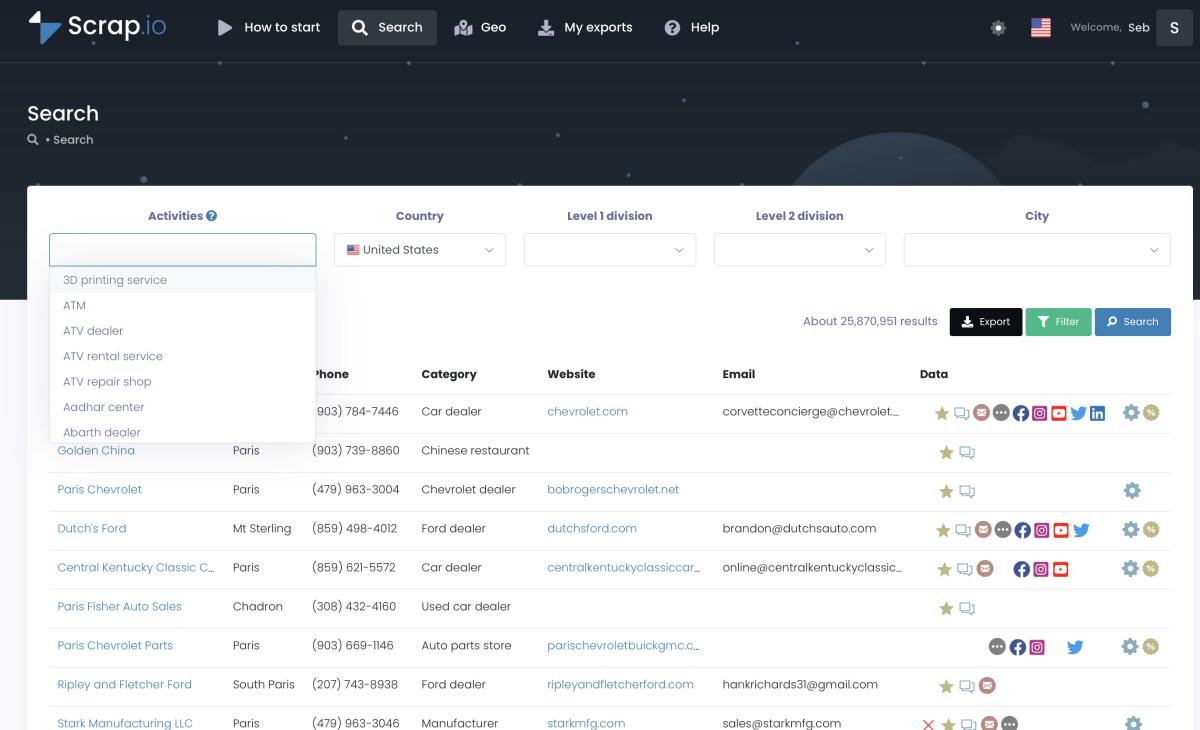
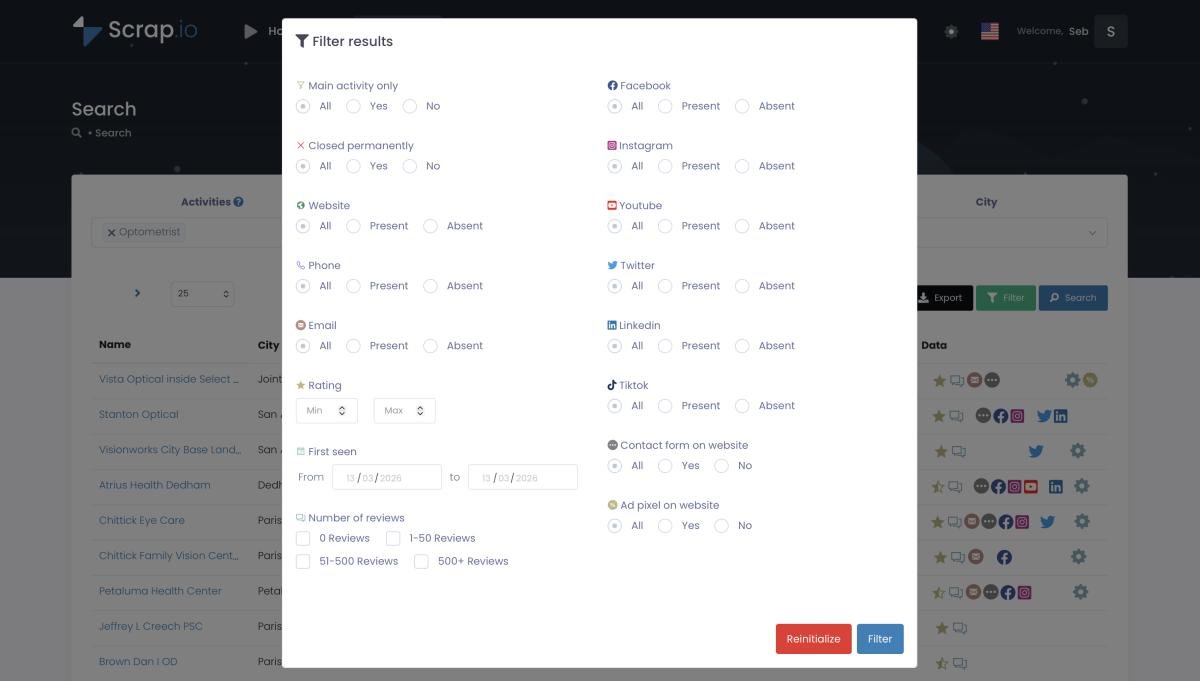
The part that saves your budget is the order of operations. The broker model makes you pay first and discover the dead addresses later. Scrap.io does the opposite: every filter runs before a single credit is spent. Want only businesses that actually have an email listed? Toggle it. Only mobile numbers for SMS? Done. A minimum rating, a specific category, "has a website but no ad pixel"? Stack them. You never pay for a record you can't use.
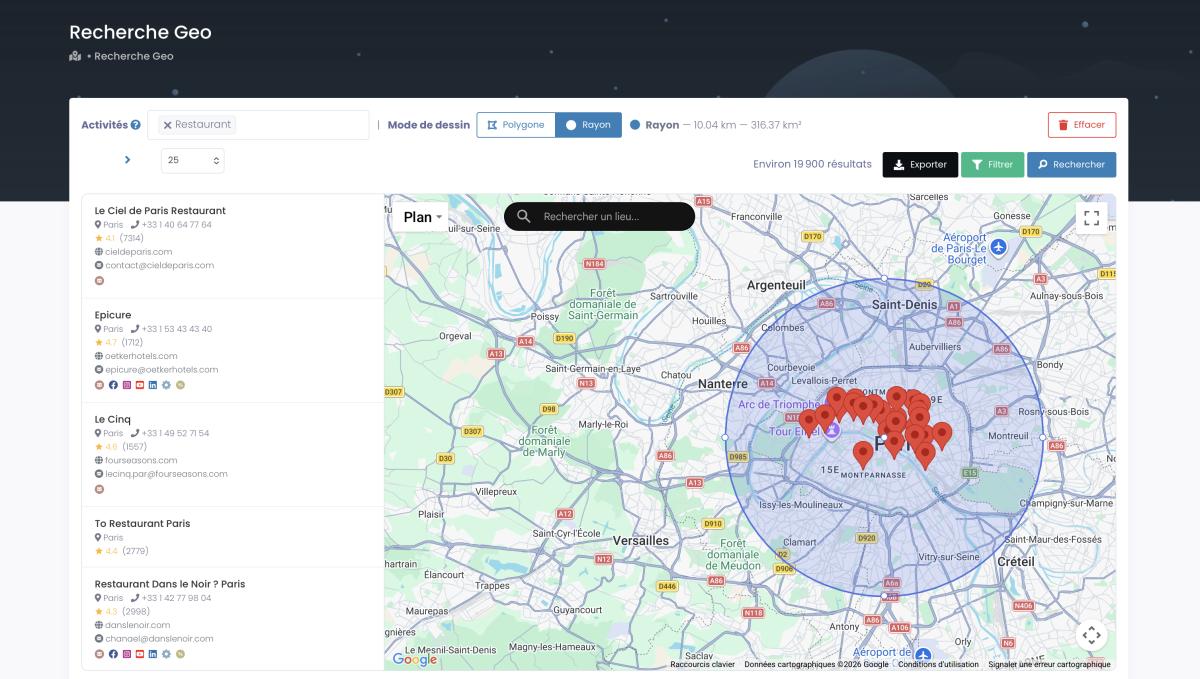
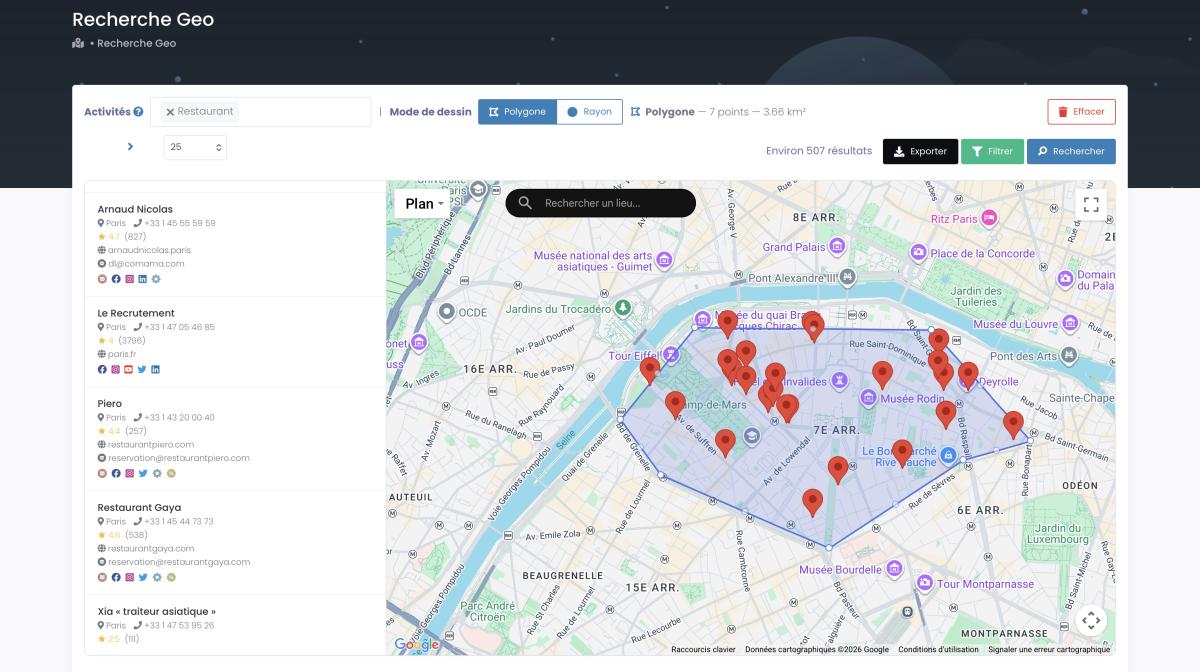
And you're not stuck with administrative boundaries either. Need a precise trade area instead of a whole city? GeoSearch lets you draw a radius around a point, or hand-trace a polygon over an exact neighborhood, and every filter still applies inside it. Try getting that from a ZIP-only consumer list.
Here's the walkthrough from a cold start:
Video: Get Emails from Google Maps for Free
And if you want to skip categories entirely and sweep a whole territory, you can do that too, pull every business in a zone with no category at all, then filter down:
Video: How to Extract Every Business in 1 Click (No Category)
How fast is it, really? One client pulled 11,734 businesses in 45 minutes. Try assembling that by hand. Actually, don't, that's how you lose a weekend. Once you've got the file, it exports to CSV or Excel with up to five classified emails per business (individual, contact, sales, marketing, admin), ready to drop into your sequencer. If you're starting from zero, here's exactly how to build a cold email list, and a step-by-step on how to extract emails from Google Maps. And because this isn't a frozen snapshot, you sidestep the whole "free consumer email lists are a trap" problem, there's no stale file to recycle. For the full picture on why cheap data costs more, read our take on free email lists for marketing.
Try Scrap.io free for 7 days, 100 export credits included. Pick a category, draw your zone, filter to email-present businesses only, and see your whole list before you spend a credit. 225M+ businesses, 195 countries, GDPR and CCPA compliant, every record traceable to its public source. Start your free trial.
FAQ
Is buying consumer email lists legal in 2026?
Yes, in the United States, buying consumer email lists is legal. You must still follow CAN-SPAM (accurate headers, a physical address, a working opt-out), comply with GDPR for any EU contacts, and respect CCPA/CPRA in California. But buying a list never gives you an automatic right to cold-email everyone on it, and you inherit liability for how those addresses were collected.
How much do consumer email lists cost?
Roughly $0.025 per record at the low end (Melissa, pay-as-you-go) up to $299.95 per 1,000 for "verified opt-in" data (LeadsPlease). Cheaper almost always means older and resold more times. And the sticker price ignores the real cost: 15% to 30% bounce rates that can get your domain blacklisted.
Do purchased consumer email lists actually convert?
Rarely. Industry benchmarks put purchased, unverified lists at under 2% open and under 0.5% reply, versus 15% to 35% open and 3% to 8% reply for fresh opt-in data (Apollo.io, 2026). Bounce rates of 15% to 30% also wreck your sender reputation, so a bought list often costs you more future deliverability than it delivers today.
Consumer email lists vs B2B data, which converts better?
Fresh, targeted B2B data wins for cold outreach. Consumer lists are big but generic, and they decay 10% to 15% a year. A B2B file filtered by category and location reaches named businesses about something relevant to them, which is the only thing that moves a cold reply rate. Volume loses to relevance, every time.
Can I upload a bought list to Mailchimp or Klaviyo?
Not without serious risk. Most email service providers prohibit or block blasting purchased lists, and they suspend accounts for high bounces (Mailchimp around 2% hard bounce, Klaviyo around 1%). Upload a stale bought list and you can lose both the list and your sending platform. Use a dedicated cold-email tool for outbound, and verify before you send.
The bottom line
Consumer email lists look cheap. That's the bait. The real bill shows up as bounces, spam complaints, a blacklisted domain, and conversion rates that round to zero. A 200-million-record file isn't an asset if nobody on it wanted your email.
So flip the question. Instead of "where's the biggest consumer list I can buy," ask "how do I reach the exact businesses that need what I sell, with data that's true today." Pick your category, draw your zone, filter before you pay, and email people you can actually reach and actually document. Fresh beats big. It isn't close.
Stop renting stale data. Build your first targeted list today. Scrap.io pulls verified business contacts from Google Maps across 195 countries, filtered to email-present before you spend a credit. Free for 7 days, 100 leads on us. Build your list now.
Generate a list of restaurant with Scrap.io